Introduction
Artificial Intelligence (AI) did not simply appear overnight—the history and evolution of AI is a story of ambition, breakthroughs, setbacks, and an unshakable belief that machines could one day think. Today, we interact with AI through smartphones, recommendation systems, autonomous vehicles, and generative tools that write, create, and design. But behind these innovations lies a remarkable journey that began more than seven decades ago. Understanding the history of AI is not just a lesson in technology—it is a story of human imagination pushing the boundaries of what machines can achieve.
1. The Early Foundations (1950–1960): The Birth of AI Thinking
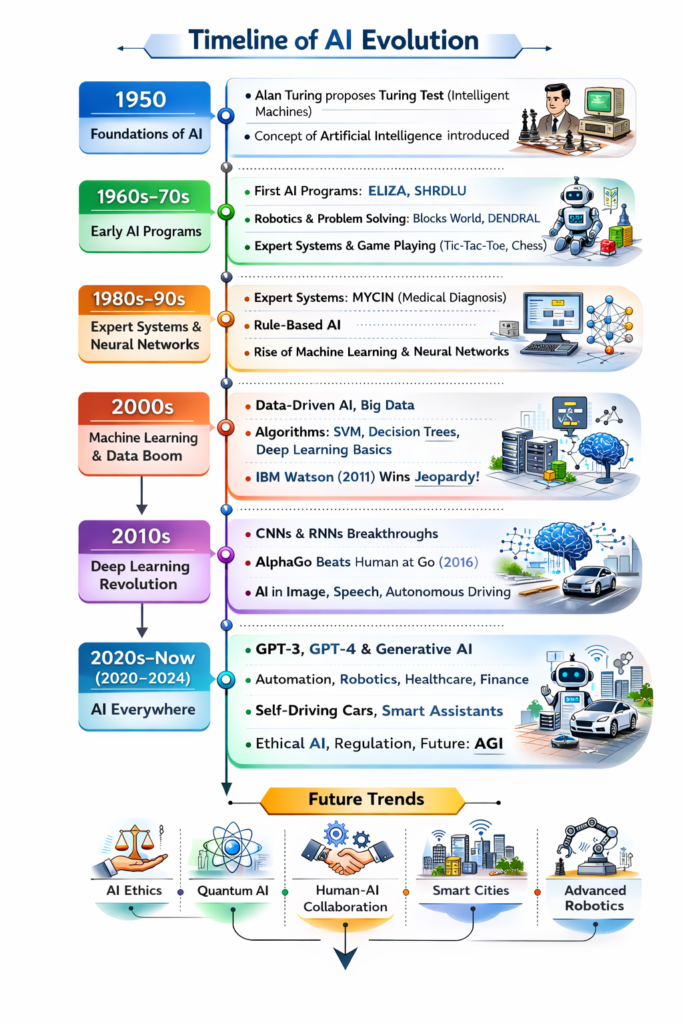
The conceptual seeds of Artificial Intelligence were planted in the 1950s, long before computers had the power to support the ambitious dreams of researchers. One of the earliest turning points was the work of Alan Turing, who proposed the Turing Test in 1950—an idea that explored whether machines could exhibit intelligent behavior indistinguishable from humans. This decade also saw the Dartmouth Summer Research Project on Artificial Intelligence, often celebrated as the birthplace of AI as a formal academic field. During this historic event in 1956, researchers gathered to explore how symbolic reasoning and logic could be used to design intelligent machines.
Computers at the time were extremely limited, yet the enthusiasm was immense. Researchers believed real machine intelligence was only years away. This early optimism drove attempts to build programs that could play chess, solve algebraic equations, and understand logic-based commands. Although primitive by today’s standards, these efforts laid the theoretical foundation upon which AI would grow.
2. The Era of Symbolic AI (1960–1970): Machines Begin to “Reason”
During the 1960s, symbolic AI—or “good old-fashioned AI” (GOFAI)—became the dominant approach. Researchers focused on teaching machines how to reason with rules, symbols, and logical structures. Projects such as SHRDLU demonstrated how a computer could understand language commands in a small virtual world, while early robotics experiments began exploring how machines might interact with physical environments.
This period also saw government interest in AI, leading to increased funding. The belief that machines would soon reach human-level intelligence inspired ambitious projects in natural language processing, automated theorem proving, and early machine learning concepts. However, despite the rapid theoretical advancements, hardware limitations made it difficult for AI to scale beyond simple tasks.
3. AI Winters and Renewed Hope (1970–1990)
By the 1970s and 1980s, the initial excitement surrounding AI faded as systems repeatedly failed to meet expectations. Funding agencies grew skeptical, leading to the first major AI Winter, a period marked by reduced budgets, slower progress, and growing doubts about AI’s potential. Symbolic systems struggled in unpredictable real-world settings because they relied on manually encoded rules that could not adapt or learn.
Yet even in this difficult phase, important progress occurred. The development of expert systems—programs designed to mimic the decision-making abilities of human specialists—brought AI back into industry. Companies adopted expert systems for medical diagnosis, finance, and manufacturing automation. The return of investment interest, supported by improved computing hardware, brought AI research back into the spotlight.
Still, by the late 1980s, limitations such as high maintenance costs and poor scalability triggered a second AI Winter. Critics argued that without the ability to learn from data, AI would remain limited.
4. The Rise of Machine Learning (1990–2010): Data Becomes the New Fuel
The revival of Artificial Intelligence in the 1990s can largely be attributed to the emergence of machine learning—a paradigm shift from rule-based reasoning to data-driven learning. Instead of programming a computer with fixed instructions, researchers trained machines to learn patterns from large datasets. Statistical models, decision trees, support vector machines, and early neural networks gained popularity.
The growth of the internet accelerated this revolution by creating massive amounts of digital data. Search engines, predictive text, and spam filters began using machine learning to improve user experience. In 1997, IBM’s IBM Deep Blue defeated world chess champion Garry Kasparov, a symbolic achievement marking AI’s growing capabilities.
During this era, researchers laid the groundwork for modern deep learning through experiments with neural networks and backpropagation. While computational power was still limited, the ideas were ready to explode once hardware caught up.
5. The Deep Learning Revolution (2010–2020): AI Becomes Mainstream
The 2010s unleashed a new age driven by deep learning, where multi-layered neural networks achieved previously unimaginable accuracy in image recognition, speech processing, translation, and autonomous driving. Breakthroughs like the ImageNet competition accelerated innovation, while graphics processing units (GPUs) allowed massive models to train efficiently.
Companies like Google DeepMind, OpenAI, and major cloud computing providers invested heavily in large-scale AI training. One of the most iconic achievements was DeepMind AlphaGo defeating world Go champion Lee Sedol in 2016—a milestone long believed to be decades away.
During this time, AI also became widely accessible. Tools for marketers, businesses, and developers emerged rapidly. Platforms such as TensorFlow and PyTorch allowed anyone with basic programming knowledge to build powerful models. Parallelly, users explored practical online tools like this AI writing platform and automation tools such as n8n automation workflows to simplify work across industries.
AI was no longer a lab experiment—it became part of everyday life.
6. The Generative AI Explosion (2020–2025): Machines Learn to Create
The early 2020s ushered in the era of generative AI, where models could produce human-like text, images, code, audio, and video. Large language models (LLMs) such as ChatGPT, GPT-4, and GPT-5 showed dramatic improvements in reasoning, creativity, and contextual understanding.
This period also saw the introduction of diffusion-based image generators, autonomous agents, and voice models capable of mimicking human speech. Businesses rapidly adopted AI for customer service, research, content generation, and analytics. Students used AI tutors, writers used AI assistants, and enterprises automated workflows from marketing to product design.
By 2025, generative AI ecosystems expanded to include:
- Multimodal assistants capable of understanding text, audio, images, and video simultaneously
- AI-driven development tools that generate entire applications
- Autonomous research agents performing end-to-end analysis
- Personalized AI companions and tutors
Many professionals leveraged AI productivity platforms such as AI-powered SEO tools and project automation solutions to expand their capabilities.
The acceleration during this period positioned AI as one of the most transformative technologies since electricity and the internet.
7. Key Milestones in AI History (1950–2025)
Here are some major events that shaped AI over seven decades:
- 1950: Turing Test introduced
- 1956: Dartmouth Conference—AI named as a field
- 1960s: Growth of symbolic reasoning and early NLP programs
- 1970s: First AI Winter
- 1980s: Rise of expert systems
- 1997: Deep Blue defeats Kasparov
- 2006–2012: Deep learning resurgence
- 2016: AlphaGo beats Lee Sedol
- 2020+: Generative AI boom
- 2025: Integration of AI agents into everyday tools and workflows
Each milestone reflects a shift not only in technology but in the way humans imagine and interact with intelligent systems.
8. AI in 2025 and Beyond: What the Future Holds
As of 2025, AI continues to evolve toward autonomy, multimodality, and personalization. Instead of merely assisting with tasks, AI is beginning to anticipate needs, recommend actions, and collaborate with humans in meaningful ways. Ethical AI development, fairness, and transparency are becoming central to global discussions. Governments and organizations pursue responsible innovation to ensure AI benefits society without causing harm.
Emerging trends shaping AI’s future include:
- Self-improving AI systems capable of recursive learning
- AI governance frameworks to manage global risks
- Hyper-personalized education and healthcare
- Autonomous research engines for scientific discovery
- Seamless AI integration in entertainment, finance, and urban planning
The story of AI is far from over. In fact, its most transformative chapters may still be unfolding.