Artificial Intelligence has reached a point where two distinct worlds—Symbolic AI and Data-Driven AI—are shaping how machines understand, reason, and interact with us. One operates like a strict logician, obeying rules and structures. The other behaves like an adaptive learner, training itself from vast datasets to detect patterns. Both have existed for decades, but today’s rapid advances in automation, robotics, and cognitive systems have revived a crucial question: Which approach – Symbolic AI vs Data-Driven AI, holds the key to more human-like intelligence?
This article dives deep into the foundations, strengths, weaknesses, and future trajectories of these two paradigms so you can understand where AI is heading—and which method truly aligns with the future of intelligent systems.
1. Understanding Symbolic AI: When Intelligence Comes from Rules
Symbolic AI, often referred to as classical AI or Good Old-Fashioned AI (GOFAI), is built on the idea that intelligence can be represented using symbols, logic, and explicit rules. Instead of learning from examples, symbolic systems reason by applying structured knowledge—much like a human expert following a decision tree or logic manual.
Symbolic AI emerged during the early days of AI research with systems that relied heavily on expert knowledge bases, if-else logic, and rule-based reasoning. Its central belief is simple: if you can define knowledge accurately, a machine can reason like a human. Many early expert systems in medicine, finance, and engineering relied on this approach because they provided traceable and predictable reasoning processes.
However, symbolic systems do not “learn.” They only do what they are programmed to do. This makes them powerful in stable, rule-heavy environments but limited in dynamic, real-world scenarios.
2. Understanding Data-Driven AI: When Machines Learn from Experience
Data-Driven AI—also called statistical AI, machine learning, or neural network-based AI—works fundamentally differently. Instead of manually defining logic, data-driven methods allow systems to learn patterns, correlations, and structures directly from large amounts of data.
Modern deep learning, including transformer models, convolutional networks, and recurrent architectures, dominates today’s AI applications—from image recognition and speech processing to generative models and autonomous systems.
These models excel in complex, high-dimensional environments where patterns are too subtle or too numerous for humans to encode manually. The more data they ingest, the more sophisticated their predictions become.
However, these systems often operate as “black boxes,” providing highly accurate predictions without explaining how they arrived at their conclusions—raising questions about interpretability, reliability, and reasoning.
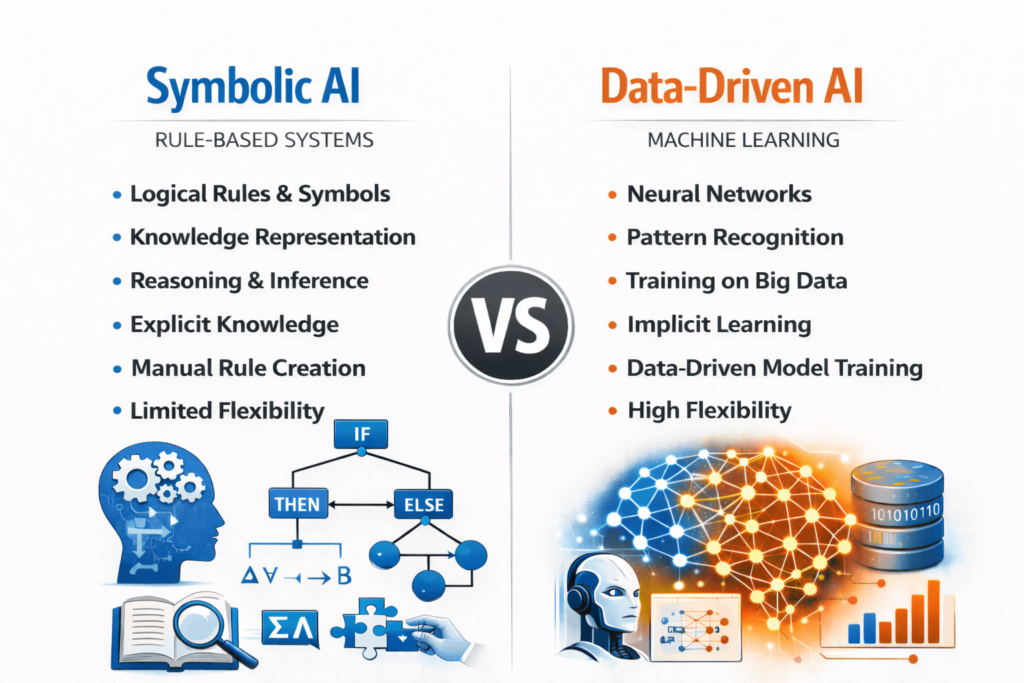
3. Key Differences at a Glance
Although both fall under the umbrella of AI, symbolic and data-driven systems differ deeply in philosophy and execution.
3.1 Knowledge Representation
- Symbolic AI: Knowledge is stored explicitly using symbols, rules, logic, and ontologies.
- Data-Driven AI: Knowledge is stored implicitly in mathematical structures like weights and biases.
3.2 Learning vs Reasoning
- Symbolic AI: Strong in reasoning but weak in learning.
- Data-Driven AI: Strong in learning but struggles with logic-based reasoning and generalization.
3.3 Interpretability
- Symbolic AI: Highly interpretable with clear reasoning steps.
- Data-Driven AI: Often opaque, making decisions difficult to explain.
4. Strengths of Symbolic AI
Symbolic AI remains uniquely valuable, especially for tasks requiring structured, verifiable, and logical reasoning.
4.1 Transparency and Explainability
Symbolic systems provide explicit reasoning paths, making them easy to audit, debug, and verify. This makes them ideal for fields like:
- Legal automation
- Medical expert systems
- Financial rule frameworks
- Compliance-driven decision engines
Interpretability also makes symbolic AI easier to trust in high-stakes environments.
4.2 Strong Logical Reasoning
Symbolic AI excels at:
- Encoding domain expertise
- Handling deductive and inductive logic
- Representing relationships between concepts
This makes it irreplaceable for structured reasoning tasks like theorem proving, scheduling, or constraint optimization.
4.3 Works Well with Limited Data
Because symbolic AI does not rely on large datasets, it can function in domains where data is scarce or expensive to collect.
5. Weaknesses of Symbolic AI
5.1 Fragility and Lack of Adaptability
Symbolic AI systems cannot adapt when rules change or real-world conditions shift. Every update requires manual intervention—a limitation in fast-changing domains.
5.2 Difficulty in Capturing Real-World Complexity
Human environments are messy. Symbolic rules cannot always account for ambiguity, emotion, or unpredictable behavior.
This is why symbolic-only solutions struggled historically with:
- Natural language understanding
- Image recognition
- Real-world robotics
5.3 Scaling Becomes Impractical
As rule complexity increases, symbolic systems become too large, slow, and expensive to maintain.
6. Strengths of Data-Driven AI
Data-driven AI dominates modern applications due to its flexibility, scalability, and predictive power.
6.1 Learns Directly from Data
These systems do not need human-crafted rules—they create their own internal representations through training.
This makes them extremely effective in:
- Image classification
- Speech recognition
- Language translation
- Pattern detection
6.2 Handles Complex, High-Dimensional Problems
Deep neural networks shine when dealing with intricate domains that cannot be fully encoded using symbolic logic.
6.3 Can Generalize from Examples
Once trained effectively, data-driven models can make accurate predictions even on unseen cases—something symbolic systems struggle with.
7. Weaknesses of Data-Driven AI
7.1 Lack of Transparency
Modern neural networks often operate as “black boxes.”
Even experts struggle to interpret fully:
- Internal representations
- Decision pathways
- Failure modes
This raises concerns about trust in high-risk fields like healthcare and criminal justice.
7.2 Requires Large Quantities of Data
Data-driven systems often need:
- Vast datasets
- Extensive computing power
- Long training time
This makes them expensive and inaccessible for smaller teams.
7.3 Vulnerability to Bias
If the training data contains biases—racial, social, linguistic—the model inherits and amplifies them.
8. Symbolic AI vs Data-Driven AI: Which is Better?
There is no single winner. They complement each other.
Symbolic AI excels at:
- Clear logic
- Transparent decision pathways
- Low-data environments
- Structured reasoning
Data-Driven AI excels at:
- Learning patterns
- Handling ambiguity
- Processing complex inputs
- Scaling across domains
The real breakthrough comes from combining the two.
9. Neuro-Symbolic AI: The Best of Both Worlds
Neuro-symbolic AI aims to merge symbolic reasoning with data-driven learning.
It enables machines to:
- Learn from raw data
- Reason using explicit logic
- Provide interpretable outputs
- Adapt to new situations
This hybrid approach is becoming essential for the next wave of advanced systems that require both flexibility and reliability.
10. Real-World Applications of Each AI Category
Symbolic AI Applications
- Fraud detection systems with rule-based triggers
- Knowledge graphs and logic-based search engines
- Automated theorem solvers
- Robotics requires strict rule-following
- Multi-step reasoning in regulated industries
Data-Driven AI Applications
- Computer vision (facial recognition, object detection)
- NLP models (chatbots, summarizers, translation systems)
- Predictive analytics (finance, marketing)
- Recommender systems (e-commerce, entertainment)
Neuro-Symbolic Applications
- Autonomous vehicles combining vision + rules
- Intelligent tutoring systems
- AI agents requiring reasoning and perception
- Scientific discovery models that mix logic + pattern detection
11. Which Approach Should Businesses Choose?
The choice depends on your use case.
Choose Symbolic AI if:
- You need explainability
- Rules are stable and well-defined
- Compliance or regulation is important
- Data is scarce
Choose Data-Driven AI if:
- Enough data is available
- Patterns are complex
- Flexibility is required
- Scalability matters
Choose Neuro-Symbolic if:
- You want human-like reasoning
- You need transparency + accuracy
- The task requires both data and logic
Conclusion: The Future of AI Lies in Integration
Symbolic AI and data-driven AI represent two complementary philosophies of intelligence. Symbolic AI provides structure, logic, and reasoning, while data-driven AI offers learning, adaptability, and pattern recognition. The future belongs to systems that integrate both—flexible, explainable, and capable of real-world understanding.
As businesses and developers move toward advanced AI systems, understanding these two foundations becomes essential. The world is shifting from “either-or” thinking to “best of both”: combining rules and learning to build more intelligent, reliable, and transparent AI.