
Introduction: How Simple “If–Then” Logic Built the Foundations of Modern Artificial Intelligence
Artificial Intelligence today is often associated with deep learning, neural networks, and complex algorithms capable of learning from massive datasets. Yet, before the rise of machine learning, AI was powered by something surprisingly simple—rule-based systems. These systems used handcrafted logical rules to make decisions, diagnose problems, and even mimic expert-level reasoning.
Understanding rule-based systems is not only useful for beginners studying AI but also essential for professionals who want to appreciate how today’s intelligent models evolved. More importantly, rule-based reasoning still powers automation, fraud detection, medical diagnostics, and customer support workflows in many industries. This article explores how rule-based AI works, where it is used today, its strengths and limitations, and how it compares to modern machine learning.
What Are Rule-Based Systems in AI?
Rule-based systems are AI programs that make decisions based on a predefined set of if–then rules. These rules are crafted by human experts and represent knowledge in a structured, logical manner.
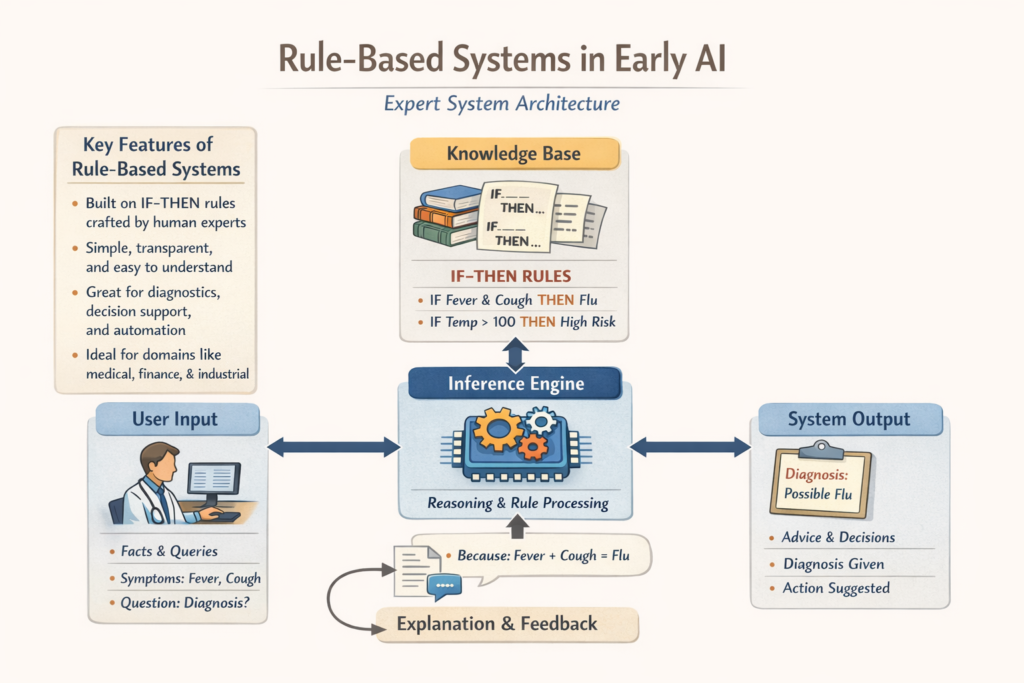
At the core of every rule-based AI system are two components:
1. Knowledge Base (KB)
This contains a large collection of rules such as:
- If the temperature is high and humidity is low, then the risk of fire is high.
- If a patient has fever + cough + body aches, then suspect viral infection.
These rules reflect real-world knowledge encoded in plain logic.
2. Inference Engine
The inference engine applies the rules from the knowledge base to the data and determines what conclusions can be made.
It behaves like a decision-making engine that evaluates facts and matches them with rules, similar to how a human expert reasons.
Rule-based systems operate on certainty. They don’t “learn.” They don’t improve on their own. Instead, their power comes from the accuracy and completeness of the rules they are given.
How Do Rule-Based AI Systems Work?
Rule-based AI follows a clear and structured workflow:
Step 1: Input Facts Are Collected
The system gathers facts about the environment or user query.
Example: A symptom checker collects fever=Yes, cough=Yes, headache=Yes.
Step 2: Facts Are Matched to Rules
The inference engine compares the input to the stored rules.
Step 3: Applicable Rules Are Triggered
Whenever conditions match, the rule fires.
Example: If cough + fever → maybe flu.
Step 4: The System Provides Conclusion or Action
Based on matched rules, the system gives a diagnosis, recommendation, or decision.
This step-by-step reasoning makes rule-based systems reliable, predictable, and easy to interpret—even by beginners.
Why Rule-Based Systems Were Revolutionary in Early AI
In the 1970s–1990s, rule-based systems dominated AI. They were used in medicine, finance, manufacturing, insurance, and diagnostics. The most famous early expert systems included medical diagnostic tools and industrial troubleshooting systems.
The reason they were popular:
- They captured human expertise digitally.
- They could mimic specialist reasoning.
- They offered clear explanations for decisions.
- They were easier to trust compared to statistical models.
Even today, many industries prefer rule-based automation for compliance, safety, and auditing—because rules create transparency.
Types of Rule-Based Systems
1. Simple Rule-Based Systems
These systems use straightforward logic similar to flowcharts.
Example: Banking transaction alerts or loan eligibility checks.
2. Expert Systems
Expert systems simulate human experts in specific domains like medicine, engineering, or law.
They store hundreds to thousands of rules derived from real specialists.
3. Production Systems
These systems have structured sets of rules (productions) and often use pattern matching to determine which rule applies next.
4. Hybrid Rule-Based + Machine Learning Systems
Many modern AI applications combine rule-based logic with machine learning for better accuracy.
For example, fraud detection uses ML to spot anomalies and rules to enforce compliance.
Applications of Rule-Based Systems in Today’s World
Despite modern AI advancements, rule-based systems remain essential. They are widely used where transparency, control, and predictability matter.
1. Medical Decision Support & Diagnostics
Rule-based expert systems assist doctors by providing structured decision-making.
They help in diagnosing diseases, triaging patients, and suggesting treatment steps.
Examples include:
- Symptom checkers
- Drug interaction checks
- Hospital triage rules
- Rule-driven medical workflows
These systems remain popular because medicine requires explainability.
2. Finance, Banking & Credit Decisions
Banks rely heavily on rule-driven automation due to regulatory requirements.
Use cases:
- Loan eligibility
- Risk scoring
- Fraud alert systems
- KYC verification
- Compliance checks
Rules ensure consistency and follow strict legal guidelines.
3. Industrial Automation & Manufacturing
Factories frequently use rule-based control systems for:
- Fault detection
- Machine maintenance schedules
- Production quality checks
- Safety automation
These systems support reliability and minimal downtime.
4. Customer Support & Chatbots
Before AI chatbots became popular, rule-based chatbots dominated customer service.
Examples:
- FAQ-based bots
- Troubleshooting assistants
- Predefined response workflows
Even today, many customer support chatbots use hybrid rule + AI models.
5. Business Process Automation
Organizations automate everyday tasks using rule-driven engines such as:
- Approval workflows
- HR processes
- Email filtering
- Notifications
- Ticket routing
Because rule-based logic is easy to audit, enterprises prefer it for process consistency.
Strengths and Limitations of Rule-Based Systems
Rule-based systems excel in structured domains but struggle in uncertain or complex scenarios.
Here is a detailed comparison:
Comparison Table: Rule-Based Systems vs. Machine Learning Systems
| Feature / Aspect | Rule-Based Systems | Machine Learning Systems |
|---|---|---|
| How they work | Handcrafted “if–then” rules made by experts | Models trained on data patterns |
| Learning ability | No learning; requires manual updates | Learns automatically from data |
| Transparency | Very high — easy to explain | Often low — decisions can be opaque |
| Best suited for | Clear, stable, rule-driven environments | Complex, data-rich environments |
| Handling uncertainty | Poor | Strong |
| Scalability | Difficult with large rule sets | Highly scalable |
| Maintenance | Manual and time-consuming | Automated retraining possible |
| Accuracy | Depends on rule quality | Typically higher with large datasets |
| Examples | Medical rules, finance compliance, industrial automation | Fraud detection, speech recognition, predictive analytics |
Advantages of Rule-Based AI Systems
1. High Interpretability
Humans can understand exactly why a rule-based system made a particular decision. This is important in regulated domains.
2. Full Control Over Logic
Developers can explicitly define behaviors, ensuring accuracy in predictable scenarios.
3. Easy to Debug
Because rules are simple, identifying errors is faster compared to debugging neural networks.
4. Ideal for Low-Data Environments
Rule-based systems don’t require large datasets—only expert knowledge.
5. Predictable and Stable Behavior
They behave consistently, making them reliable for safety-critical applications.
Limitations of Rule-Based Systems
1. No Learning Capability
Systems cannot improve automatically; rules must be manually updated.
2. Hard to Scale
Managing thousands of rules becomes complex and error-prone.
3. Limited Flexibility
Real-world scenarios change, and rules may quickly become outdated.
4. Struggle With Ambiguity
Rule-based systems are not good at handling uncertainty, noise, or unstructured information (e.g., images, speech).
Why Rule-Based Systems Still Matter in Modern AI
Although machine learning dominates today’s AI landscape, rule-based systems continue to be relevant because:
- Many industries require explainability (finance, healthcare, law).
- They are ideal for compliance-driven environments.
- They combine effectively with ML models in hybrid AI architectures.
- They ensure governance and decision transparency, especially in mission-critical applications.
Modern AI is not purely data-driven—it often blends learned patterns with rule-driven logic.
Rule-Based Systems vs. AI Agents vs. Rule Engines
To give better clarity, here is a distinction:
- Rule-Based Systems: Use fixed “if–then” logic.
- Rule Engines: Software that executes rules but may support more advanced logic and automation workflows.
- AI Agents: Intelligent entities capable of goal-directed actions, sometimes combining rules, ML, planning, and reasoning.
Rule-based logic remains a core building block behind many agent frameworks even today.
When Should You Use Rule-Based Systems?
Use rule-based AI when:
- The problem has clear and stable rules.
- High transparency is required.
- Expert knowledge is available and reliable.
- Data is limited or unavailable.
- Predictability is more important than adaptability.
They are still among the best solutions for business process automation.
Conclusion
Rule-based systems represent the earliest and most foundational approach to artificial intelligence. Their strength lies in structured logic, predictability, and transparency. While machine learning and neural networks dominate modern AI, rule-based models remain valuable for industries that demand controlled decision-making and explainability. Understanding rule-based systems helps students, professionals, and beginners appreciate the evolution of AI—and see how human-crafted logic still influences intelligent systems today.