Introduction: How Knowledge Representation Powers AI Understanding & Reasoning
In the rapidly evolving world of artificial intelligence, one question sits quietly beneath every breakthrough: How do machines actually understand what they know? While algorithms and neural networks often dominate discussions, the true foundation of AI lies in knowledge representation (KR)—the methods we use to encode information so that machines can interpret, reason, and act intelligently.
Whether you are a student, researcher, or industry practitioner, understanding KR is essential because it shapes how AI systems make decisions, explain outcomes, and interact with the world. From self-driving cars interpreting traffic rules to chatbots understanding user intent, knowledge representation forms the underlying structure that makes AI more human-like in reasoning and more reliable in judgment.
At its core, knowledge representation bridges raw data and meaningful intelligence. It organizes facts, relationships, rules, and conceptual hierarchies into formats that machines can process logically. The techniques—ranging from semantic networks to logical representations, frames, ontologies, and production rules—provide varying levels of structure and expressiveness. Each technique serves distinct cognitive purposes within AI systems, enabling pattern recognition, inference, and problem-solving. This article dives deep into these approaches, offering a clear, comprehensive guide with detailed comparisons to help you determine which representation form suits your AI or ML applications.
What Is Knowledge Representation in AI?
Knowledge representation is the process of encoding information about the world into formats that an AI system can use to solve complex tasks such as reasoning, decision-making, natural language understanding, or expert-level diagnosis.
Good KR must fulfill several goals:
- Represent real-world knowledge accurately
- Support reasoning and inference
- Handle incomplete or uncertain information
- Be computationally efficient
- Enable communication between humans and machines
In essence, KR defines how knowledge is stored, what form it takes, and how an AI system uses that structure to produce intelligent outcomes.
Major Knowledge Representation Techniques
Below are the foundational KR techniques used in artificial intelligence.
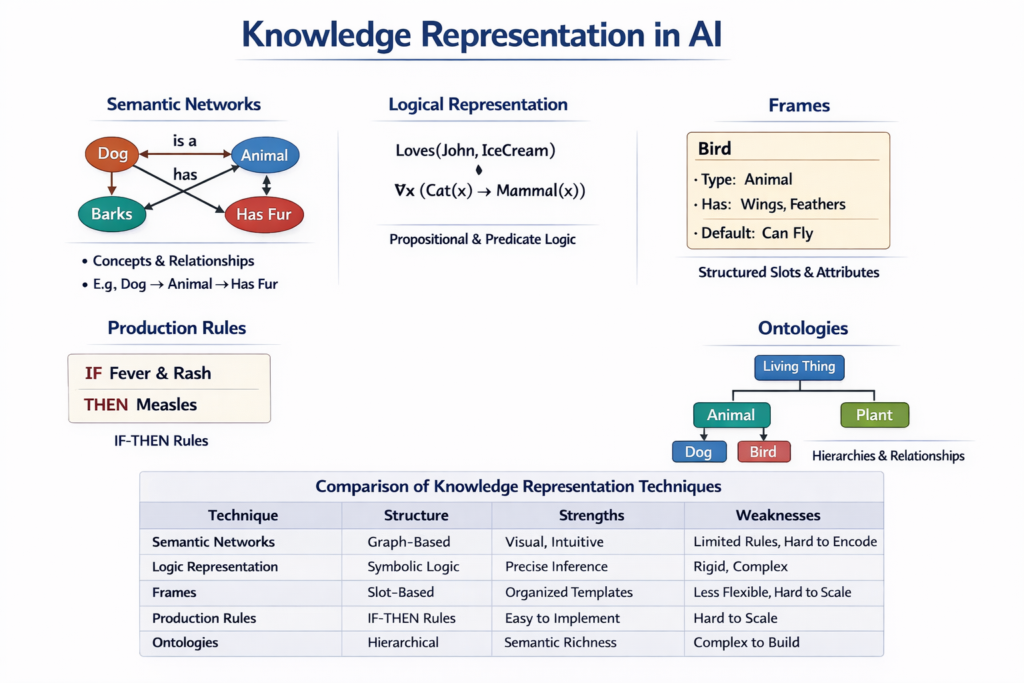
1. Semantic Networks: Mapping Knowledge Through Connected Concepts
Semantic networks are one of the most intuitive and visually powerful ways of representing knowledge. They show concepts as nodes and relationships as edges—creating a graph-like structure that resembles human memory organization.
How Semantic Networks Work
A semantic network expresses meaning by connecting concepts like:
- A dog is an animal
- A dog has fur
- A dog can bark
Machines can then infer new knowledge. For example:
If Dog → Animal and Animal → Living Being,
then Dog → Living Being.
Advantages
- Highly visual and easy to understand
- Supports inheritance (e.g., animal properties passed to a dog)
- Useful in NLP, knowledge graphs, and chatbots
Limitations
- Difficulty handling complex rules
- Ambiguous relationships may require additional constraints
Semantic networks are widely used in modern AI systems such as knowledge graphs behind search engines and recommendation systems.
2. Logical Representation: Using Logic to Derive Intelligent Conclusions
Logic-based representation is one of the oldest and most powerful approaches in classical AI. It encodes knowledge in formal logic—particularly propositional and first-order predicate logic (FOPL).
Propositional Logic
Represents facts using true/false statements.
Example:
- It is raining.
- The ground is wet.
Predicate Logic
Represents relationships using predicates, quantifiers, variables, and functions.
Example:
- Loves(John, IceCream)
- ∀x (Cat(x) → Mammal(x))
Advantages
- Rigorous and mathematically precise
- Enables deep logical inference
- Ideal for rule-based systems and expert systems
Limitations
- Strict: cannot easily handle uncertainty
- Knowledge base construction is time-consuming
Logical representation forms the backbone of traditional expert systems and rule-based reasoning.
3. Frames: Structured Templates for Representing Objects
Frames represent knowledge using structured data templates—similar to objects in programming.
How Frames Work
A frame contains:
- Slots: attributes
- Values: possible states
- Defaults: typical values
- Procedural attachments: triggers or rules
Example (simplified frame for “Bird”):
- Type: Animal
- Has: Wings, Feathers
- Default Action: Fly
Frames are powerful for representing real-world objects with a consistent structure.
4. Production Rules: If-Then Knowledge for Expert Systems
Production rules represent knowledge as IF condition THEN action.
These Rule-Based Systems were central to early expert systems.
Example
IF symptom = fever AND symptom = rash
THEN possible_disease = measles
Advantages
- Simple to interpret
- Captures procedural knowledge well
Limitations
- Scaling becomes difficult as rules grow
- Conflicts and redundancies may appear
5. Ontologies: Formal Knowledge Structures for Modern AI
Ontologies define structured representations of concepts, categories, and relationships within a domain, making them ideal for semantic search, reasoning engines, and knowledge-based applications.
Ontologies are used extensively in:
- Semantic web
- Search engine knowledge panels
- AI agents
- Data interoperability systems
They combine:
- Hierarchical classification
- Constraints
- Logical rules
Comparison of Knowledge Representation Techniques
| Technique | Best For | Structure Type | Strengths | Weaknesses | Typical Use Cases |
|---|---|---|---|---|---|
| Semantic Networks | Conceptual relationships | Graph-based | Visual, intuitive, supports inheritance | Hard to encode complex rules | NLP, knowledge graphs |
| Logic Representation | Formal reasoning | Symbolic logic | Precise, supports inference | Rigid, limited with uncertainty | Expert systems, theorem proving |
| Frames | Object-like knowledge | Structured templates | Organized, supports defaults | Limited flexibility | Object representation, planning |
| Production Rules | Rule-based decisions | If-Then rules | Easy interpretation | Hard to scale | Diagnostic systems, automation |
| Ontologies | Domain-wide organization | Hierarchical + rules | Semantic richness | Complex to build | Semantic web, enterprise knowledge |
Why Knowledge Representation Matters in Modern AI
KR remains essential even in the age of deep learning. While neural networks excel at pattern recognition, they struggle with:
- Understanding structured relationships
- Explaining reasoning
- Ensuring consistency and traceability
Knowledge representation complements machine learning by making AI:
- More interpretable
- More reliable
- More explainable
- More context-aware
This hybrid approach—combining symbolic reasoning with neural learning—is the foundation of Neuro-Symbolic AI, which researchers and industry leaders are increasingly exploring.
Conclusion
Knowledge representation is the backbone of intelligent systems. Whether through semantic networks, formal logic, frames, ontologies, or production rules, each KR technique contributes a powerful way for AI to store, understand, and use knowledge. As AI continues to advance, the importance of transparent, structured, and logic-aware knowledge representation becomes even more vital—especially for real-world applications that require trust, clarity, and reasoning.