
Introduction: From Brute-Force Search to Advanced Optimization Strategies
Artificial Intelligence is often described as the science of making machines think, reason, and make decisions like humans. Yet behind many intelligent systems lies a structured approach to problem-solving. Whether an AI system is recommending a movie, planning a route for a robot, diagnosing a disease, or predicting financial risks, it must determine the best possible solution among many possibilities. This is where AI problem-solving techniques become essential.
Over the decades, researchers have developed a wide spectrum of strategies—from simple brute-force approaches that explore every possibility to sophisticated optimization methods that efficiently identify the best solution within complex environments. Understanding these techniques not only helps students grasp core AI principles but also enables professionals to design better algorithms and systems. In this article, we explore the major AI problem-solving methods, how they evolved, and when each technique is most effective.
Understanding AI Problem-Solving Techniques in Artificial Intelligence
AI problem-solving refers to the process by which an intelligent system identifies the steps required to reach a goal from an initial state. This typically involves defining the problem, representing the environment, exploring possible actions, and selecting the most effective path toward the objective.
In many AI applications, a problem can be represented as a search space. The search space contains all possible states or solutions, and the AI system must explore this space to find the desired outcome. However, exploring all possibilities can be computationally expensive or even impossible in large problems. As a result, different strategies have been developed to make the process efficient.
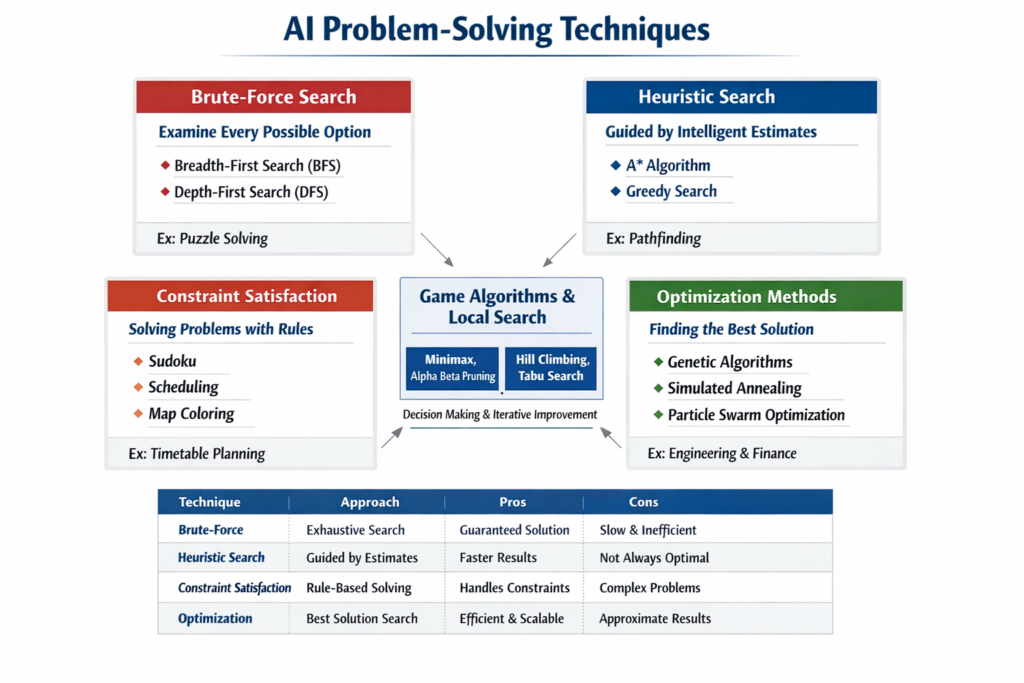
These strategies generally fall into several categories:
- Brute-force search
- Heuristic search
- Constraint-based methods
- Game-theoretic approaches
- Optimization techniques
Each method addresses different types of problems and varies in terms of computational complexity, efficiency, and accuracy.
Brute-Force Search: The Most Basic Problem-Solving Method
Brute-force search is the simplest form of AI problem-solving. In this method, the algorithm explores every possible solution in the search space until it finds the correct one.
This technique does not rely on prior knowledge, heuristics, or optimization strategies. Instead, it systematically checks all possibilities to guarantee that the optimal solution is found.
For example, imagine solving a password combination lock by trying every possible combination until it opens. That is essentially how brute-force methods operate.
Common brute-force algorithms include:
- Breadth-First Search (BFS)
- Depth-First Search (DFS)
Breadth-First Search explores nodes level by level, ensuring the shortest path in many cases. Depth-First Search, on the other hand, explores as far as possible down a path before backtracking.
While brute-force methods guarantee correctness, they become extremely inefficient for large or complex problems because the number of possible states grows exponentially.
Heuristic Search: Guiding the Search with Intelligent Estimates
To improve efficiency, AI researchers introduced heuristic search methods, which use domain knowledge or estimation techniques to guide the search process.
A heuristic is essentially an educated guess that helps the algorithm decide which path is most promising. Instead of exploring every possible option, heuristic methods prioritize the paths most likely to lead to a solution.
One of the most famous heuristic algorithms is the A* (A-star) algorithm, widely used in robotics, GPS navigation systems, and video games.
The A* algorithm evaluates nodes using a cost function:
- g(n) – the actual cost from the start node
- h(n) – the estimated cost to reach the goal
The combined value helps determine which node should be explored next.
Heuristic search dramatically reduces computation time while still producing near-optimal solutions.
Constraint Satisfaction Problems (CSP): Solving Problems with Rules
Many AI problems involve constraints, which are rules that restrict the possible solutions. These problems are known as Constraint Satisfaction Problems (CSPs).
In CSPs, the goal is to assign values to variables in such a way that all constraints are satisfied.
Common examples include:
- Sudoku puzzles
- Timetable scheduling
- Resource allocation
- Map coloring problems
A typical CSP consists of three elements:
- Variables – items that need values
- Domains – possible values for each variable
- Constraints – rules limiting the combinations of values
Algorithms such as Backtracking Search and Forward Checking are commonly used to solve CSPs.
Constraint-based approaches are widely used in planning, scheduling systems, and configuration management.
Game-Playing Algorithms: Decision Making in Competitive Environments
AI also solves problems in environments where multiple agents compete or cooperate, such as board games.
Game-playing algorithms evaluate potential future states and choose moves that maximize the chances of winning while minimizing the opponent’s advantage.
One classic example is the Minimax algorithm, used in games like chess and tic-tac-toe.
The Minimax algorithm works by:
- Simulating all possible future moves
- Evaluating each position
- Choosing the move that maximizes the player’s advantage
To improve efficiency, techniques such as Alpha-Beta Pruning are used to eliminate branches that do not influence the final decision.
Game-playing AI has played a major role in AI research, leading to breakthroughs such as machines defeating world champions in chess and Go.
Optimization Techniques: Finding the Best Solution Efficiently
Optimization methods aim to find the best possible solution within a large search space without evaluating every option.
These techniques are particularly useful when problems involve thousands or millions of possible states.
Some widely used optimization algorithms include:
Genetic Algorithms
Genetic algorithms are inspired by the process of natural evolution. They work by generating a population of possible solutions and gradually improving them through operations such as selection, crossover, and mutation.
Over multiple generations, weaker solutions are eliminated while stronger ones survive and evolve.
Simulated Annealing
Simulated annealing is inspired by the cooling process in metallurgy. The algorithm explores the search space by occasionally accepting worse solutions to avoid getting trapped in local optima.
This strategy allows the system to explore diverse possibilities before gradually converging to an optimal or near-optimal solution.
Particle Swarm Optimization
Particle swarm optimization models the behavior of flocks of birds or schools of fish searching for food. Multiple candidate solutions move through the search space and adjust their positions based on both personal and collective experiences.
Optimization techniques are commonly used in machine learning, engineering design, financial modeling, and robotics.
Local Search Methods: Improving Solutions Iteratively
Local search algorithms begin with an initial solution and then continuously improve it by making small adjustments.
Unlike global search algorithms that explore entire search trees, local search focuses on improving a single candidate solution.
Common local search methods include:
- Hill Climbing
- Tabu Search
- Beam Search
Hill climbing, for instance, repeatedly moves toward the neighboring state with the highest value until no better solution is found.
Although these methods are computationally efficient, they may sometimes become stuck in local maxima, meaning the algorithm stops before reaching the global optimum.
Comparing Major AI Problem-Solving Techniques
| Technique | Core Idea | Advantages | Limitations | Typical Applications |
|---|---|---|---|---|
| Brute-Force Search | Explore every possible state | Guaranteed optimal solution | Extremely slow for large problems | Small search spaces, puzzles |
| Heuristic Search | Use estimates to guide exploration | Faster and more efficient | Find the best solution in large spaces | Pathfinding, robotics |
| Constraint Satisfaction | Solve problems with strict rules | Efficient for structured problems | Hard for highly complex constraints | Scheduling, planning |
| Game-Playing Algorithms | Evaluate competitive decision trees | Strong strategic reasoning | High computational cost | Chess, Go, strategy games |
| Optimization Methods | Find the best solution in large spaces | Handles complex real-world problems | May find approximate solutions | Engineering, ML, finance |
| Local Search | Improve solutions iteratively | Efficient and scalable | Risk of local optima | Large optimization problems |
Real-World Applications of AI Problem-Solving Methods
AI problem-solving techniques are used in a wide variety of industries.
Robotics uses heuristic search and optimization methods for navigation and motion planning. Robots must determine efficient paths while avoiding obstacles.
Healthcare systems use optimization and constraint-based algorithms for scheduling surgeries, allocating hospital resources, and analyzing medical data.
Logistics and transportation rely on optimization algorithms to determine the best delivery routes and reduce fuel consumption.
Finance and investment systems apply optimization and machine learning algorithms to analyze markets and manage portfolios.
Even everyday applications such as navigation apps, recommendation systems, and online search engines rely heavily on efficient problem-solving algorithms.
The Evolution of AI Problem-Solving Techniques
Early AI research primarily relied on brute-force search methods due to limited computational resources and theoretical understanding. As problems became more complex, researchers realized that exhaustive search was impractical.
This led to the development of heuristic methods, which introduced intelligent guidance into search processes. Later, optimization algorithms inspired by biology, physics, and social systems emerged, providing scalable solutions for real-world problems.
Today, modern AI systems often combine multiple techniques. For instance, a robotics system may use heuristic search for navigation while applying optimization algorithms for energy efficiency.
The evolution continues as researchers explore hybrid models, reinforcement learning, and neural network-based planning systems.
Conclusion
AI problem-solving techniques form the foundation of intelligent systems. From simple brute-force search methods that explore every possibility to advanced optimization algorithms capable of handling massive datasets, these strategies enable machines to make decisions efficiently.
Each technique has its strengths and limitations. Brute-force methods guarantee accuracy but lack efficiency, while heuristic and optimization methods provide practical solutions for complex real-world challenges.
Understanding these methods is essential for students studying artificial intelligence, researchers developing advanced algorithms, and professionals building intelligent systems. As AI continues to evolve, new problem-solving strategies will emerge, pushing the boundaries of what machines can achieve.