
Introduction
Artificial Intelligence often appears complex, but at its core lies a surprisingly simple concept: the intelligent agent. Every AI system—from recommendation engines and chatbots to self-driving cars and autonomous robots—relies on intelligent agents to perceive their environment, make decisions, and take actions that achieve specific goals. These agents form the fundamental building blocks of modern AI systems. Understanding how they work not only clarifies how AI operates behind the scenes but also helps students, developers, and professionals design smarter and more efficient systems.
Imagine a system that can observe its surroundings, analyze available information, and decide the best possible action to achieve a goal. That is essentially what an intelligent agent does. Whether it is a virtual assistant responding to a user query, a robot navigating through obstacles, or an AI model recommending movies, intelligent agents continuously interact with their environment to produce optimal outcomes. In this comprehensive guide, we will explore what intelligent agents are, how they work, their structural components, major types, and real-world applications that demonstrate their importance in modern artificial intelligence.
Understanding the Concept of an Intelligent Agent
An intelligent agent is an entity that perceives its environment through sensors and acts upon that environment using actuators in order to achieve specific goals. The concept comes from the field of artificial intelligence, where systems are designed to behave rationally by selecting actions that maximize their chances of success.
In simpler terms, an intelligent agent acts as a decision-making unit that receives input from its environment, processes that information, and produces an appropriate response. The key characteristic of an intelligent agent is rational behavior, meaning it chooses actions that best achieve its objectives based on the information available.
For example, a navigation system in a smartphone can be considered an intelligent agent. It perceives the environment through GPS data and traffic updates, processes that information using algorithms, and then recommends the best route for the user to reach their destination efficiently.
Another example is a chatbot that analyzes a user’s question, interprets the context, and generates an appropriate response. In both cases, the system is continuously interacting with its environment and adjusting its behavior to achieve the desired goal.
Key Components of an Intelligent Agent
An intelligent agent operates through a structured framework that allows it to interact with the environment and make decisions effectively. The fundamental components of an intelligent agent include sensors, actuators, the agent function, and the environment.
Sensors
Sensors are responsible for collecting information from the environment. They provide the agent with data about the current state of the world. In physical systems like robots, sensors may include cameras, microphones, or temperature detectors. In software-based systems, sensors may include data inputs such as user queries, database information, or system logs.
Sensors play a crucial role because an agent can only make decisions based on the information it receives.
Actuators
Actuators are the mechanisms through which the agent takes action within the environment. They convert the agent’s decisions into real-world actions.
For instance:
- A robot may use motors or wheels as actuators.
- A software agent may display messages, update databases, or trigger system processes.
Without actuators, an agent would not be able to influence the environment.
Agent Function
The agent function defines how the agent decides what action to take based on the current percept (input information). It maps percept sequences to actions. Essentially, it represents the logic or algorithm that determines the agent’s behavior.
Agent Program
The agent program is the implementation of the agent function. It runs on a computing system and executes the decision-making logic.
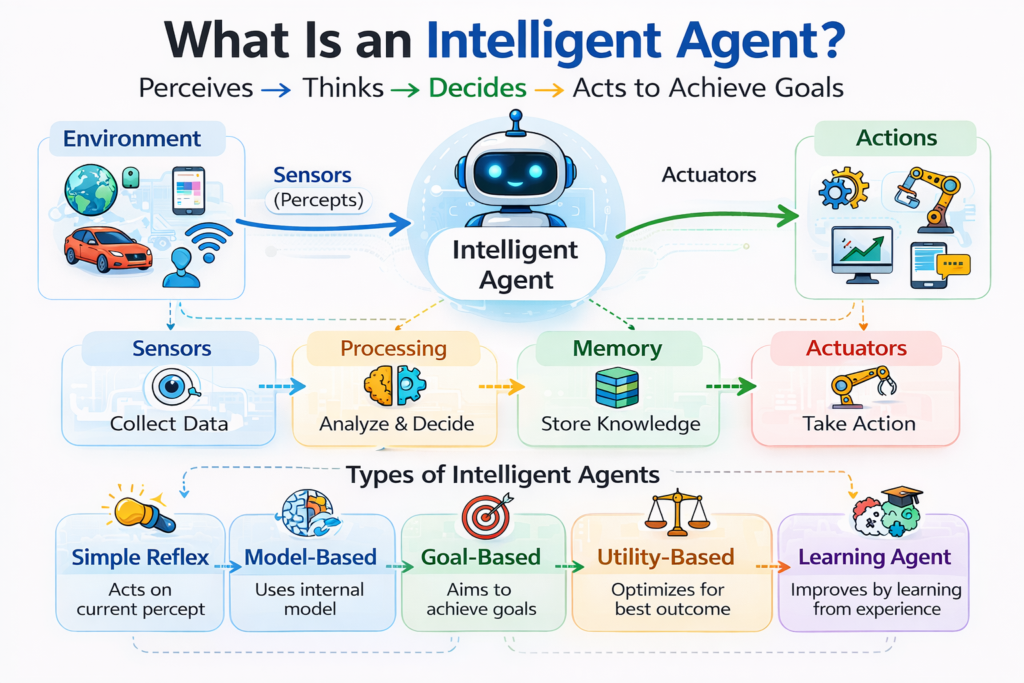
Structure of an Intelligent Agent
The structure of an intelligent agent describes how its internal components interact to produce intelligent behavior.
At a high level, the structure can be summarized as:
Agent = Architecture + Program
- Architecture refers to the hardware or software platform on which the agent runs.
- A program refers to the algorithms and decision-making rules implemented within the agent.
Intelligent Agent Structure
| Component | Description | Example |
|---|---|---|
| Environment | The external system the agent interacts with | Road network for a self-driving car |
| Sensors | Collect information from the environment | Camera, microphone, GPS |
| Agent Program | Processes input and decides actions | Machine learning algorithm |
| Actuators | Execute actions in the environment | Motors, display output |
| Performance Measure | Criteria used to evaluate success | Travel time, accuracy, efficiency |
This structure ensures that an agent can perceive, reason, and act in a coordinated manner.
Types of Intelligent Agents
Artificial intelligence systems classify intelligent agents into different categories depending on how they process information and make decisions. Each type represents a different level of complexity and intelligence.
Simple Reflex Agents
Simple reflex agents operate based on condition–action rules. They respond directly to the current percept without considering past experiences or future consequences.
For example, a thermostat that turns the heating system on when the temperature drops below a certain threshold acts as a simple reflex agent. It reacts instantly based on predefined rules.
While these agents are efficient in simple environments, they struggle in complex situations where historical context matters.
Model-Based Reflex Agents
Model-based reflex agents maintain an internal model of the environment. This model helps them track aspects of the environment that are not immediately observable.
For instance, a robotic vacuum cleaner that remembers which areas have already been cleaned uses an internal model to guide its behavior. This allows the agent to operate effectively even when it cannot directly perceive every part of its environment.
Goal-Based Agents
Goal-based agents make decisions based on specific objectives or goals. Instead of reacting immediately to stimuli, these agents evaluate possible actions and select the one that leads toward achieving their goals.
For example, a navigation system determining the shortest path to a destination evaluates multiple possible routes and selects the most efficient one.
Goal-based agents require more computational power because they must consider multiple possible future states before choosing an action.
Utility-Based Agents
Utility-based agents extend goal-based agents by considering multiple possible outcomes and choosing the action that maximizes overall utility.
Utility represents the agent’s preference for different states. For example, when selecting a travel route, a utility-based system may consider factors such as:
- Travel time
- Fuel consumption
- Traffic conditions
- Safety
By assigning utility values to different outcomes, the agent selects the action that provides the greatest benefit.
Learning Agents
Learning agents improve their performance over time by learning from experience. They adapt their behavior using machine learning techniques and feedback from the environment.
A learning agent typically consists of four components:
- Learning element
- Performance element
- Critic
- Problem generator
For example, recommendation systems used by streaming platforms learn from user behavior and continuously refine their suggestions.
Comparison of Different Types of Intelligent Agents
| Agent Type | Decision Basis | Memory Usage | Complexity | Example |
|---|---|---|---|---|
| Simple Reflex Agent | Current percept only | No | Low | Thermostat |
| Model-Based Agent | Internal state model | Limited | Medium | Robot vacuum |
| Goal-Based Agent | Goal evaluation | Moderate | Medium–High | Route planning system |
| Utility-Based Agent | Utility optimization | Moderate | High | Autonomous vehicles |
| Learning Agent | Experience and feedback | High | Very High | Recommendation systems |
This comparison highlights how intelligent agents evolve from simple reactive systems to complex adaptive systems capable of learning and optimizing performance.
Characteristics of Intelligent Agents
Intelligent agents possess several defining characteristics that enable them to function effectively in dynamic environments.
Autonomy
Agents operate independently without constant human intervention. They make decisions based on internal logic and environmental input.
Reactivity
Agents can respond quickly to changes in the environment. This ability allows them to adapt to new situations.
Proactiveness
Rather than simply reacting to events, intelligent agents can take initiative to achieve long-term goals.
Learning Capability
Advanced agents improve their performance by learning from experience and adapting their behavior.
Social Interaction
Some intelligent agents can interact with other agents or humans through communication protocols.
Real-World Examples of Intelligent Agents
Intelligent agents are used across numerous industries and technologies.
Virtual Assistants
Voice assistants can interpret user commands, retrieve information, and perform tasks such as setting reminders or controlling smart home devices.
Self-Driving Cars
Autonomous vehicles rely on multiple intelligent agents that process sensor data, detect obstacles, and make driving decisions.
Recommendation Systems
Online platforms use intelligent agents to analyze user preferences and recommend relevant content, products, or services.
Robotics
Industrial robots use intelligent agents to automate tasks such as assembly, packaging, and quality inspection.
Financial Trading Systems
Automated trading algorithms act as intelligent agents that analyze market data and execute trades based on predefined strategies.
Advantages of Intelligent Agents
Intelligent agents offer several advantages that make them essential in modern AI systems.
- They automate complex decision-making processes.
- They improve efficiency and productivity.
- They can operate continuously without fatigue.
- They adapt to changing environments.
- They enhance user experience through personalization.
Because of these benefits, intelligent agents are widely used in fields such as healthcare, finance, transportation, and cybersecurity.
Challenges and Limitations
Despite their capabilities, intelligent agents also face several challenges.
Complexity of Real-World Environments
Real-world environments are unpredictable and often incomplete, making decision-making difficult.
Ethical Concerns
Autonomous systems must address issues related to fairness, accountability, and transparency.
Computational Requirements
Advanced agents require significant computational power and data resources.
Security Risks
Agents connected to networks may be vulnerable to cyberattacks or manipulation.
Addressing these challenges remains a key area of research in artificial intelligence.
The Future of Intelligent Agents
As artificial intelligence continues to evolve, intelligent agents are expected to become more sophisticated and autonomous. Advances in machine learning, natural language processing, and robotics are enabling agents to operate in increasingly complex environments.
Future intelligent agents may collaborate with humans in areas such as healthcare diagnostics, scientific research, and smart city management. These systems could analyze massive datasets, provide strategic recommendations, and assist humans in solving complex global challenges.
The integration of intelligent agents with emerging technologies such as the Internet of Things (IoT), edge computing, and autonomous robotics will likely transform industries and reshape how humans interact with machines.