
Introduction: Understanding AI Environment Types That Shape Intelligent Systems
Artificial Intelligence systems do not operate in isolation. Every AI agent—whether it is a recommendation engine, a self-driving car, a chatbot, or a robotic assistant—interacts with an environment that influences how it perceives information, makes decisions, and performs actions. The nature of these environment types plays a critical role in determining how complex the AI system must be, what algorithms it should use, and how effectively it can perform tasks.
In the field of AI, environments are categorized based on different characteristics such as predictability, uncertainty, time dependency, and the level of information available to the agent. These categories help researchers and engineers design systems that can handle real-world complexity. For instance, a chess-playing AI operates in a predictable and deterministic environment, whereas a self-driving car must navigate a dynamic and stochastic world filled with uncertainties.
Understanding AI environment types such as deterministic, stochastic, static, dynamic, fully observable, and partially observable environments is fundamental for students, developers, and professionals working with machine learning, robotics, and intelligent systems. This article explores the major types of AI environments, explains how they work, and provides practical examples to help you understand their significance in modern AI development.
What Is an AI Environment?
In Artificial Intelligence, an environment refers to the world in which an AI agent operates and interacts. The agent perceives the environment through sensors and performs actions using actuators. The environment then responds to those actions by changing its state.
For example, in a chess game, the board and pieces form the environment. The AI agent observes the current board configuration, calculates the best move, and acts by moving a piece. The environment then updates based on that move.
However, real-world environments can be significantly more complex. Some environments are predictable, while others involve randomness and uncertainty. Some remain unchanged while an agent is thinking, whereas others continuously evolve. Because of this diversity, AI researchers classify environments into different types.
These classifications help determine the appropriate AI techniques, such as rule-based systems, probabilistic models, reinforcement learning, or deep learning approaches.
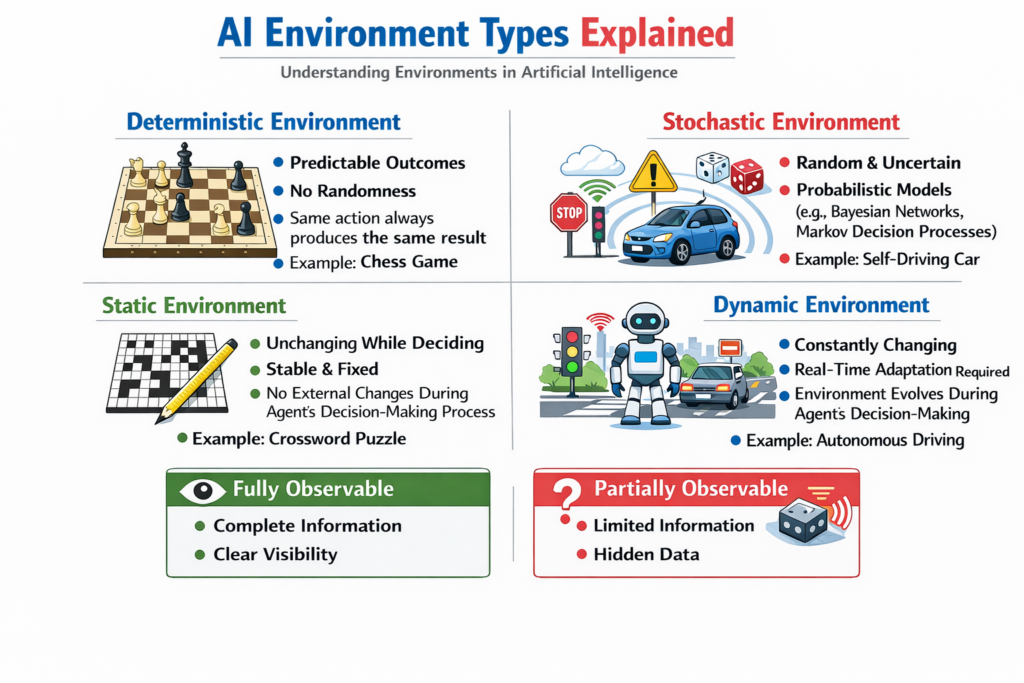
Why Understanding AI Environment Types Matters
The environment determines the design strategy for intelligent agents. Different environments require different computational approaches and algorithms.
For example:
- Deterministic environments allow precise predictions and planning.
- Stochastic environments require probabilistic reasoning.
- Dynamic environments require real-time decision-making.
- Partially observable environments require inference and estimation.
Without understanding the type of environment, it becomes difficult to design effective AI systems. Engineers must carefully analyze the environment before selecting machine learning models, decision algorithms, or control strategies.
Deterministic Environments
A deterministic environment is one in which the next state of the system is completely determined by the current state and the action performed by the agent. There is no randomness or uncertainty involved in the outcome.
In such environments, if the agent performs the same action in the same state, the result will always be identical. This predictability makes deterministic environments relatively easier to model and analyze.
A classic example is the game of chess. If a player moves a piece in a certain way, the outcome is fully predictable. The board changes in a clearly defined manner, and there is no randomness affecting the move.
Deterministic environments are ideal for search algorithms and planning systems, such as:
- Minimax algorithm
- A* search
- Depth-first search
- Breadth-first search
Because outcomes are predictable, AI systems can explore multiple possibilities and determine optimal strategies.
However, deterministic environments are relatively rare in real-world situations. Most real-world systems contain some level of uncertainty or unpredictability.
Stochastic Environments
A stochastic environment introduces randomness and uncertainty into the system. In this type of environment, the same action performed in the same state can produce different outcomes.
This uncertainty may arise from incomplete information, environmental variability, or unpredictable external factors.
For example, consider self-driving cars. Even if a vehicle performs the same driving action—such as accelerating or turning—the outcome may vary due to weather conditions, pedestrian movement, traffic behavior, or road obstacles.
Because of this uncertainty, AI systems operating in stochastic environments must rely on probabilistic models and statistical reasoning. Algorithms often calculate probabilities of different outcomes rather than predicting a single deterministic result.
Common techniques used in stochastic environments include:
- Bayesian networks
- Markov Decision Processes (MDP)
- Reinforcement learning
- Probabilistic reasoning models
These techniques help AI agents evaluate risks and make decisions under uncertainty.
Stochastic environments are extremely common in real-world applications such as finance, healthcare diagnosis, robotics, and autonomous driving.
Static Environments
A static environment is one that does not change while the AI agent is making decisions. The environment remains stable during the agent’s reasoning process.
This means the agent has enough time to analyze the environment without worrying about external changes occurring simultaneously.
A typical example is solving a crossword puzzle or playing a board game where the environment remains unchanged until the agent makes a move.
Static environments simplify decision-making because the agent does not need to react in real time. It can carefully evaluate different possibilities and choose the best action.
However, static environments are mostly found in controlled or artificial scenarios. Real-world systems often change continuously, which leads to the concept of dynamic environments.
Dynamic Environments
In contrast to static environments, dynamic environments change continuously over time, even while the agent is making decisions.
This makes them significantly more challenging for AI systems because they must operate in real time and adapt to evolving situations.
A good example is autonomous driving. While the AI system is calculating the next action, pedestrians may move, vehicles may change lanes, traffic lights may switch, and road conditions may evolve.
Because of this constant change, AI agents operating in dynamic environments require:
- Real-time perception systems
- Continuous monitoring
- Fast decision-making algorithms
- Adaptive control strategies
Dynamic environments are commonly found in robotics, traffic systems, stock markets, and online recommendation platforms.
Fully Observable Environments
In a fully observable environment, the AI agent has complete access to all relevant information about the environment’s current state.
This means the agent can observe everything necessary to make optimal decisions.
For instance, in chess, the agent can see the entire board and all the pieces. There is no hidden information, which allows the agent to plan strategies with complete knowledge.
Fully observable environments simplify problem solving because the agent does not need to infer hidden states or estimate missing information.
However, most real-world environments are not fully observable.
Partially Observable Environments
A partially observable environment occurs when the AI agent cannot access the complete state of the environment.
Some information may be hidden, noisy, or inaccessible, forcing the agent to make decisions based on incomplete data.
For example, in medical diagnosis systems, doctors (or AI models) cannot directly observe the underlying disease. Instead, they rely on symptoms, test results, and probabilities to infer the condition.
Similarly, autonomous robots may have limited sensor ranges and cannot detect everything in the environment.
To handle partial observability, AI systems use techniques such as:
- Hidden Markov Models
- Bayesian inference
- Belief state tracking
- Reinforcement learning with uncertainty
These approaches allow agents to estimate the hidden parts of the environment and make informed decisions.
Comparison of Major AI Environment Types
| Environment Type | Definition | Key Characteristics | Example Applications |
|---|---|---|---|
| Deterministic | Outcome depends completely on current state and action | Predictable, no randomness | Chess, puzzle solving |
| Stochastic | Outcomes include randomness or probability | Uncertain, probabilistic | Self-driving cars, financial forecasting |
| Static | Environment does not change during decision-making | Stable during reasoning | Board games, crossword puzzles |
| Dynamic | Environment changes continuously | Requires real-time adaptation | Autonomous driving, robotics |
| Fully Observable | Agent has access to complete information | No hidden states | Chess, checkers |
| Partially Observable | Agent has limited or incomplete information | Requires inference | Medical diagnosis, robotics |
This comparison highlights how different environments impose different challenges for AI systems.
Real-World Applications of AI Environment Types
Understanding AI environments is not just theoretical—it directly impacts the design of practical AI solutions.
In robotics, robots often operate in dynamic and partially observable environments where sensors may provide incomplete data.
In autonomous vehicles, the environment is both stochastic and dynamic due to unpredictable human behavior and changing road conditions.
In financial forecasting, stochastic environments dominate because market conditions change unpredictably.
Meanwhile, game-playing AI systems like chess engines operate in deterministic, fully observable environments, enabling precise strategic planning.
Because real-world environments often combine multiple characteristics, modern AI systems frequently integrate several techniques such as deep learning, reinforcement learning, and probabilistic modeling.
Key Takeaways
The classification of AI environments is fundamental for designing intelligent agents capable of solving real-world problems. By understanding whether an environment is deterministic, stochastic, static, dynamic, fully observable, or partially observable, developers can choose the most suitable algorithms and decision-making frameworks.
Deterministic environments yield predictable outcomes and are easier to model, whereas stochastic environments require probabilistic reasoning because outcomes are uncertain. Static environments remain unchanged during decision-making, whereas dynamic environments evolve continuously and demand real-time responses. Similarly, fully observable environments provide complete information, while partially observable environments require agents to infer missing data.
As Artificial Intelligence continues to advance, the ability to design systems that can operate effectively in complex, uncertain, and dynamic environments will become increasingly important.