Introduction
Artificial Intelligence (AI) is no longer a futuristic idea from science fiction movies. It is already part of our everyday lives—powering smartphone assistants, recommending videos on YouTube, filtering spam emails, detecting fraud in banks, and even helping doctors diagnose diseases. Yet, for many beginners, AI still feels mysterious, complex, and intimidating. People often imagine AI as a “thinking machine” with human-like intelligence, but in reality, AI works in a much more logical, mathematical, and data-driven way.
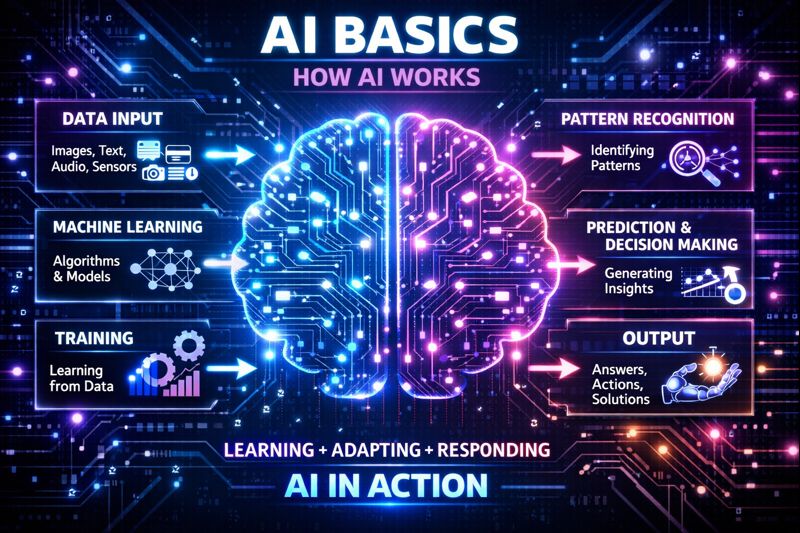
In this beginner-friendly guide, we will break down how artificial intelligence actually works, step by step, using simple language, relatable examples, and real-world applications. By the end of this article, you will understand the core ideas behind AI without needing a technical background.
What Is Artificial Intelligence in Simple Words?
At its core, Artificial Intelligence is about teaching computers to learn from data and make decisions—just like humans do, but in a more structured and mathematical way. Instead of manually programming every possible instruction, we give machines examples and allow them to find patterns on their own.
Think of AI as a very fast learner. A human learns to recognize a cat by seeing many cats over time—small cats, big cats, different colors, and shapes. Similarly, an AI system learns by analyzing thousands or millions of examples of cats until it understands what makes a cat a cat. The machine does not “see” like humans do; instead, it looks at numbers, pixels, and patterns hidden inside the data.
AI does not think or feel. It does not have emotions, consciousness, or intentions. It simply follows mathematical rules to arrive at the most likely answer based on what it has learned.
The Building Blocks of Artificial Intelligence
To understand how AI works, you must first understand its three foundational building blocks: data, algorithms, and models. These three components work together to make intelligent behavior possible.
Data is the fuel of AI. Without data, AI cannot learn anything. This data can be text, images, audio, videos, numbers, or even sensor readings. For example, a face recognition system needs thousands of labeled face images, while a language model needs massive amounts of text from books, articles, and conversations.
Algorithms are the step-by-step rules that tell the computer how to learn from the data. An algorithm decides how to compare examples, how to reduce errors, and how to improve performance over time. Different problems require different algorithms.
Models are the final result of training an algorithm on data. A model is what we actually use in real life. When you ask a chatbot a question or upload a photo to identify an object, you are interacting with a trained AI model, not the raw algorithm or dataset.
How Machines Learn: The Core Idea Behind AI
The heart of AI lies in machine learning, which is a method that allows computers to learn from experience rather than explicit programming. Instead of saying, “If this happens, do that,” we say, “Here are many examples—figure out the rules yourself.”
Imagine teaching a child to recognize fruits. You do not explain chemical formulas or biological structures. You simply show apples, bananas, and oranges repeatedly while naming them. Over time, the child learns to identify them correctly. AI learns in a similar way, except it uses mathematics instead of intuition.
Machine learning works by:
- Taking input data
- Making a prediction
- Measuring how wrong the prediction is
- Adjusting itself to improve next time
This loop repeats thousands or millions of times until the model becomes accurate enough.
Types of Machine Learning Explained Simply
There are three main ways machines learn, and understanding these will help you grasp most AI systems.
Supervised learning is like learning with a teacher. The AI is given data along with the correct answers. For example, if we want an AI to detect spam emails, we give it thousands of emails labeled as “spam” or “not spam.” Over time, it learns the patterns that separate the two.
Unsupervised learning is learning without labels. Here, the AI is given data but no answers. Its job is to find hidden patterns or group similar items together. This is commonly used in customer segmentation, recommendation systems, and market analysis.
Reinforcement learning is learning by trial and error. The AI takes actions and receives rewards or penalties based on its performance. This is how AI learns to play games, control robots, or optimize decision-making systems. The idea is similar to training a pet—good actions are rewarded, bad actions are discouraged.
What Are Neural Networks and Why Are They Important?
Neural networks are inspired by the human brain, but they are far simpler than real neurons. A neural network is made up of layers of artificial “neurons” that process information step by step.
Each neuron takes input, applies a mathematical calculation, and passes the result forward. As data flows through the network, it gets transformed again and again until the final layer produces an output—such as a prediction or classification.
For example, in image recognition, early layers may detect simple features like edges and shapes. Deeper layers combine these features to recognize objects like faces, animals, or cars. This layered learning is what makes deep learning, a subset of AI, so powerful.
Why Data Quality Matters More Than You Think
A common saying in AI is: “Garbage in, garbage out.” This means that even the most advanced AI model will fail if the data it learns from is poor, biased, or incomplete.
If a face recognition system is trained mostly on one type of face, it may struggle to recognize others accurately. If a language model is trained on incorrect or misleading information, it may produce unreliable outputs.
High-quality data should be:
- Accurate and relevant
- Diverse and representative
- Properly labeled (when required)
Good AI is not just about complex algorithms—it is equally about responsible and thoughtful data collection.
How AI Makes Predictions and Decisions
AI does not “know” answers in the human sense. Instead, it calculates probabilities. When you ask an AI a question or show it an image, it analyzes patterns from its training data and predicts the most likely response.
For example, when a recommendation system suggests a movie, it is not thinking creatively. It is comparing your viewing history with millions of other users and predicting what you are most likely to enjoy based on statistical patterns.
This probabilistic nature is why AI can sometimes make mistakes—it is always choosing what seems most likely, not what is guaranteed to be correct.
Real-World Applications of Artificial Intelligence
AI is already transforming industries across the world. In healthcare, it helps detect diseases early, analyze medical scans, and assist doctors in decision-making. In finance, AI detects fraud, predicts market trends, and automates customer support.
In everyday life, AI powers voice assistants, language translation, navigation apps, social media feeds, and online shopping recommendations. Even your smartphone camera uses AI to enhance photos, detect faces, and adjust lighting automatically.
As AI continues to evolve, its applications will only expand, making systems faster, smarter, and more personalized.
Common Myths About Artificial Intelligence
One of the biggest myths is that AI will suddenly become conscious and replace humans entirely. In reality, AI is highly specialized. It excels at specific tasks but lacks general understanding, emotions, and moral judgment.
Another misconception is that AI learns instantly. In truth, training AI models takes time, data, computing power, and constant fine-tuning. AI systems also require human oversight to ensure fairness, accuracy, and ethical use.
Understanding these limitations helps us use AI responsibly rather than fear it unnecessarily.
The Future of AI: What to Expect
The future of artificial intelligence is not about replacing humans but augmenting human abilities. AI will handle repetitive, data-heavy tasks, allowing people to focus on creativity, strategy, and problem-solving.
We can expect AI to become more explainable, transparent, and regulated, especially in sensitive areas like healthcare and finance. As tools become more accessible, even non-technical users will be able to build and use AI solutions.
Learning the basics of AI today is not just for developers—it is becoming an essential skill for everyone.
Conclusion
Artificial Intelligence may sound complex, but at its core, it is simply about learning from data, recognizing patterns, and making predictions. By understanding how AI works behind the scenes, you can better appreciate its capabilities, limitations, and impact on your life.
AI is not magic—it is mathematics, logic, and data working together at scale. And as technology continues to grow, having a clear, simple understanding of AI will empower you to adapt, innovate, and make informed decisions in an AI-driven world.