Top AI Use Cases in Healthcare (2026 Edition)
Introduction: Transforming Diagnosis, Medical Imaging & Drug Discovery
The year 2026 marks a major turning point in healthcare innovation, with Artificial Intelligence (AI) becoming deeply integrated into clinical workflows, diagnostics, imaging, patient monitoring, therapy development, and hospital administration. What started as basic algorithmic prediction tools has now evolved into highly sophisticated, real-time, AI-powered medical systems capable of reading CT scans, detecting early diseases long before symptoms appear, designing new drugs in months rather than years, and assisting doctors with clinical decision-making.
This article covers the top AI use cases in healthcare for 2026, explaining how technologies like deep learning, large medical models (LMMs), computer vision, predictive analytics, and generative AI are reshaping medicine. We will focus on key domains such as diagnostic AI, medical imaging, drug discovery, workflow automation, robot-assisted surgery, virtual nursing, and more—with real-world examples, insights, and useful external resources.
1. AI in Medical Diagnosis: Enhancing Accuracy and Early Detection
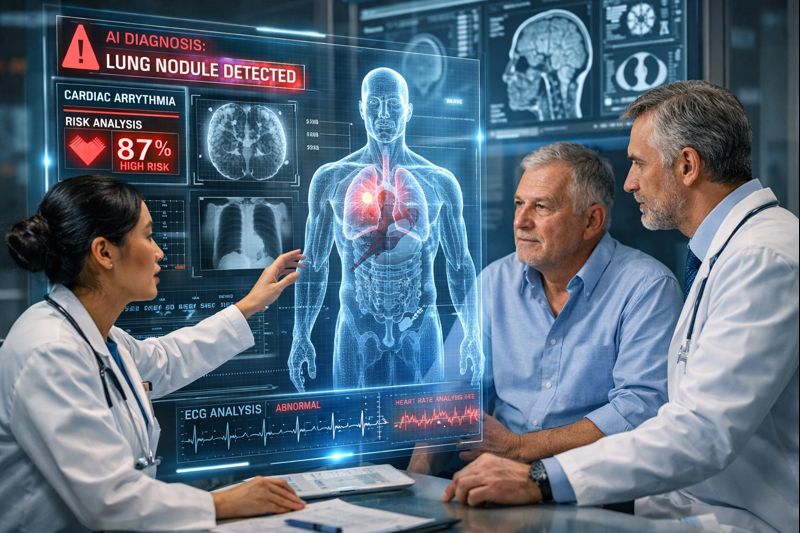
AI-powered diagnosis systems are one of the most impactful healthcare transformations in 2026. Modern diagnostic AI models can analyze patient symptoms, lab results, genomics, electronic health records (EHR), and medical imaging to identify conditions with high precision. They don’t replace doctors but enhance their ability to recognize diseases early—sometimes even before a human clinician can detect visible signs.
Today’s AI diagnostic tools incorporate multi-modal data, combining text, images, biomarkers, and longitudinal patient data to produce comprehensive risk assessments. These tools can detect early-stage cancers, neurological disorders, cardiovascular events, metabolic diseases, and infectious conditions with remarkable accuracy.
For instance, AI-based predictive models can now forecast the risk of cardiac arrest several hours or even days in advance using vitals and real-time monitoring data. Clinical decision support platforms like IBM Watson Health and Google DeepMind Health (now Google Health AI) have also evolved into more mature systems that actively support doctors with automated diagnosis suggestions and medical literature analysis.
2. AI in Medical Imaging: Revolutionizing Scans, X-rays, CT, MRI & Ultrasound
AI’s most mature and widely adopted healthcare use case continues to be medical imaging. By 2026, almost all top hospitals and diagnostic centers rely on computer vision and deep learning models to interpret imaging scans. AI tools can spot tiny anomalies—such as early tumors, microfractures, arterial blockages, hemorrhages, and lung nodules—sometimes with performance exceeding human radiologists.
The key advantage is speed + accuracy. AI can process thousands of imaging slices in seconds, ensuring faster patient throughput and drastically reducing radiologist workload. This is especially critical in regions facing healthcare workforce shortages. Advanced image-segmentation techniques allow AI to highlight critical areas, quantify tumor growth, measure organ health, and track disease progression over time.
Another major trend in 2026 is the rise of real-time imaging AI, where models analyze ultrasound or X-ray feeds instantly during procedures. For example, AI-assisted ultrasound machines guide technicians to capture optimal images even without extensive training. Tools like Google’s AI for breast cancer screening, Qure.ai, Arterys, Aidoc, and Siemens Healthineers AI-Rad Companion are widely used globally.
External Resource:
Explore advanced AI radiology platforms:
https://www.aidoc.com
3. AI in Drug Discovery and Development: Accelerating Innovation
Drug discovery traditionally took 10–15 years and billions of dollars. In 2026, AI has dramatically reduced this timeline. Thanks to generative AI, molecular simulation models, and protein-structure prediction systems, biotech companies can now identify drug candidates in weeks or months, not years. AI models simulate how molecules behave, how proteins fold, and how potential drugs interact with the human body—long before physical experiments begin.
Breakthroughs like AlphaFold 2, AlphaFold 3, and other protein prediction models have enabled researchers to map complex biological structures with unprecedented detail. AI also helps identify new therapeutic targets by analyzing genomic datasets, medical literature, and real-world clinical data. Pharmaceutical leaders like Pfizer, Moderna, AstraZeneca, and Insilico Medicine now use AI platforms to design molecules, repurpose drugs, optimize clinical trials, and personalize treatment protocols.
In 2026, AI-driven breakthroughs are especially prominent in oncology, rare diseases, metabolic conditions, and immunotherapy. Many biotech startups also use AI-driven simulations to predict drug toxicity, bioavailability, and efficacy—reducing failure rates dramatically.
External Resource:
Learn how AI accelerates drug discovery:
https://www.deepmind.com/research
4. AI-Powered Virtual Health Assistants and Nursing Bots
Virtual nursing assistants have rapidly grown in both hospitals and home healthcare environments. These AI-driven assistants guide patients through medication schedules, monitor vital signs through connected devices, remind them of follow-ups, and even answer basic medical questions. Advanced AI chatbots integrated with EHRs can analyze patient history and provide personalized recommendations.
In 2026, hospitals use virtual assistants for triage, symptom reporting, and preliminary assessments to reduce emergency room congestion. AI-based voice assistants also support elderly patients by detecting falls, tracking health metrics, and providing telemedicine connections to doctors. These systems significantly reduce hospital readmissions and improve patient engagement.
External Resource:
Explore virtual healthcare assistant platforms:
https://www.nuance.com
5. Predictive Analytics for Disease Prevention and Population Health
One of AI’s strongest contributions is predictive analytics, which helps physicians anticipate diseases before they become life-threatening. By analyzing vast amounts of patient data—including lifestyle patterns, blood biomarkers, genetic predispositions, medical history, and wearable device metrics—AI models create risk profiles for individuals and large populations.
Hospitals use predictive analytics to identify patients at high risk of sepsis, heart disease, stroke, diabetes complications, and respiratory failure. Governments and insurance providers use similar AI models to detect disease outbreaks, predict healthcare demand, and optimize resource distribution.
Wearables integrated with AI—such as smartwatches, ECG-enabled devices, glucose monitors, and blood pressure trackers—send continuous health data to AI dashboards. These algorithms provide early warnings, empowering preventive care.
External Resource:
Learn more about predictive health analytics:
https://www.healthit.gov
6. AI in Personalized Medicine and Genomics
Another transformative area is personalized or precision medicine, where AI analyzes DNA sequences to tailor treatments for individuals. By studying genetic mutations, biomarkers, metabolic pathways, and immunological responses, AI helps determine the best drug, best dosage, and the probability of treatment success for each patient.
In oncology, AI-powered genomic analysis identifies mutations driving specific cancers and suggests targeted therapies. In 2026, AI also plays a major role in reproductive genomics, newborn screening, hereditary disease prediction, and personalized nutrition.
7. AI for Hospital Automation and Workflow Optimization
Hospitals are under tremendous pressure due to long patient queues, staffing shortages, and operational inefficiencies. AI automation tools in 2026 streamline everything from scheduling and triage to billing and inventory management. Machine learning systems predict patient admissions, optimize bed allocation, and ensure faster patient discharge processes.
Robotic process automation (RPA) tools handle repetitive administrative tasks, freeing up staff for patient care. AI-based supply chain systems ensure that medicines, surgical instruments, and critical supplies are never out of stock. Hospitals also use AI to monitor ICU patients through continuous sensor data, reducing human error and ensuring timely intervention.
8. AI-Assisted Surgery and Robotics
Surgical robotics combined with AI enables greater precision, reduced invasiveness, and quicker recovery times. AI helps surgeons by analyzing pre-operative imaging, predicting complications, guiding robotic arms, and offering real-time feedback during procedures. Autonomous robotic systems can now perform basic tasks such as suturing and instrument handling.
Companies such as Intuitive Surgical (da Vinci Robot) and Medtronic have integrated intelligent control systems to assist surgeons with delicate operations like neurosurgery, orthopaedic procedures, and cardiovascular surgery.
Final Thoughts: AI Is Reshaping Healthcare in Every Direction
Healthcare in 2026 is entering a golden era where AI improves diagnosis accuracy, optimizes imaging interpretation, accelerates drug discovery, personalizes treatments, and enhances hospital efficiency. While AI will not replace doctors, it will continue to empower them with superhuman analytical capabilities and faster clinical insights. From predictive analytics to robotic surgeries, the future of medicine is intelligent, automated, and deeply data-driven.
As we move forward, continuous adoption of ethical AI practices, strong regulation, data privacy, patient consent, and explainability will ensure that AI remains a trusted partner in delivering world-class healthcare globally.