
Introduction
Artificial Intelligence no longer belongs only to researchers, tech giants, or advanced developers. Today, anyone—students, working professionals, creators, business owners, or someone simply curious—can start building practical AI projects with minimal coding knowledge. What makes AI so empowering is not just the technology but the feeling of creating something meaningful, something that learns, improves, and interacts intelligently.
This article brings you ten beginner-friendly AI projects that are easy to follow, require simple tools, and come with openly available datasets so you can start right away. These projects will strengthen your foundation, make your portfolio stand out, and help you develop real-world problem-solving skills.
Each project includes a dataset source, step-by-step workflow, and a clear explanation of why the idea matters. Whether you’re aiming for a career in AI or simply exploring your curiosity, these ideas will help you build momentum and confidence—one project at a time.
1. Sentiment Analysis on Movie Reviews
Sentiment analysis is one of the simplest and most powerful ways to understand how people feel about a topic. In this project, you train a small model to classify text as positive or negative. It’s a great introduction to Natural Language Processing (NLP), data cleaning, tokenization, and model building.
Dataset recommendation:
Use the IMDb Movie Review Dataset (free on Kaggle) — Sentiment Dataset.
How to build it
Start by cleaning the text data by removing stopwords, special characters, and unnecessary symbols. Convert words into numerical representations using TF-IDF or simple word embeddings. Train a logistic regression or Naive Bayes model to classify sentiment. Finally, create a small Streamlit UI so users can enter a review and see the prediction. This interactive touch will make your AI project portfolio more friendly.
2. House Price Prediction Using Linear Regression
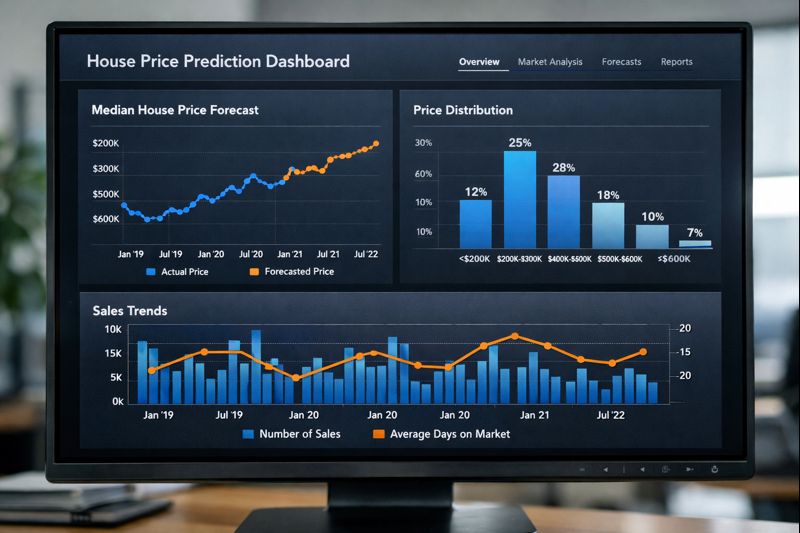
Regression-based AI problems help beginners understand patterns and relationships between variables. In this project, your goal is to predict house prices based on features like location, square feet, number of rooms, and age of the building.
Dataset suggestion:
Boston Housing Dataset — Housing Data.
How to build it
Import the dataset, visualize correlations between variables, and remove outliers. Then split the dataset into training and testing sets. Apply linear regression or decision trees and evaluate performance using MSE or R² score. Wrap up by creating a prediction function where users enter property details and receive an estimated price instantly.
3. Email Spam Classifier
Cybersecurity is an important domain in AI, and a spam classifier is a perfect beginner project. You train a model to detect whether an email is spam based on its content.
Dataset source:
Enron Spam Dataset — Spam Email Data.
How to build it
Start by cleaning the email body text. Then use TF-IDF vectorization to convert emails into a numerical format. Train the model using logistic regression or SVM. Test the accuracy and fine-tune your parameters. To make it portfolio-ready, deploy it using Flask or Streamlit.
4. Fake News Detection System
With misinformation increasing globally, AI-powered text classification models can help detect fake news. The project teaches NLP, classification, and ethical data handling.
Dataset:
Fake News Dataset from Kaggle — Fake News Data.
How to build it
Clean the dataset and perform EDA to understand common patterns in fake versus real headlines. Convert text to vectors using word embeddings like Word2Vec or TF-IDF. Train models such as random forests, LSTM networks, or logistic regression. Build a prediction interface so users can input a news headline and get an instant credibility score.
5. Customer Churn Prediction (Telecom Dataset)
Churn prediction is one of the most in-demand applications in AI for businesses. You predict whether a customer will leave a service based on behavioral patterns.
Dataset:
Telco Customer Churn Dataset — available on Kaggle Datasets.
How to build it
Start by preprocessing numerical and categorical data. Encode text data using label encoding and handle missing values. Train a classification model such as Random Forest or XGBoost. Evaluate your model using the F1 score and confusion matrix. Add a dashboard using Power BI or Tableau for a polished, business-friendly one of the AI projects.
6. Chatbot Using Python (Rule-Based or NLP-Powered)
Building a simple chatbot helps you understand conversational AI. You can start with a rule-based approach and then upgrade to an NLP model that responds based on intent.
How to build it
Start by creating a small dataset of intents—greetings, queries, responses. Convert text into vectors and train a small neural network. Build a chat interface using Tkinter or Streamlit. This project gives a feel of real human-computer interaction, making it both fun and productive.
7. Image Classification Using CIFAR-10
Computer Vision is one of the most exciting fields in AI. Image classification lets you train a model to recognize objects like cars, birds, airplanes, and animals.
Dataset:
CIFAR-10 dataset from the UCI repository — downloadable at Image Dataset Source.
How to build it
Import the dataset, normalize images, and build a small CNN model using Keras or PyTorch. Train the model and visualize accuracy and loss. Experiment with adding layers to improve performance. This AI project is ideal for portfolios, as visuals make it appealing.
8. Personality Prediction from Social Media Posts
An interesting, psychology-meets-AI project where you analyze text and predict personality traits based on writing style.
Dataset suggestion:
MyPersonality Dataset (publicly available social data) — Personality Dataset.
How to build it
Perform NLP cleaning, tokenize posts, and extract emotional or behavioral patterns. Train classification models to predict traits like introversion, openness, or emotional stability. This project is engaging and unique, often surprising employers during interviews.
9. Recommendation System for Movies or Products
Recommendation engines power Netflix, Amazon, YouTube, and Spotify. You can create a simple content-based or collaborative filtering recommender.
Dataset:
MovieLens Dataset — Recommendation Dataset.
How to build it
Load the dataset, calculate similarities between movies using cosine similarity or Pearson correlation. Build functions to recommend movies based on a selected title. Deploy using a simple web interface where users click a movie and instantly receive recommendations.
10. Handwritten Digit Recognition with MNIST
MNIST is the “Hello World” of AI. It teaches beginners the basics of image preprocessing and neural network building.
Dataset link:
MNIST Dataset — available on OpenML.
How to build it
Load grayscale images, normalize values, and build a neural network with dense layers. Train and evaluate accuracy. Finally, create a canvas UI where users draw digits, and the model predicts the number. This adds a delightful interactive touch to your project.
Conclusion
Each of these ten AI projects is crafted to build your confidence, spark curiosity, and help you progress from beginner to intermediate level. They cover various domains—NLP, Computer Vision, machine learning, deep learning, and real-world data handling. Whether you’re preparing for job interviews, building a portfolio, or simply exploring AI as a passion, these projects will guide you step-by-step toward mastering practical AI skills. Start small, experiment, break things, fix them, and grow with every line of code.
📚 Related Article
How Artificial Intelligence Actually Works — Explained Simply