
Introduction
Education in 2026 stands at a remarkable crossroads—one where innovation meets emotion, intelligence blends with intuition, and technology finally supports, rather than replaces, human potential.
Artificial Intelligence, once seen only as a futuristic concept, has now become the invisible companion shaping how students learn, how teachers teach, and how institutions operate. This evolution isn’t simply about automation or convenience. It’s about creating a more equitable, personalized, emotionally connected, and globally accessible system—one where every learner feels seen, supported, and inspired.
In this new landscape, AI has emerged as the bridge between what education was and what it can finally become: meaningful, empowering, and beautifully human.
The Emotional Shift: Why AI Matters in Today’s Educational World
By 2026, classrooms—whether physical, hybrid, or entirely digital—are no longer defined by walls or limitations. AI has played a pivotal role in transforming the emotional experience of learning by giving every student a personalized pathway. Instead of forcing millions of learners into a one-size-fits-all model, AI now adapts to individual strengths, weaknesses, pace, and learning style.
Teachers no longer struggle to divide their attention among 40 students. Parents no longer feel lost trying to keep up with school demands. And most importantly, students no longer feel invisible. AI doesn’t replace the warmth of a teacher, but it does give teachers superpowers—deep insights, instant feedback loops, and tools that remove the stress of administrative overload. The result is a more compassionate, more responsive education system that finally recognizes that learners are not data points; they are dreams in progress.
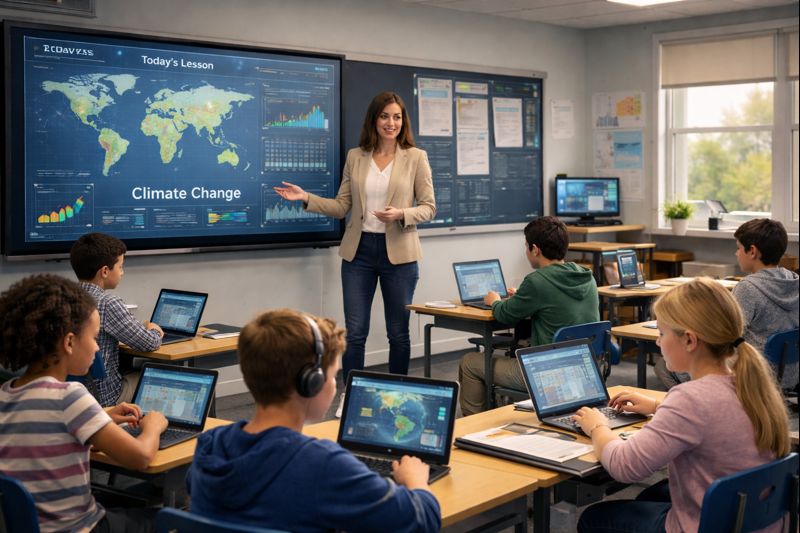
1. AI-Powered Teaching Tools: Empowering Educators Like Never Before
1.1 Intelligent Lesson Planning & Content Generation
One of the biggest transformations in 2026 is AI-driven lesson planning. Educators now rely on powerful platforms that can design full lesson plans, create worksheets, generate examples, produce quizzes, and provide differentiated versions of the same material for varying student abilities. Tools like AI curriculum designers, smart whiteboards, and even voice-activated classroom assistants allow teachers to focus more on meaningful interaction and less on manual preparation.
Teachers can even use integrated AI tools from platforms like
Coursera, which offers ready-made course materials, educator support, and professional upskilling options. By blending prepared content with AI-generated suggestions, teachers can create lessons that are engaging, flexible, and customized to the unique needs of their classrooms.
1.2 Real-Time Teaching Assistants and Classroom Support
AI-based classroom assistants—available through tablets, projectors, or even AR-enabled smart glasses—help teachers streamline real-time interactions. These assistants monitor class participation, track attention levels, adjust the pace of lessons, and instantly provide teachers with cues on when a student needs additional help. The teacher can also quietly ask the AI for alternative explanations or examples to clarify a topic without interrupting the class flow.
This shift allows educators to reclaim something valuable: presence. Instead of juggling lesson plans, grading piles, and administrative tasks, teachers can fully engage emotionally and intellectually with their students. AI supports the structure; teachers support the soul.
2. AI for Students: Personalized Learning, Motivation & Emotional Growth
2.1 Adaptive Learning Systems for Every Student
The biggest gift AI has given learners in 2026 is personalized education. Platforms like adaptive digital tutors adjust difficulty levels, recommend learning paths, identify weak areas, and even celebrate the student’s micro-achievements. Unlike traditional systems that push students ahead or leave them behind, AI ensures that no learner ever feels “slow” or “incapable.”
Students using AI-enhanced tools like
Grammarly or intelligent math solvers experience real-time correction, feedback, and improvement strategies. These tools don’t just highlight errors—they explain them, guide learners step by step, and reinforce better learning habits.
2.2 AI for Emotional & Mental Support
In 2026, AI doesn’t just focus on academics—it supports emotional well-being too. Sentiment-driven learning apps analyze stress levels, frustration signals, and motivational dips using voice tone, typing speed, facial cues, and interaction patterns. These tools offer supportive messages, breaks, stretch reminders, and relaxation exercises. Some can even alert teachers or counselors if a student shows signs of burnout or emotional distress.
AI, in this form, becomes a silent guardian—ensuring that learning remains joyful, safe, and emotionally sustainable.
3. AI in Assessment & Grading: Faster, Fairer, and More Transparent
3.1 Automated Grading Systems
Gone are the days when teachers spent weekends grading piles of papers. AI-driven grading tools now evaluate assignments in minutes—whether they’re essays, coding tasks, MCQs, or problem-solving questions. These systems analyze grammar, reasoning, creativity, structure, and even originality. They offer detailed reports not only for teachers but also for students, explaining where they went wrong and how to improve.
This has not only reduced workload but also dramatically improved fairness in grading. Biases—conscious or unconscious—are minimized. Every student receives an equal opportunity to be evaluated based on merit.
3.2 Real-Time Feedback Loops
Students in 2026 no longer wait days or weeks for results. AI provides instant corrections, improvement suggestions, and revision recommendations. This immediate feedback strengthens understanding, boosts confidence, and reduces exam stress. When students can instantly see where they made mistakes and how to fix them, learning becomes a continuous, empowered journey.
Teachers, too, receive insights into class performance—common mistakes, trending challenges, and curriculum gaps—allowing them to adjust their teaching strategies in real time.
4. AI-Driven Classroom Management & School Administration
4.1 Smart Attendance, Scheduling & Record Keeping
School administration has undergone a silent revolution powered by AI. Automated attendance through facial recognition, smart timetables, predictive scheduling, and AI-generated reports have made administrative work seamless. Educators no longer waste hours on routine tasks; everything from attendance to timetable adjustments is handled intelligently.
Institutions even use AI-powered workflow tools such as
Zapier, which helps automate repetitive tasks across educational apps, saving time and reducing human error.
4.2 Predictive Analytics for Student Success
Predicting academic success or identifying risk factors before they become serious is now possible thanks to AI. Schools use predictive analytics to monitor indicators such as participation rates, assignment completion, performance patterns, and emotional markers. These insights help teachers and counselors offer early interventions—personalized counseling, tailored assignments, or targeted support.
In many ways, AI has made education not only smarter but also more compassionate.
5. AI and the Future of Learning Environments
5.1 Virtual Classrooms & Immersive Learning
AI transformed the boundaries of learning post-2025 by enabling VR and AR classrooms. Students can visit ancient civilizations, explore microscopic organisms, conduct virtual chemistry experiments, or practice real-life scenarios—all from home. AI guides these experiences, adapts the difficulty level, and ensures that learning remains safe and engaging.
Hyper-personalized virtual tutors can now teach in multiple languages, using culturally relevant examples to create a deeply inclusive learning environment.
5.2 AI Skills Becoming Essential for Students
AI literacy has become as crucial as reading and writing in 2026. Students are now encouraged to understand how AI works, how data is used, how algorithms behave, and how to create AI-assisted projects. Courses on machine learning basics, ethical technology, and digital creativity have become mainstream in schools and colleges.
Tools such as
Udemy makes it easy for students to access thousands of AI and tech courses at beginner to advanced levels—empowering them for the future job market.
Conclusion: AI Is Not Replacing Education—It’s Humanizing It
Despite fears that AI may depersonalize learning, 2026 has proven the opposite. AI has amplified what education should have always been: a nurturing, personalized, emotionally supportive journey where every student is seen and every teacher is valued. It has reduced stress, increased accessibility, and unlocked opportunities that once seemed impossible.
Education now stands at a place where technology fuels human connection rather than replacing it. AI may handle the complexity, but the heart of learning—the laughter, curiosity, mentorship, and personal growth—remains beautifully human.