
Introduction
Artificial Intelligence (AI) has become one of the most transformative forces in the automotive industry. What once relied purely on mechanical engineering and basic electronics is now deeply integrated with data-driven intelligence. Modern cars are no longer just vehicles that move from one place to another; they are intelligent systems capable of understanding their environment, predicting risks, and assisting drivers in real time. AI plays a central role in powering navigation and safety, making driving smarter, safer, and more efficient for both everyday users and professionals in the automotive and technology sectors.
This article explains how AI works behind the scenes in modern vehicles, focusing on navigation and safety systems. The explanation is kept conceptual and learning-oriented, making it suitable for students, engineers, data scientists, and automotive professionals alike.
How to Create a Personal Brand Using AI Tools | Cognitive Kraft
The Role of AI in Modern Automotive Systems
At its core, AI enables machines to learn from data, recognize patterns, and make decisions with minimal human intervention. In modern cars, AI systems continuously process massive amounts of data generated by sensors, cameras, GPS modules, and onboard computers. This data is analyzed in real time to support navigation decisions, detect hazards, and assist or even replace human driving actions in certain scenarios.
Unlike traditional rule-based systems, AI-powered automotive systems adapt to changing environments. They can learn from traffic patterns, driving behavior, road conditions, and historical data to improve accuracy and performance over time. This adaptability is what makes AI particularly valuable in navigation and safety applications, where conditions are dynamic and unpredictable.
Traditional GPS navigation systems primarily rely on satellite signals and static maps. While effective, they are limited in their ability to respond to real-time conditions such as traffic congestion, accidents, road closures, or weather-related disruptions. AI-enhanced navigation systems go far beyond this basic functionality.
AI-powered navigation combines GPS data with real-time inputs from traffic sensors, cameras, connected vehicles, and cloud-based services. Machine learning models analyze traffic flow patterns to predict congestion before it happens. Instead of simply reacting to traffic jams, AI systems can proactively suggest alternative routes that save time and fuel.
Natural language processing (NLP), another branch of AI, enables voice-based navigation assistants. Drivers can interact with their vehicles using conversational commands, reducing distraction and improving focus on the road. These systems continuously improve their understanding of accents, speech patterns, and context through learning algorithms.
AI navigation systems also adapt to individual driving preferences. Over time, they learn whether a driver prefers highways over city roads, avoids toll routes, or favors fuel-efficient paths. This personalization makes navigation more intuitive and user-centric.
Real-Time Decision Making with Sensor Fusion
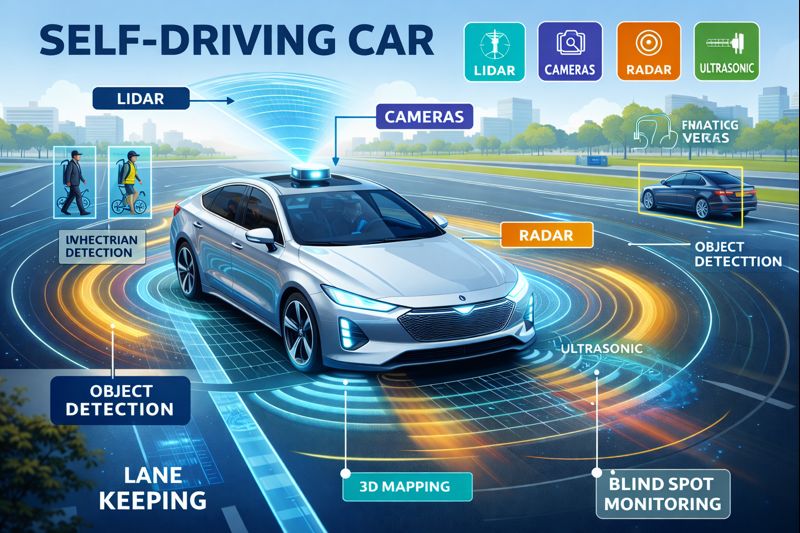
One of the most critical aspects of AI-driven navigation and safety is sensor fusion. Modern cars are equipped with multiple sensors such as cameras, radar, ultrasonic sensors, and sometimes LiDAR. Each sensor has strengths and limitations, but AI combines data from all of them to create a unified and accurate understanding of the vehicle’s surroundings.
For navigation, sensor fusion helps in lane-level positioning, detecting road signs, understanding lane markings, and identifying temporary changes such as construction zones. AI algorithms cross-verify information from different sensors to reduce errors and uncertainty. This capability is especially important in urban environments where GPS signals may be weak or inconsistent.
By continuously processing fused sensor data, AI systems can make split-second decisions that support both navigation accuracy and safety, even in complex driving conditions.
AI and Advanced Driver Assistance Systems (ADAS)
Advanced Driver Assistance Systems, commonly known as ADAS, represent one of the most widespread applications of AI in vehicle safety. These systems are designed to assist drivers rather than replace them, providing an additional layer of protection and awareness.
AI enables ADAS features such as lane-keeping assistance, adaptive cruise control, blind-spot detection, and automatic emergency braking. Machine learning models are trained on millions of real-world driving scenarios, allowing them to recognize pedestrians, vehicles, cyclists, and obstacles with high accuracy.
For example, adaptive cruise control uses AI to maintain a safe distance from the vehicle ahead by continuously adjusting speed based on traffic flow. Lane-keeping systems rely on computer vision algorithms to detect lane markings and gently correct steering if the car begins to drift unintentionally.
Automatic emergency braking systems use AI to assess collision risk in real time. If the system determines that a crash is imminent and the driver does not respond quickly enough, it can apply the brakes automatically to reduce impact or avoid the collision altogether.
Computer Vision and Road Understanding
Computer vision is a key AI technology that allows cars to “see” and interpret the world around them. Cameras mounted on modern vehicles capture visual data that AI models analyze to identify objects, road signs, traffic lights, and lane boundaries.
Unlike human vision, AI-powered computer vision can operate consistently without fatigue or distraction. It can detect subtle patterns and changes in the environment that may not be immediately obvious to drivers. For example, AI can recognize partially obscured road signs, detect pedestrians at night, or identify unusual driving behavior from nearby vehicles.
In navigation, computer vision enhances map accuracy by validating real-world conditions against digital maps. This capability is particularly useful in rapidly changing environments, such as newly developed areas or temporary road diversions.
Predictive Safety Through Machine Learning
One of the most powerful advantages of AI in vehicle safety is its predictive capability. Machine learning models analyze historical accident data, driving behavior, and environmental conditions to identify patterns that precede dangerous situations.
Instead of responding only after a hazard appears, AI systems can predict potential risks and issue early warnings. For instance, if a driver is approaching an intersection with a high accident rate at a speed that historically correlates with collisions, the system may alert the driver or adjust vehicle behavior.
Driver monitoring systems also use AI to enhance safety. Cameras and sensors track eye movement, head position, and facial expressions to detect signs of fatigue or distraction. If the system identifies risky behavior, it can issue alerts or recommend breaks, significantly reducing the likelihood of accidents.
AI in Autonomous and Semi-Autonomous Driving
While fully autonomous vehicles are still evolving, AI already plays a central role in semi-autonomous driving features available today. These systems rely on deep learning, reinforcement learning, and real-time data processing to perform complex driving tasks.
AI-driven autonomy involves three major functions: perception, decision-making, and control. Perception systems interpret sensor data to understand the environment. Decision-making systems evaluate possible actions based on safety, efficiency, and traffic rules. Control systems execute these decisions by steering, accelerating, or braking.
Companies like Tesla and Waymo use AI models trained on billions of kilometers of driving data. This massive scale of learning allows vehicles to handle complex scenarios such as merging traffic, navigating intersections, and responding to unpredictable human behavior.
Even in semi-autonomous modes, AI significantly reduces driver workload and enhances safety by handling routine tasks while keeping the driver informed and engaged.
Connectivity, Cloud AI, and Smart Infrastructure
Modern vehicles are increasingly connected to the internet and to each other. This connectivity allows AI systems to access cloud-based intelligence and real-time data from smart infrastructure.
Cloud AI enables vehicles to receive live traffic updates, weather information, and hazard alerts shared by other vehicles. If one car detects icy conditions or an accident, that information can be communicated to nearby vehicles, allowing them to adjust routes or driving behavior proactively.
Smart traffic lights and road infrastructure also contribute data to AI systems. By integrating this information, navigation systems can optimize routes not just for individual drivers, but for overall traffic efficiency, reducing congestion and emissions at a city-wide level.
Ethical, Safety, and Reliability Considerations
While AI greatly enhances navigation and safety, it also raises important ethical and technical considerations. Ensuring reliability in all conditions, avoiding algorithmic bias, and maintaining transparency in decision-making are critical challenges.
Automotive AI systems undergo extensive testing and validation to meet safety standards. Redundancy is built into critical systems so that failures in one component do not compromise overall safety. Human oversight remains an essential part of current AI-driven driving systems, especially in complex or uncertain situations.
From a learning perspective, understanding these challenges is as important as understanding the technology itself. Students and professionals must consider not only how AI systems work, but also how they can be deployed responsibly and safely.
The future of AI-powered navigation and safety lies in greater autonomy, deeper personalization, and tighter integration with smart cities. Advances in deep learning, edge computing, and sensor technology will further enhance real-time decision-making capabilities.
As vehicles become more intelligent, navigation systems will evolve into predictive mobility assistants that plan entire journeys based on schedules, preferences, and environmental impact. Safety systems will move closer to accident prevention rather than accident mitigation, using predictive intelligence to eliminate risks before they arise.
For students, this field offers opportunities at the intersection of AI, data science, robotics, and automotive engineering. For professionals, it represents a rapidly growing domain with real-world impact on safety, efficiency, and sustainability.
Conclusion
AI has fundamentally reshaped how modern cars navigate and protect their occupants. By combining machine learning, computer vision, sensor fusion, and real-time data processing, AI-powered systems deliver smarter navigation and significantly enhanced safety. These technologies reduce human error, improve driving comfort, and pave the way toward autonomous mobility.
Understanding how AI powers navigation and safety is essential for anyone looking to work in automotive technology, artificial intelligence, or intelligent transportation systems. As AI continues to evolve, its role in making roads safer and travel more efficient will only become more central, marking a defining shift in the future of mobility.