
Introduction: How the A* Algorithm Finds the Best Path Faster
Artificial Intelligence often appears mysterious, but many of its most powerful techniques are built on surprisingly simple ideas. One of these ideas is heuristic search, a method that allows computers to make intelligent decisions while exploring complex problems. Instead of blindly checking every possible solution, heuristic search uses informed guesses to guide the search process toward the most promising options. This approach dramatically reduces the time required to solve large problems such as route planning, robotics navigation, game AI, and even network optimization.
Among heuristic search methods, the A* (A-Star) algorithm stands out as one of the most widely used and efficient techniques. It combines mathematical precision with practical intuition to find optimal paths in graphs and maps. Whether it is used by navigation systems to compute the fastest route or by video games to control intelligent characters, A* demonstrates how heuristics can transform brute-force searching into efficient decision-making.
This article explains heuristic search and the A* algorithm in simple terms, exploring how they work, why they matter, and where they are used. By the end, readers will understand the core concepts behind heuristic-based search and why it is a cornerstone of modern artificial intelligence.
Understanding the Concept of Search in Artificial Intelligence
Search is one of the most fundamental processes in artificial intelligence. Many AI problems can be viewed as finding a sequence of actions that leads from an initial state to a desired goal state. For example, a robot navigating a building must determine a sequence of movements that takes it from its starting position to its destination.
Traditional search methods, often called uninformed search algorithms, explore possible paths without any knowledge about which direction might lead to the goal faster. Examples include Breadth-First Search (BFS) and Depth-First Search (DFS). While these methods are systematic, they become inefficient when the search space grows large.
To address this challenge, AI researchers introduced heuristic search techniques, which guide the search process using additional knowledge about the problem. Instead of treating every path equally, heuristic methods estimate which options are more promising and prioritize them.
This shift from blind exploration to informed guidance makes heuristic search significantly more efficient, especially in real-world applications where millions of possibilities may exist.
What Is a Heuristic?
A heuristic is a rule-of-thumb or educated guess used to estimate how close a particular state is to the goal. In simple terms, it provides a way to measure how promising a path might be.
For example, imagine you are traveling in a city and want to reach a specific destination. Even without knowing the exact route, you can estimate which direction brings you closer by considering the straight-line distance. This distance acts as a heuristic because it approximates the remaining travel cost.
Heuristics do not always provide perfect answers. Instead, they provide useful approximations that guide the search process efficiently.
Key characteristics of heuristics include:
- They provide estimates, not exact solutions.
- They help reduce search time by focusing on promising paths.
- Their effectiveness depends on how accurate the estimate is.
A well-designed heuristic can transform an extremely complex problem into a manageable one.
Why Heuristic Search Is Important in Artificial Intelligence
Modern AI systems frequently operate in environments where exploring every possibility is impossible due to time or computational limits. Heuristic search provides a practical way to solve such problems efficiently.
Some of the main reasons heuristic search is important include:
1. Reduces Computational Complexity
Large search spaces can contain millions or billions of possible states. Heuristics help the algorithm ignore unlikely paths, reducing computational effort.
2. Improves Decision-Making Speed
AI systems often operate in real-time environments. Heuristic search allows them to make decisions quickly without sacrificing too much accuracy.
3. Enables Real-World Applications
Heuristic search algorithms power numerous real-world technologies, including:
- GPS navigation systems
- Robotics path planning
- Video game AI
- Network routing
- Automated planning systems
Without heuristics, many of these systems would be too slow to function effectively.
Introduction to the A* (A-Star) Algorithm
The A* algorithm is one of the most important heuristic search algorithms in artificial intelligence. It was developed to efficiently find the shortest path between two points in a graph or map.
The algorithm works by combining two types of information:
- Actual cost from the start node
- Estimated cost to reach the goal
By combining these two values, A* determines which path is most promising.
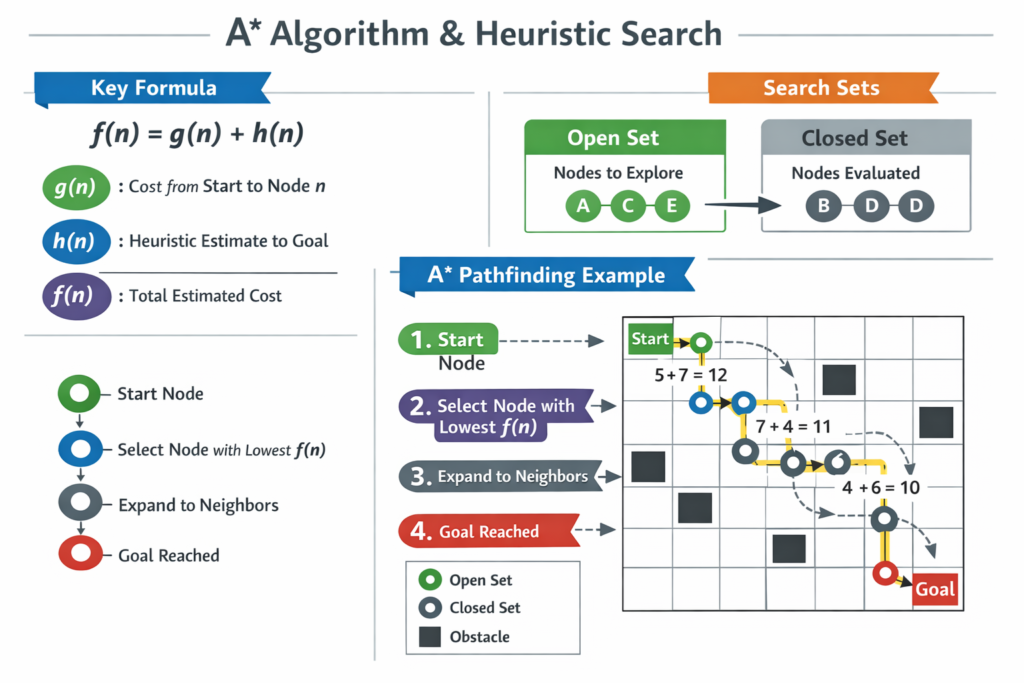
The algorithm uses the following evaluation function:
f(n) = g(n) + h(n)
Where:
- f(n) = total estimated cost of the path through node n
- g(n) = cost from the start node to node n
- h(n) = heuristic estimate from node n to the goal
This formula allows A* to balance known costs and estimated future costs, making it both efficient and accurate.
How the A* Algorithm Works
The A* algorithm operates by maintaining two main sets of nodes:
- Open Set – nodes that need to be explored
- Closed Set – nodes that have already been evaluated
The algorithm proceeds through the following steps:
Step 1: Start at the Initial Node
The starting node is added to the open set.
Step 2: Choose the Node with the Lowest f(n)
The algorithm selects the node with the lowest estimated total cost.
Step 3: Expand the Node
All neighboring nodes are evaluated and added to the open set if they appear promising.
Step 4: Update Path Costs
If a better path to a node is discovered, the algorithm updates its cost values.
Step 5: Repeat Until Goal Is Found
The process continues until the goal node is reached.
Because the algorithm always chooses the node with the lowest estimated cost, it efficiently navigates toward the goal.
Example of A* in Pathfinding
Imagine a grid map where a robot must move from one location to another while avoiding obstacles.
The algorithm evaluates each possible step by considering:
- Distance already traveled
- Estimated distance to the goal
If a particular path looks shorter overall, the algorithm prioritizes it.
This approach ensures that the robot reaches its destination using the optimal or near-optimal route, even in complex environments.
Properties of the A* Algorithm
The popularity of A* comes from several powerful properties that make it reliable for solving search problems.
Completeness
If a path to the goal exists, the algorithm will eventually find it.
Optimality
If the heuristic used is admissible (never overestimates the true cost), A* guarantees the shortest path.
Efficiency
Compared to uninformed search methods, A* significantly reduces the number of explored nodes.
These properties make it one of the most trusted algorithms in artificial intelligence.
Types of Heuristic Functions
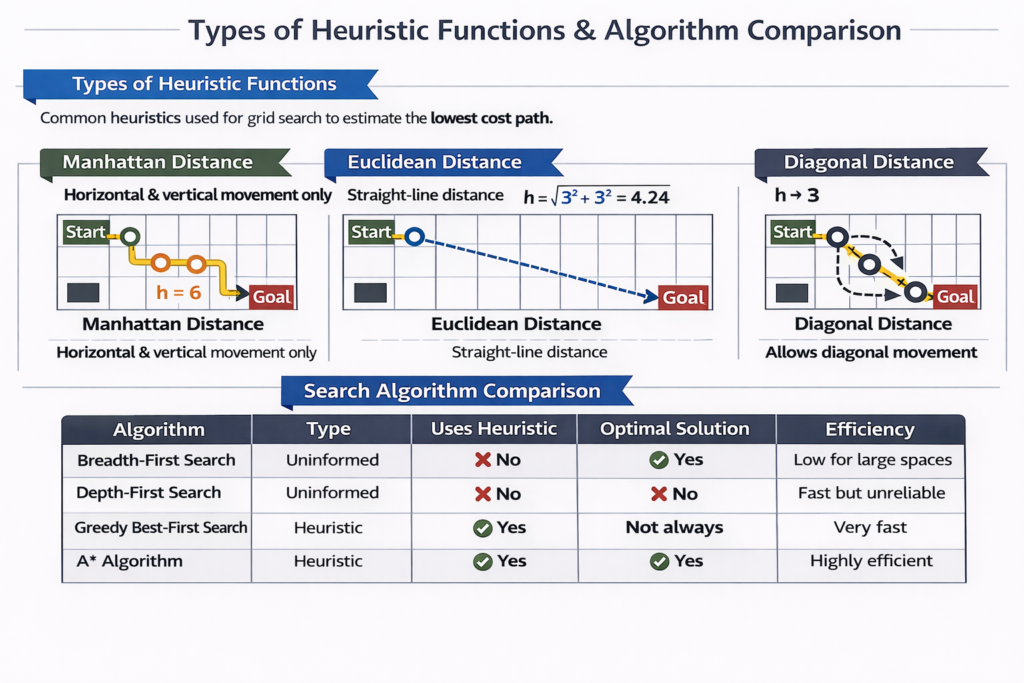
The performance of A* depends heavily on the heuristic function used. Some common heuristics include:
Manhattan Distance
Often used in grid-based maps where movement is limited to horizontal and vertical directions.
Euclidean Distance
Measures straight-line distance between two points.
Diagonal Distance
Used in grid systems where diagonal movement is allowed.
Each heuristic is chosen based on the structure of the problem.
Comparison of Search Algorithms
| Algorithm | Type | Uses Heuristic | Optimal Solution | Efficiency |
|---|---|---|---|---|
| Breadth-First Search | Uninformed | No | Yes | Low for large spaces |
| Depth-First Search | Uninformed | No | No | Fast but unreliable |
| Greedy Best-First Search | Heuristic | Yes | Not always | Very fast |
| A* Algorithm | Heuristic | Yes | Yes (with admissible heuristic) | Highly efficient |
This comparison highlights why A* is often preferred for many practical applications.
Real-World Applications of A* and Heuristic Search
Heuristic search algorithms are widely used across industries.
GPS systems compute the fastest route between locations using pathfinding algorithms similar to A*.
Robotics
Autonomous robots use heuristic search to plan safe and efficient movements.
Video Games
Game characters rely on A* to navigate complex environments and pursue objectives intelligently.
Network Routing
Internet traffic routing can use heuristic-based approaches to determine efficient communication paths.
These applications demonstrate the practical value of heuristic search methods.
Advantages and Limitations of the A* Algorithm
Although powerful, A* is not perfect.
Advantages
- Guarantees optimal solutions with proper heuristics
- Highly efficient compared to uninformed search
- Widely applicable to many problems
Limitations
- Can require large amounts of memory
- Performance depends heavily on heuristic quality
- Computational cost increases with extremely large graphs
Researchers often develop variations of A* to overcome these challenges.
The Future of Heuristic Search in Artificial Intelligence
As artificial intelligence systems grow more sophisticated, heuristic search continues to play a critical role. Modern AI techniques combine heuristic methods with machine learning and optimization algorithms to improve decision-making.
For example:
- Self-driving vehicles use advanced path planning algorithms
- Logistics companies optimize delivery routes
- AI planners automate complex decision processes
Even as AI evolves, the fundamental idea of using informed estimates to guide problem-solving remains central to intelligent systems.
Conclusion
Heuristic search represents one of the most practical strategies for solving complex problems in artificial intelligence. By guiding the search process with informed estimates, heuristics dramatically reduce computational effort while maintaining accuracy.
The A* algorithm is one of the most successful implementations of this idea. By combining the actual cost traveled with an estimated cost to the goal, it efficiently identifies optimal paths in complex environments. Its reliability, efficiency, and flexibility have made it a standard tool in fields ranging from robotics to navigation systems and video games.
Understanding heuristic search and the A* algorithm provides valuable insight into how modern AI systems make intelligent decisions. For students, professionals, and researchers, mastering these concepts enables the design of more effective algorithms to solve real-world problems.