
Introduction: Uninformed vs. Informed Search Algorithms in Artificial Intelligence
Search algorithms in are the hidden engines that power intelligent systems—from navigation and robotics to recommendation engines and strategic game-playing. Whether we realize it or not, every AI system that makes a decision is effectively searching for the best path or solution. But not all search strategies behave the same. Some explore blindly, while others navigate with foresight and precision. Understanding uninformed and informed search strategies is essential for anyone studying artificial intelligence, preparing for interviews, or building real-world AI solutions.
This guide offers a comprehensive and beginner-friendly exploration of the two foundational search categories in AI. We break down their concepts, applications, strengths, limitations, and the subtle ways they shape the intelligence of machines.
What Are Search Algorithms in Artificial Intelligence?
Search algorithms in AI are computational techniques that explore possible states, decisions, or paths to solve a problem or reach a goal. They simulate step-by-step reasoning, the way humans mentally search for answers.
AI search problems typically consist of:
- Initial state
- Actions
- Transition model
- Goal state
- Path cost
To find the best or optimal path, search algorithms analyze how states evolve based on actions, using rules or heuristics depending on the strategy.
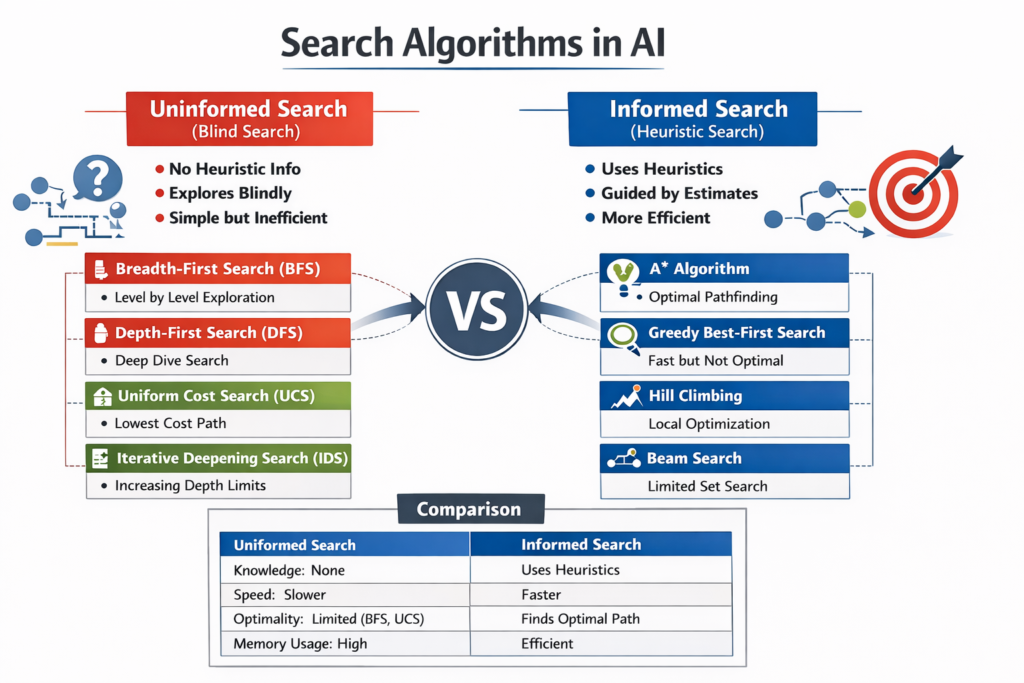
Part 1: Uninformed Search Strategies (Blind Search Methods)
Uninformed search strategies operate without any domain-specific knowledge about the goal’s location beyond what the problem definition provides. These algorithms explore the state space blindly and systematically. Because they don’t rely on extra information, they are easier to implement but often less efficient.
Below are the major uninformed strategies.
1. Breadth-First Search (BFS)
Breadth-First Search expands nodes level by level, starting from the initial node. It explores all immediate neighbors before moving deeper. BFS guarantees finding the optimal solution if all edge costs are equal.
This technique works well in scenarios where the solution lies close to the start or when minimal cost is required. However, it requires high memory because it stores all nodes at each depth, making it less suitable for large state spaces.
2. Depth-First Search (DFS)
Depth-First Search dives deep into a branch of the state space before backtracking. It uses a stack-based approach and is memory-efficient compared to BFS. Although simple, DFS does not guarantee finding the optimal solution and may get stuck in an infinite branch if loops aren’t controlled.
DFS is often useful in puzzle-solving or scenarios where exploring depth quickly might lead to a solution.
3. Depth-Limited Search (DLS)
Depth-Limited Search is a modified DFS with a depth cutoff. The algorithm avoids exceeding a certain level, preventing infinite descent. But choosing a poor depth limit could prevent the solution from being found entirely.
4. Iterative Deepening Search (IDS)
IDS combines the depth-first nature of DFS with the completeness of BFS. It repeatedly runs DLS with increasing depth. Though it seems repetitive, IDS is efficient and guarantees optimality in uniform-cost scenarios.
5. Uniform Cost Search (UCS)
Uniform Cost Search expands the node with the lowest cumulative path cost, making it ideal for weighted problems where paths have different costs. UCS always finds the least-cost path, but it is computationally heavy for huge state spaces.
Strengths of Uninformed Search
- Simple implementation
- No need for heuristic knowledge
- BFS, UCS, and IDS guarantee completeness
Limitations of Uninformed Search
- Often slow for large or complex spaces
- Memory-intensive (especially BFS)
- Less intelligent—explores blindly without guidance
Part 2: Informed Search Strategies (Heuristic Search Methods)
Informed search strategies use heuristics, meaning problem-specific knowledge that estimates the “closeness” of a state to the goal. These algorithms are far more efficient, intelligent, and widely used in real-world AI applications.
Heuristics allow the algorithm to prioritize promising paths, reducing computation time and increasing accuracy.
1. Greedy Best-First Search
Greedy Best-First Search selects the node with the lowest heuristic value (h(n)). It aims to get to the goal quickly but does not guarantee the shortest path. It can get trapped in loops or local minima, but performs very fast in many use cases like navigation and pathfinding.
2. A Search (A-star)*
A* is one of the most important search algorithms ever built. It evaluates nodes using:
f(n) = g(n) + h(n)
Where:
- g(n) = cost from start
- h(n) = heuristic estimate to goal
A* finds the optimal solution if the heuristic is admissible (never overestimates). This algorithm is used in:
- GPS navigation
- Robotics
- Games (path planning)
- Intelligent search systems
3. Iterative Deepening A* (IDA*)
IDA* merges the memory efficiency of IDS with the guided nature of A*. It performs depth-first exploration with increasing cost limits based on A* evaluations. Useful in large, complex problems like puzzle-solving or planning tasks.
4. Hill Climbing Search
Hill Climbing moves uphill by selecting the neighboring state with the highest heuristic value. Although simple and fast, it gets stuck on local maxima or plateaus. It’s used in optimization and machine learning hyperparameter tuning.
5. Beam Search
Beam Search limits the number of nodes stored at each level using a fixed-width beam. It’s efficient and widely used in NLP, especially in text generation and machine translation.
Strengths of Informed Search
- More efficient exploration
- Uses heuristics to guide decisions
- A* ensures optimality with admissible heuristics
- Used extensively in real-world AI systems
Limitations of Informed Search
- Requires good heuristics
- More complex to implement
- Poor heuristics can degrade performance
Comparison Table: Uninformed vs. Informed Search
| Feature | Uninformed Search | Informed Search |
|---|---|---|
| Knowledge Used | None (blind search) | Uses heuristics |
| Speed | Slower | Faster |
| Optimality | Only some (BFS, UCS, IDS) | A* guarantees if heuristic is admissible |
| Memory Use | Often high | Efficient with proper heuristics |
| Examples | BFS, DFS, UCS, IDS | A*, Greedy, IDA*, Hill Climbing |
| Real-World Use | Limited due to cost | Extensive use in AI applications |
| Complexity | Simpler | More complex |
Why These Algorithms Matter in Real-World AI
Search algorithms are the foundation of:
- Route planning and GPS
- Game AI (chess, Go, video-game NPCs)
- Robotics pathfinding
- Scheduling and automation
- Optimization tasks
- Information retrieval and recommendation engines
Conclusion
Both uninformed and informed search strategies play essential roles in the evolution of artificial intelligence. Uninformed search teaches the fundamentals of state exploration, while informed search represents the practical, efficient, and intelligent path forward. Combined, they form the theoretical backbone of modern AI applications, from self-driving cars to real-time decision-making systems.
Understanding these algorithms helps learners gain deeper insight into how AI systems operate—and how intelligence can be modeled, optimized, and enhanced.