Introduction
Artificial Intelligence has become the invisible engine driving everything from your smartphone’s voice assistant to global financial systems. Yet, behind this powerful technology lies an important distinction that shapes how AI behaves, what it can accomplish, and how far it can go: Strong AI Vs Weak AI. This isn’t just a technical classification—it’s the boundary between machines that simulate intelligence and those that could one day possess it.
As organizations race to integrate AI into products and workflows, and as individuals rely on AI tools for learning, creativity, business, and automation, understanding this difference is becoming essential for anyone preparing for the future. Whether you are a researcher, a student, a tech enthusiast, or an entrepreneur, knowing how strong and weak AI differ will help you make smarter decisions about adopting and leveraging AI systems.
1. Understanding the Foundation: What Is Weak AI?
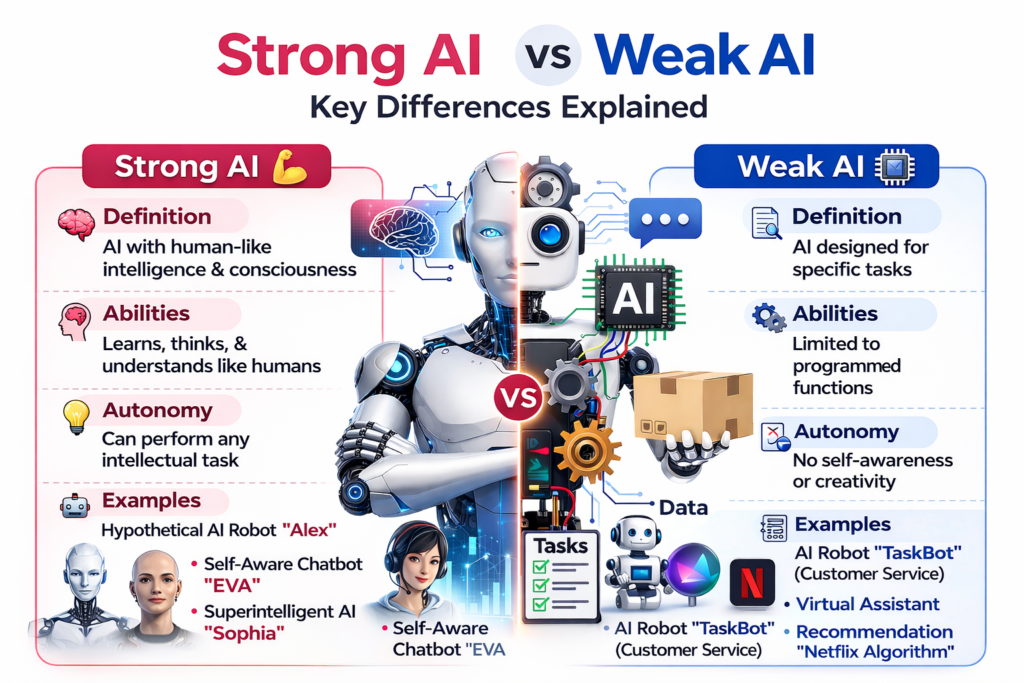
Weak AI—also known as Narrow AI—refers to artificial intelligence systems designed and trained to perform a specific task. These systems do not possess consciousness, emotions, real-world understanding, or self-awareness. They operate strictly within predefined boundaries and rules, no matter how complex or advanced they may appear. When you interact with a chatbot that answers customer queries, or when your smartphone corrects your spelling, you are experiencing Weak AI.
Weak AI systems rely entirely on algorithms, pattern recognition, supervised learning, reinforcement learning, and machine perception. They excel at repetitive and data-driven tasks and can outperform humans in tightly scoped areas like image recognition, fraud detection, or product recommendations. However, they cannot make decisions outside their programmed knowledge, nor can they reason abstractly like humans. They cannot truly “understand”—they can only compute.
Real-world examples include voice assistants, spam filters, e-commerce recommendation engines, and autonomous customer support bots. These systems can feel impressively human-like, especially with the rise of large language models, but they remain fundamentally narrow in scope.
2. What Is Strong AI? The Vision of Machines with Human-Like Intelligence
Strong AI—also known as Artificial General Intelligence (AGI)—represents a theoretical level of intelligence where machines could think, reason, understand, and learn in a manner similar to humans. Unlike Weak AI, which is bound by its programming, Strong AI would be capable of forming conscious decisions, developing self-awareness, and applying knowledge across multiple domains without being explicitly trained in each.
This type of AI would not just simulate intelligence—it would possess it.
Strong AI remains largely hypothetical, as no existing AI system has achieved this level of cognitive ability. Research labs, universities, and AI-driven enterprises continue exploring AGI through neural networks, cognitive computing models, and advanced learning systems. The journey toward Strong AI involves overcoming numerous challenges: emotional understanding, contextual reasoning, moral decision-making, and the ability to use common sense.
If developed, Strong AI could revolutionize medicine, education, engineering, governance, and creativity. It could diagnose diseases with human-like intuition, hypothesize scientific theories independently, or autonomously design cities and ecosystems.
3. Strong AI vs Weak AI: Key Differences
3.1 Level of Intelligence and Learning Scope
Weak AI functions with pre-defined logic and learns only within specific datasets and domains. For example, a facial recognition model trained on millions of images can identify faces but cannot translate languages or make business decisions. Its expertise is narrow.
Strong AI, on the other hand, would function with a human-like ability to learn continuously across diverse areas without requiring specialized training per task. Such a system could analyze a geopolitical event, compose music, and troubleshoot machinery—all with seamless cognitive flexibility.
3.2 Consciousness and Understanding
Weak AI lacks self-awareness and interpretive understanding. It cannot “feel” or “interpret” meaning; it simply processes patterns.
Strong AI would theoretically possess consciousness or at least a functional equivalent that allows it to comprehend, reason, reflect, and make value-based decisions.
3.3 Autonomy
Weak AI requires human oversight and predefined rules. Even the most sophisticated automated system ultimately depends on constraints built by human engineers.
Strong AI would make autonomous decisions based on general intelligence, much like humans operate without needing specific instructions for every task.
3.4 Adaptability
Weak AI adapts only when trained with specific data.
Strong AI would adapt dynamically—learning from real-world experience, forming its interpretations, and applying principles across contexts.
4. Real-World Examples of Weak AI
4.1 Digital Assistants
Tools like Siri or Google Assistant can schedule tasks, answer questions, and interpret voice commands. While advanced, they operate within fixed ecosystems and lack true comprehension.
4.2 Recommendation Engines
Platforms such as Netflix and Spotify use algorithms to study user preferences and suggest content. These systems process data patterns but do not understand emotional context or human taste beyond statistics.
4.3 Autonomous Vehicles
Self-driving technology interprets road environments and makes real-time decisions through sensors and machine learning models. However, despite sophisticated autonomy, these vehicles do not truly “understand” driving—they simply execute rules and predictions.
4.4 Spam Filters and Fraud Detection
Banking platforms and email providers use machine learning to identify anomalies and suspicious activities. These models perform highly specialized tasks with great precision but remain limited to their training scope.
5. Hypothetical Future Examples of Strong AI
5.1 Medical AGI Assistants
Imagine a system capable of diagnosing rare diseases, designing pharmaceuticals, predicting treatment outcomes, and explaining reasoning with human-level logic. This is the goal of Strong AI in healthcare.
5.2 Cognitive Robotics
Robots capable of emotional understanding, ethical reasoning, and general cognitive functioning could perform tasks that require empathy—such as elderly care, therapy support, or personal companionship.
5.3 Autonomous Scientific Discovery
Strong AI could independently run experiments, form hypotheses, and accelerate scientific breakthroughs decades faster than human researchers alone.
5.4 Superintelligent Governance Models
AGI could analyze economic data, historical patterns, and real-time conditions to propose optimized policies for cities and countries.
6. Use Cases: Strong AI vs Weak AI in Action
6.1 Business and Industry
Weak AI drives automation, predictive analytics, lead generation, customer classification, and sales recommendations. Most business AI tools today—CRM automation, chatbot support, lead scoring systems—fall under this category.
Strong AI, if realized, could act as a virtual CEO, making strategic decisions, forecasting markets, designing business models, and optimizing operations in real time.
6.2 Education
Weak AI is used in adaptive learning platforms that customize courses based on student performance.
Strong AI could provide personalized tutoring with human-like reasoning, emotional sensitivity, and expertise in learning psychology.
6.3 Healthcare
Weak AI helps analyze X-rays, predict disease progression, and automate administrative tasks.
Strong AI would integrate medical knowledge, emotional intelligence, and ethical decision-making to assist in real-time clinical judgment.
6.4 Creativity
Weak AI can generate text, images, music, and design templates—but without emotional understanding or original intent.
Strong AI would be capable of producing art with meaning, context, and self-driven creativity.
7. The Ethical and Philosophical Divide
Weak AI raises concerns about data privacy, algorithmic bias, job displacement, and fairness. These issues are significant but manageable.
Strong AI, though still theoretical, raises deeper questions:
- Should machines have rights?
- Can a machine be considered conscious?
- What happens if AGI surpasses human intelligence?
- How do we establish safe boundaries for self-aware systems?
These questions continue to fuel debate among AI researchers, ethicists, and global policymakers.
8. Which One Matters Today?
Weak AI powers nearly all modern AI tools and industries. It is the foundation of digital transformation and will continue evolving with more powerful models, automation techniques, and domain-specific capabilities.
Strong AI, while a future concept, remains the guiding vision for long-term innovation. The gap between the two is closing gradually, but it will take massive breakthroughs in reasoning, cognition, and machine understanding before AGI becomes a reality.
Also Read: How Artificial Intelligence Actually Works -Explained Simply
Also Read: What is a Neural Network? Explained Simply