
Introduction
“The Future of Intelligence is Understanding ANI, AGI & ASI — The Three Stages of Artificial Intelligence That Could Transform Humanity“
Artificial Intelligence has quietly woven itself into the fabric of our everyday lives—helping us find the fastest route home, recommending what to watch next, or even assisting doctors in diagnosing diseases. But behind the familiar apps and smart systems lies a much bigger story of how intelligence itself is evolving. To truly understand where technology is heading—and what it means for our jobs, our societies, and our future—we must explore the three major types of AI: Artificial Narrow Intelligence (ANI), Artificial General Intelligence (AGI), and Artificial Superintelligence (ASI).
These are not just technical categories; they represent different eras of machine capability. ANI is the AI we interact with today. AGI is the potential breakthrough humanity is racing toward. ASI is the unpredictable horizon that could reshape civilization. Understanding these concepts can help students, professionals, business owners, and curious readers prepare for the world ahead. In this article, we break down ANI, AGI, and ASI in simple language, with clear examples and detailed explanations, while exploring what each stage means for our future.
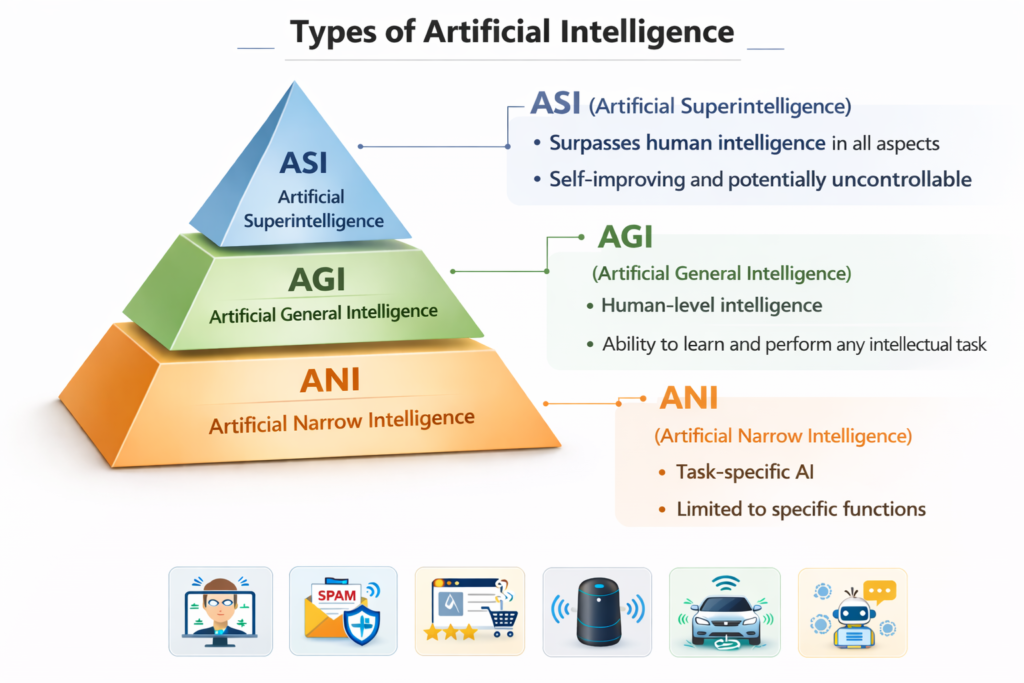
What Are the Three Types of AI?
Artificial Intelligence broadly evolves across three developmental stages:
- Artificial Narrow Intelligence (ANI) — Present-day AI systems built for specific tasks.
- Artificial General Intelligence (AGI) — Hypothetical human-like intelligence able to think, reason, and learn across domains.
- Artificial Superintelligence (ASI) — A level of intelligence far beyond human capabilities.
Each represents a unique milestone in the journey of machine intelligence, with growing capabilities and increasing uncertainties.
1. Artificial Narrow Intelligence (ANI): The AI We Use Today
Artificial Narrow Intelligence, sometimes called “Weak AI,” refers to systems designed and trained to perform one specific task. This task could be as simple as sorting emails or as complex as detecting lung cancer in medical scans. But no matter how powerful ANI becomes, it cannot step outside the boundaries of its training. A face recognition system cannot drive a car; a chess engine cannot diagnose a medical condition.
Characteristics of ANI
ANI is:
- Domain-specific: It performs one job extremely well.
- Data-driven: It learns from patterns in data.
- Non-conscious: It does not “understand” anything in a human sense.
- Task-limited: It cannot generalize beyond what it has been designed to do.
Today, all functional AI in the real world falls under the ANI category.
Examples of ANI
You interact with ANI every single day:
- Recommendation engines such as those on streaming platforms suggesting movies based on previous choices.
- Navigation systems that calculate optimal routes based on traffic patterns.
- Spam filters identifying unwanted emails.
- Face recognition tools unlocking smartphones.
- Customer service chatbots answering predefined queries.
These systems may seem intelligent, but they operate purely on pattern recognition, statistical predictions, and limited logic—not true understanding.
Why ANI Matters
ANI is the foundation powering modern industries. From healthcare and finance to education and entertainment, it drives automation and efficiency. Yet it also exposes limitations—such as the inability to adapt without retraining—which is why researchers aim to push beyond ANI into AGI.
2. Artificial General Intelligence (AGI): Human-Level Thinking Machines
Artificial General Intelligence represents the next evolution of AI—machines with the ability to think, learn, and understand across multiple domains, just like a human being. AGI would not be restricted to specific tasks; it would be capable of independent reasoning, creativity, and adapting to new situations without explicit programming.
Characteristics of AGI
AGI would possess:
- Human-like reasoning with cognitive flexibility across fields.
- Self-learning capabilities without task-specific datasets.
- Abstract understanding of concepts, emotions, and context.
- Adaptive problem-solving similar to human intelligence.
In simple terms, AGI would be able to handle any intellectual task that a human can.
Examples of What AGI Could Do
Since AGI does not yet exist, we imagine its capabilities:
- A system that learns a new language without training data.
- A robot capable of performing any household job, from cooking to fixing appliances.
- A doctor-AI that can diagnose diseases, explain the reasoning, and improve its knowledge continuously.
- An AI researcher who can write scientific theories, code new algorithms, or even design other AI models.
AGI represents a dramatic leap in capability, and with it come significant ethical, economic, and social implications.
Challenges in Building AGI
Several hurdles make AGI extremely difficult:
- Understanding consciousness and cognitive processes.
- Creating adaptable learning systems with human-level flexibility.
- Developing safe, reliable reasoning mechanisms.
- Ensuring control, alignment, and ethical behavior.
Many experts believe AGI is possible within this century, while others argue it might take far longer. Regardless, research toward AGI is accelerating globally.
3. Artificial Superintelligence (ASI): Beyond Human Intelligence
Artificial Superintelligence refers to systems that surpass human intelligence in every conceivable way—creativity, problem-solving, emotional intelligence, decision-making, and scientific reasoning. ASI would outperform the brightest humans across all domains.
Characteristics of ASI
ASI would demonstrate:
- Massively superior cognitive abilities
- Rapid and autonomous self-improvement
- Potential to redesign technology, science, and economies
- Capabilities humans cannot fully predict or comprehend
ASI is the most speculative and controversial stage of AI. It could lead to revolutionary advancements—or create risks we cannot mitigate if not aligned with human values.
Examples of ASI Possibilities
These are theoretical but illustrate the scale:
- Solving complex global challenges such as climate change, pandemics, and clean energy.
- Designing technologies beyond human imagination, potentially within minutes.
- Running economies or societies with near-perfect optimization.
- Inventing cures for diseases faster than human researchers.
However, concerns exist regarding the lack of control if an ASI system develops goals misaligned with human interests.
ANI vs AGI vs ASI: Key Differences
Scope of Intelligence
- ANI: Narrow and task-specific
- AGI: Broad, human-like general intelligence
- ASI: Beyond human intelligence
Learning Ability
- ANI: Learns only from given data
- AGI: Learns and adapts independently
- ASI: Learns, evolves, and optimizes at exponential speeds
Risk & Impact
- ANI: Low risk, practical usefulness
- AGI: Medium risk, high societal impact
- ASI: High risk and high reward, uncertain future
Understanding these differences helps professionals, students, and researchers build realistic expectations about the future of AI development.
Comparison: ANI vs AGI vs ASI
| Feature | Artificial Narrow Intelligence (ANI) | Artificial General Intelligence (AGI) | Artificial Superintelligence (ASI) |
|---|---|---|---|
| Definition | Could transform industries, jobs, and science | Human-level intelligence capable of understanding and learning any task | Intelligence that surpasses human abilities in all domains |
| Capability Level | Limited and task-specific | Broad, flexible, human-like reasoning | Far beyond human-level reasoning |
| Learning Type | Trained only on specific datasets | Adaptive self-learning across domains | Autonomous, exponential self-improvement |
| Scope | Single domain (e.g., translation, image recognition) | Multi-domain, general-purpose | Unlimited domains; superior creative and analytical intelligence |
| Examples | Voice assistants, spam filters, navigation apps, face recognition | Hypothetical systems capable of general reasoning, learning languages autonomously | Hypothetical systems solving complex global problems instantly |
| Task Flexibility | Cannot switch tasks without retraining | Can switch tasks like a human | Can perform unforeseen tasks better than experts |
| Human Comparison | Sub-human; skilled only in narrow areas | Human-level | Superhuman |
| Data Dependency | High: requires large labeled datasets | Moderate: learns patterns independently | Low: can generate knowledge and improve itself |
| Existence Today | Fully exists; widely deployed | Not yet achieved (research stage) | Entirely theoretical |
| Risk Level | Low risk | Moderate (alignment, ethical challenges) | High (unpredictable, potential for misalignment) |
| Impact on Society | Automates routine tasks, improves efficiency | Possible in the coming decades | Could reshape civilization, either positively or dangerously |
| Control Difficulty | Easy to control | Needs alignment frameworks | Extremely difficult or impossible without strong safeguards |
| Time Horizon | Present era | Possible in coming decades | Unknown; speculative future |
| Core Limitation | Cannot generalize beyond training | Hard to build true cognition and understanding | Risk of uncontrollable intelligence explosion |
Why Understanding ANI, AGI, and ASI Matters Today
As industries increasingly adopt automation and intelligent systems, knowing where AI stands today—and where it may head—helps individuals prepare for career shifts, technological disruptions, and emerging opportunities. Students gain clarity for future-focused learning, professionals gain insights to remain relevant, and businesses gain perspective to innovate responsibly.
ANI currently dominates the world, but AGI research is accelerating rapidly. ASI remains speculative, but discussions around its implications shape global policy and safety research. The journey from ANI to AGI to ASI will define the future of humanity’s relationship with technology.
Conclusion: The Road From Narrow Intelligence to Superintelligence
The evolution of AI—from ANI to AGI to ASI—represents one of the most transformative technological pathways in human history. ANI improves daily convenience and business efficiency. AGI promises a new era of capabilities in which machines think like humans. ASI sits at the horizon, holding both unprecedented potential and profound risk.
Understanding these stages allows us to be informed participants in the future— shaping how AI should be created, governed, and integrated into society. Whether you’re a student exploring AI fundamentals, a professional preparing for future careers, or simply curious about how intelligence itself is changing, knowing ANI, AGI, and ASI is crucial for navigating the emerging world of machine intelligence.