
What is a Neural Network? Explained Simply
In the age of artificial intelligence and deep learning, neural networks have become a buzzword, often associated with breakthroughs in technology. But what are neural networks, and how do they truly work? If you’ve ever wondered how machines seem to ‘think’ and make decisions autonomously, you’re in the right place. We’ll dive deep into the fundamentals of neural networks, breaking down complex concepts into simple, digestible insights. Whether you’re a curious novice or seeking to leverage a neural network for practical applications, this guide will equip you with the essential knowledge.
Introduction to Neural Networks
Have you ever been puzzled by how Google Assistant recognizes your voice or how Facebook suggests exactly the person you were thinking about tagging? These features are powered by a neural network, a core component of artificial intelligence. A neural network is a series of algorithms that aim to recognize underlying relationships in a set of data through a process that mimics the way the human brain operates. This concept, though rooted in complex computing, has a simple analogy – our brains. Just as our brain consists of neurons, a neural network consists of nodes, each serving a specific function.
The importance of neural networks in today’s digital landscape cannot be overstated. They’re present in everything from voice-activated assistants to predictive text, powering innovations across various industries. By understanding how these systems function, you not only gain insights into the bleeding edge of tech but also position yourself to harness these tools effectively. We’ll explore what neural networks are made of, their functioning, and why they are revolutionary in solving complex tasks that traditional algorithms struggle with.
Breaking Down the Components of Neural Networks
Understanding Neurons
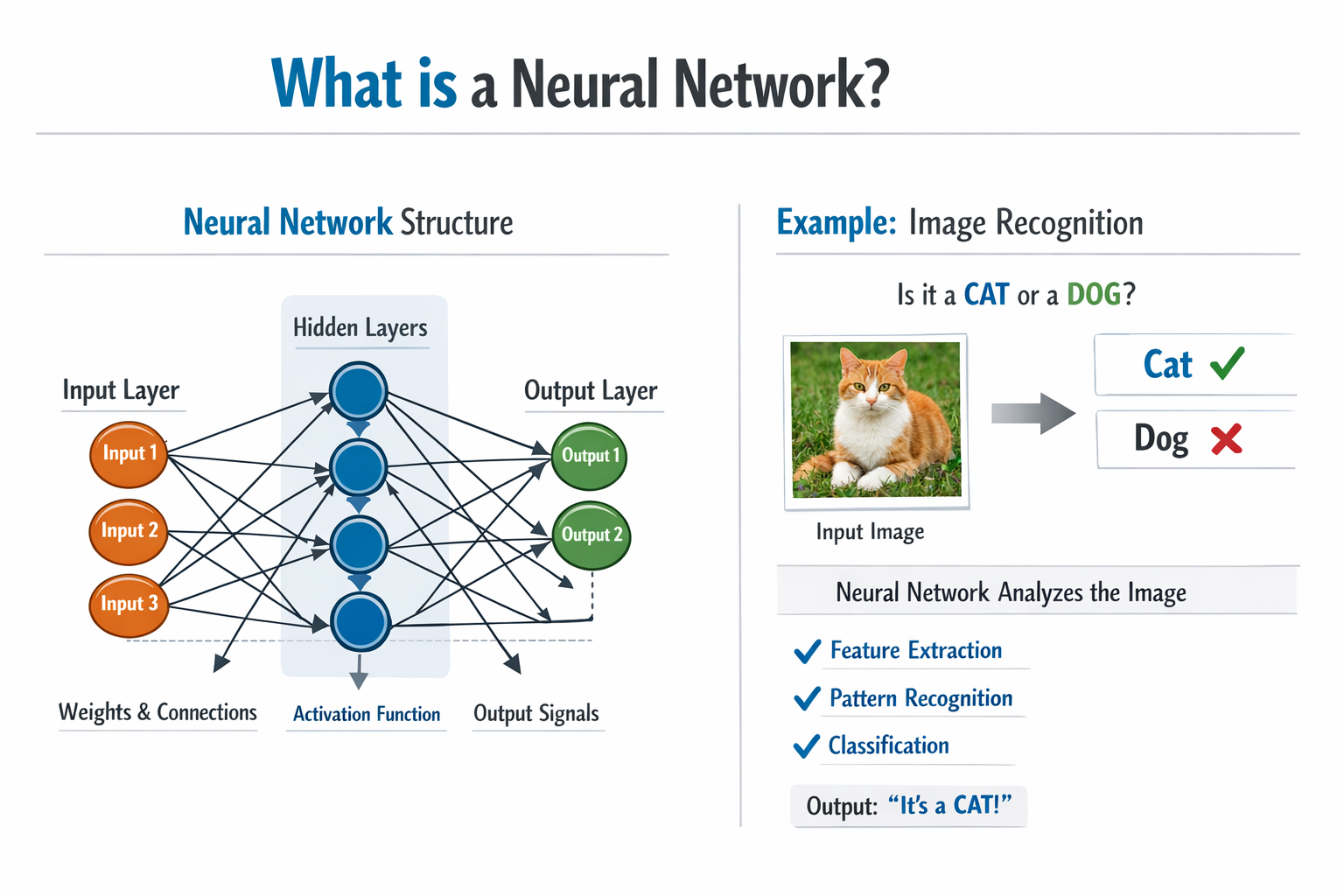
At the heart of a neural network are neurons, also known as nodes or units. These are the fundamental processing unit, resembling the neurons in a biological brain. A neuron in an artificial neural network receives a set of inputs, performs operations on these inputs, and produces an output. The operation involves applying a mathematical function called an activation function, which determines the neuron’s output.

For example, if you consider a neuron as a small factory: inputs are raw materials, the activation function represents the machinery, and the output is the final product. The power of neurons lies in their ability to work collectively, forming complex systems capable of recognizing patterns much like humans do. This cooperative process allows neural networks to perform tasks ranging from image recognition to language translation.
Exploring Layers: The Structural Backbone
Neurons are organized into layers, and these layers are the building blocks of a neural network. Typically, neural networks are made up of three types of layers: the input layer, the hidden layers, and the output layer. Every layer has specific roles, with neurons in the input layer accepting initial data, neurons in hidden layers processing the data, and neurons in the output layer presenting the result.
The hidden layers are particularly important; these are where the magic happens. Hidden layers transform inputs into something meaningful for the network’s task through multiple linear and non-linear iterations. Think of it as a chef who converts raw ingredients into a gourmet dish. The number of hidden layers and the neurons within each significantly influence the network’s capability in learning complex patterns.
The Role of Weights and Biases
A vital part of how neural networks function is the concept of weights and biases. Weights determine the strength and influence of each input into a neuron, while biases provide additional flexibility, allowing the activation function to be shifted. Both of these elements are adjusted during the network’s training process, optimizing the output accuracy.
Consider weights and biases as the knobs and levers in an old-fashioned radio. By adjusting these, the neural network tunes itself to achieve the best output, akin to finding the clearest station signal. This optimization process, called training, is the backbone of a network’s learning capabilities, enabling it to improve performance over time.
How Artificial Neural Networks Work
The Training Phase: Learning from Data
Training a neural network involves providing it with a dataset to learn from. This process is where deep learning truly shines. A commonly used method for training is supervised learning, where a network learns from labeled data. For instance, if the network is supposed to recognize cats and dogs in pictures, labeled images featuring these animals are provided as training data.
The network adjusts its weights and biases through backpropagation, a method that calculates errors by comparing the predicted output with the actual outcome and then propagates these errors backward through the network. This iterative adjustment is akin to sculpting, where the rough figure gets refined progressively.
Activation Functions: Bringing Neurons to Life
Activation functions are pivotal as they introduce non-linearity into the network, allowing neurons to learn and model complex data. Without activation functions, the neural network would behave like a simple linear perceptron, unable to handle intricate tasks.
Popular activation functions include sigmoid, tanh, and ReLU (Rectified Linear Unit). Each serves different purposes depending on the network architecture and the complexity of tasks. For example, ReLU, which transforms negative values to zero and maintains positive values, is widely used in hidden layers due to its efficiency and simplicity.
Real-World Applications of Neural Networks
Enhancing Computer Vision
One of the most profound applications of neural networks is in computer vision. Through neural networks, computers can be trained to recognize and interpret visual information just as humans do. Technologies such as facial recognition and autonomous driving heavily rely on these capabilities.
Consider self-driving cars: they process multiple data inputs, including road signs, obstacles, and pedestrians, to make split-second decisions. Neural networks empower these vehicles to understand and respond to dynamic environments, ensuring safety and efficiency.
Revolutionizing Natural Language Processing
Neural networks are also driving advancements in natural language processing (NLP), enabling machines to understand and generate human language. This is evident in applications like chatbots, sentiment analysis, and language translation services.
For instance, Google’s translation service uses neural network-based models to provide fluent and contextually accurate translations across languages. This ability to parse and generate language makes these models indispensable in global communication and commerce.
Challenges and Considerations
Data Dependency and Resource Intensity
While neural networks are powerful, they are not without challenges. A significant hurdle is their data dependency. Neural networks require vast amounts of data to deliver precise outputs. This necessity can be limiting, especially for smaller enterprises lacking access to large datasets.
Furthermore, the training process of neural networks is resource-intensive, often requiring specialized hardware like GPUs to manage the computational demands. This can translate into increased costs and accessibility barriers, particularly in developing regions.
Interpreting Neural Network Decisions
The issue of interpretability is another challenge. Neural networks, especially deep learning models, often function as ‘black boxes’, making it difficult to understand how they arrive at specific decisions. This complexity can hinder trust and reliability, particularly in applications like medical diagnoses or financial predictions where explanations are crucial.
Future of Neural Networks
Emerging Trends and Innovations
The landscape of neural networks is evolving, with new architectures such as Transformer models revolutionizing fields like NLP. These models, designed to handle sequential data, have led to breakthroughs in machine translation and sentiment analysis by leveraging attention mechanisms to focus on context-specific data efficiently.
Moreover, ongoing research is focused on improving the interpretability and efficiency of neural networks, with innovations like explainable AI gaining traction. These advancements promise to make neural networks more accessible and trustworthy, broadening their applicability across industries.
Practical Steps for Businesses
For businesses eager to integrate neural networks, the first step involves understanding their specific problem and determining how neural networks can provide a solution. It’s crucial to incorporate a strategic data collection and preparation process.
Engaging with data scientists or AI specialists can be valuable, providing the expertise needed to navigate the technical complexities and ensure the successful implementation of neural networks. Collaboration and continuous learning are key to staying ahead in this rapidly evolving technological frontier.
Conclusion: Expanding the Horizons of Technology
From enhancing everyday conveniences to pioneering new frontiers in technology, neural networks are at the heart of modern digital transformation. Understanding these complex systems equips individuals and businesses with a powerful toolset to innovate and address diverse challenges. As the technology evolves, the potential applications of neural networks will continue to expand, unlocking opportunities we are only beginning to imagine.
With this newfound knowledge, you can explore the possibilities within AI, develop solutions that capitalize on neural networks, and ultimately, embrace the future of intelligent technology. Whether you aim to implement neural networks in a business context or simply marvel at their capabilities, this understanding provides a foundation to engage with the profound impacts of this evolving field.