Introduction
The future of work is unfolding faster than anyone expected. Every day, artificial intelligence moves closer to becoming not just a tool but a collaborator—a digital teammate that thinks, assists, generates, and even anticipates what humans need before they ask.
As businesses race to adopt advanced automation platforms, generative models, and intelligent assistants, a quiet revolution is happening inside offices, factories, studios, and remote workspaces worldwide. This shift isn’t about replacing people—it’s about transforming how we work, what tasks we do, and how human-AI collaboration will redefine productivity, creativity, and innovation.
In this deep-dive article, we explore how collaborative AI is reshaping jobs, what emerging roles will dominate the next decade, and how professionals can prepare for this new era of hybrid teamwork.
What Is Collaborative AI?
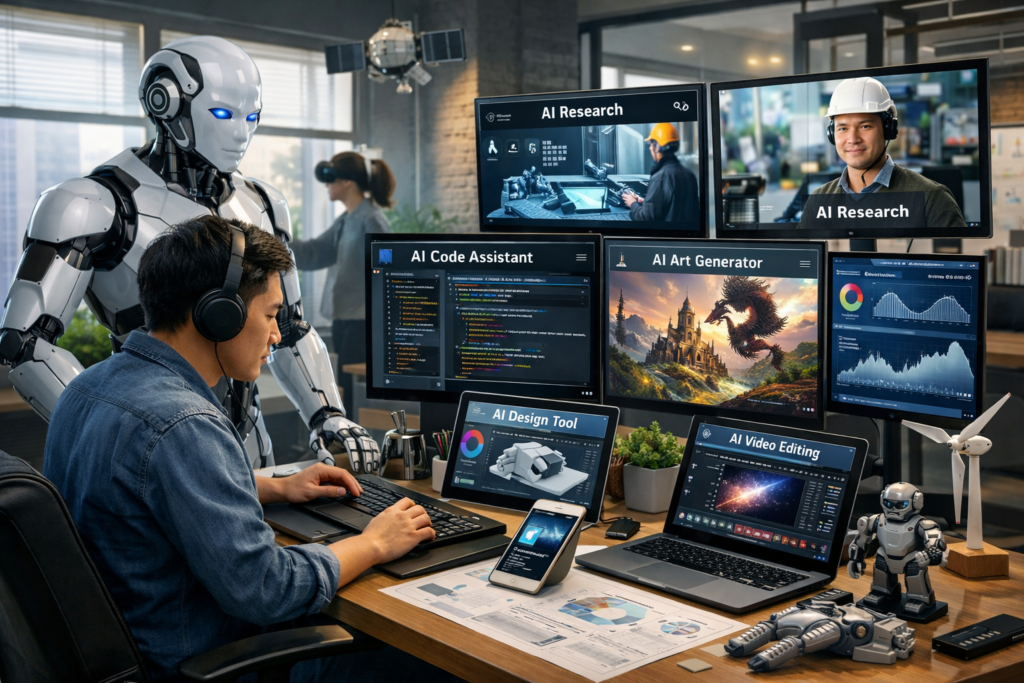
Collaborative AI refers to intelligent systems designed to work alongside humans rather than independently. Unlike traditional automation—built to replace repetitive tasks—collaborative AI enhances human abilities by analyzing complex data, generating insights, and handling cognitive workloads that were once manually exhausting. Companies like OpenAI, Google, and Microsoft are investing heavily in this area, creating models that can learn in real time, adapt to different work contexts, and collaborate across multiple tools and workflows.
Where older AI focused on efficiency, today’s collaborative AI prioritizes partnership. It helps marketers brainstorm ideas, assists engineers in debugging, supports customer teams, and even collaborates in research and design. The shift is profound: instead of viewing AI as a competitor, companies are now embracing it as a colleague that amplifies human potential.
Why AI Is Becoming a Workplace Teammate
Collaborative AI is emerging as a teammate because modern work is increasingly complex and fast-paced. Traditional workflows rely heavily on manual analytics, time-consuming content creation, and inefficient decision-making. AI accelerates every stage of this process by offering predictive insights, rapid content generation, and intelligent task suggestions that keep projects moving forward.
With tools like generative AI platforms, business automation suites, and AI-powered analytics dashboards, employees can focus on meaningful work rather than tedious tasks.
Moreover, companies want AI that can integrate into existing team structures—not fully replace them. AI teammates don’t take jobs; instead, they take tasks, freeing professionals to work smarter, faster, and more creatively. For industries like healthcare, education, marketing, finance, and logistics, this means new opportunities for human-AI collaboration that were previously unimaginable.
How AI Is Transforming Workflows Across Industries
1. Content & Marketing Teams
In creative industries, AI is becoming a brainstorming buddy, campaign strategist, and execution assistant. Writers use AI to draft long-form content while marketers use it to generate audience insights. AI-powered automation tools like Zapier, Make, Notion AI, etc., seamlessly integrate with content schedulers and email systems.
Professionals can now reduce planning time by using AI-powered research platforms or AI-enhanced SEO optimization tools like keyword analyzers or rank trackers.
2. Customer Support & Service
Customer support teams are adopting AI co-pilots capable of analyzing sentiment, summarizing conversations, and recommending ideal responses. AI assistants connect with CRM platforms such as those developed by IBM to offer real-time support, give agents contextual suggestions, and improve customer satisfaction rates significantly.
3. Software Development
Developers are experiencing a massive shift. AI writing assistants help generate code, review security vulnerabilities, and auto-fix bugs. Technical teams can run faster workflows by integrating AI debugging platforms or task-automation tools like continuous integration enhancements and auto-testing suites.
4. Operations, Logistics & Manufacturing
In the industrial world, AI-powered robots work alongside humans to handle complex tasks such as predictive maintenance, advanced robotics collaboration, and warehouse automation. Companies like Boston Dynamics are pushing boundaries with collaborative robots that learn from human tasks and adapt to environments, creating a seamless hybrid work setting.
5. HR & Recruitment
AI is also heavily reshaping human resources. Intelligent systems can scan thousands of résumés in seconds, identify best-fit candidates, assist with onboarding, and help HR teams maintain engagement through predictive analytics. Teams now integrate platforms that automate hiring and skill assessments using tools like HireVue, GreenHouse Hiring Automation, Workable, etc.
New Job Roles Emerging in AI-Augmented Workplaces
AI Workflow Architects
These professionals design how humans and AI collaborate inside an organization. They map out workflows, connect automation tools, and ensure AI systems complement human tasks.
Prompt Engineers
With the rise of generative AI, prompt engineers specialize in writing structured prompts that produce accurate, context-rich outputs. They are essential for industries relying on creative generation, predictive modeling, or AI-driven customer communication.
AI Ethics & Trust Officers
As AI grows, so does the need for oversight. Companies are hiring professionals to ensure responsible, ethical deployment of AI—protecting consumer rights, eliminating algorithmic bias, and maintaining compliance with global AI regulations.
AI-Integrated Project Managers
Project managers are evolving into coordinators of human-AI collaboration. They use intelligent dashboards to assign workloads and analyze progress while ensuring human creativity remains central.
Automation Analysts & Engineers
These roles focus on analyzing workflows, identifying automation opportunities, and building AI-powered pipelines that improve operational efficiency.
How Professionals Can Prepare for AI as a Teammate
1. Learn AI-Compatible Skills
Employees must develop skills that complement AI, such as strategic thinking, creativity, emotional intelligence, critical analysis, and domain expertise. Machines excel at data—but humans excel at judgment.
2. Adopt AI Tools Early
Early adopters gain a competitive edge. Start using platforms offering AI-assisted writing, data analysis, video generation, or business automation. These tools not only save time but also provide hands-on experience that will be crucial in the future of work.
3. Build Adaptability
Professionals should sharpen their ability to learn new workflows quickly. Every year, businesses upgrade to new AI systems, and those who adapt fastest will benefit the most.
4. Cultivate a Human-Centered Mindset
No matter how smart AI becomes, humans remain essential for empathy, creativity, leadership, and innovation. AI will enhance—not replace—these human capabilities.
Challenges of AI Collaboration
1. Data Privacy & Bias
AI systems are only as fair as the data they’re trained on. Without proper oversight, biases may appear. This is why AI governance roles and strong compliance frameworks are gaining importance.
2. Skills Gaps
Many professionals fear AI because they lack training. Bridging this skills gap requires investment in learning, reskilling, and AI literacy.
3. Overdependence on Automation
People sometimes rely too heavily on AI systems. The future requires maintaining a balance, ensuring that human intuition remains at the core of decision-making.
The Future: AI Will Be a True Teammate, Not a Competitor
The future workplace will not pit humans against robots or algorithms. Instead, it will cultivate a hybrid environment where AI automates what humans dislike—repetition and complexity—while humans focus on what AI cannot do: innovate, empathize, imagine, and lead. As AI systems integrate more deeply into daily tools and workflows, they will become trusted teammates who accelerate business success across industries.
The question is no longer if AI will join your team—but how prepared will you be to collaborate with it?
Also Read: How AI Is Transforming Education in 2026: A New Era of Learning, Teaching & Human Connection