Introduction
Imagine speaking to a machine that not only understands your words but senses your frustration, excitement, hesitation, or joy. Not because you explicitly state it—but because your tone, rhythm, pitch, and subtle vocal tremors reveal it. Welcome to the world of AI-powered Speech Emotion Recognition (SER)—where artificial intelligence doesn’t just process language, it interprets human emotion.
As voice assistants, virtual therapists, customer service bots, and AI companions become more integrated into daily life, the ability for machines to detect emotion is no longer a luxury—it’s a necessity. In this deep-dive guide, we’ll explore how AI listens, how it processes speech signals and natural language, and how advanced deep learning models combine NLP and audio features to decode human emotion with remarkable precision.
What Is Speech Emotion Recognition (SER)?
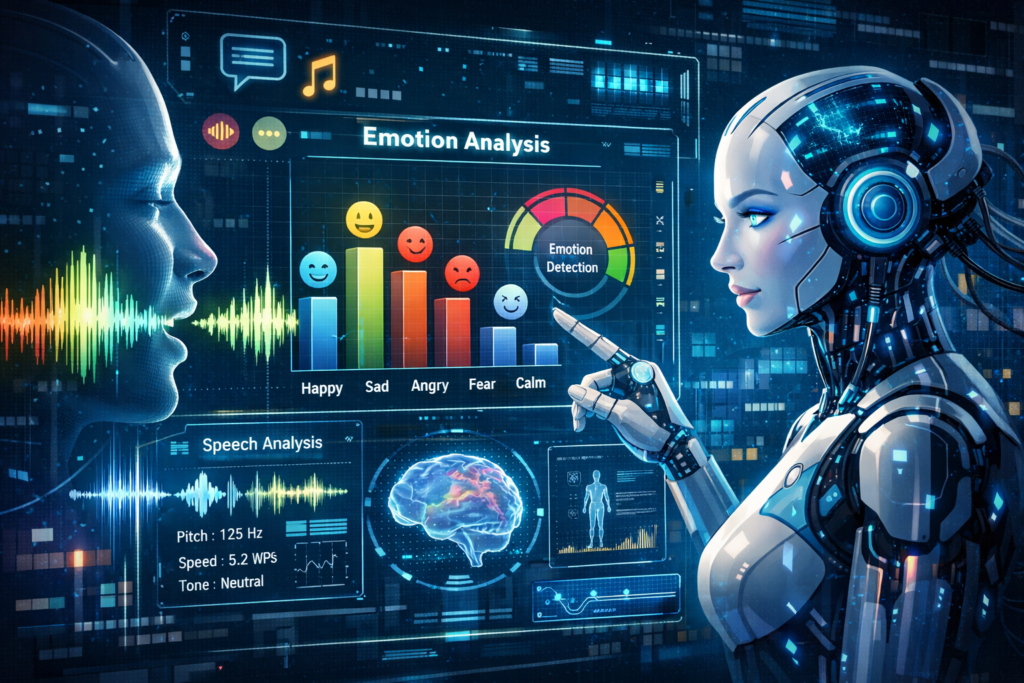
Speech Emotion Recognition (SER) is a subfield of artificial intelligence that focuses on identifying emotional states from spoken language. Unlike traditional speech recognition systems that convert audio into text, SER goes further. It analyzes how something is said, not just what is said.
Emotions such as happiness, sadness, anger, fear, surprise, and neutrality can be detected using a combination of:
- Acoustic features (tone, pitch, volume, tempo)
- Linguistic features (word choice, sentence structure)
- Contextual patterns (conversation flow, semantic meaning)
Modern systems combine signal processing techniques with machine learning and deep learning architectures such as Convolutional Neural Networks (CNNs), Recurrent Neural Networks (RNNs), and Transformers.
Why Emotion Detection in Speech Matters
The ability to interpret emotional cues opens up transformative applications across industries:
- Customer Support: Detecting frustration in real-time allows AI agents to escalate calls or adjust tone.
- Healthcare & Mental Health: Voice emotion analysis can assist in depression or anxiety monitoring.
- Education Technology: AI tutors can adapt teaching styles based on learner stress levels.
- Human-Computer Interaction: Emotional awareness creates more natural AI experiences.
- Automotive Safety: Detecting stress or fatigue in drivers enhances road safety systems.
Emotion-aware AI enhances personalization, empathy simulation, and real-time decision-making in voice-driven applications.
The Science Behind Emotional Signals in Speech
Human speech carries emotional signals through multiple acoustic layers. Before AI can interpret emotion, it must first process raw audio data.
1. Acoustic Features (Audio Signal Processing)
Emotion often manifests in measurable vocal attributes. Key features include:
- Pitch (Fundamental Frequency): High pitch often correlates with excitement or fear.
- Energy/Intensity: Loudness variations can signal anger or enthusiasm.
- Speech Rate: Fast speech may indicate stress; slow speech may indicate sadness.
- Formants: Resonance frequencies that shape vowel sounds.
- Mel-Frequency Cepstral Coefficients (MFCCs): Widely used features that represent the short-term power spectrum of sound.
MFCCs are particularly important in speech analysis. They transform audio into a representation aligned with human auditory perception, making it easier for machine learning models to process.
If you want to explore hands-on feature extraction and audio modeling, platforms like DeepLearning.AI’s Speech Processing Specialization provide structured learning paths.
2. Linguistic Features (Natural Language Processing)
While tone carries emotional cues, the words themselves also convey sentiment and emotional context.
For example:
- “I’m fine.” → Neutral text, but tone may imply sarcasm or sadness.
- “I’m so thrilled!” → Linguistic markers of happiness.
NLP models analyze:
- Sentiment polarity (positive, negative, neutral)
- Emotion classification (joy, anger, fear, etc.)
- Semantic context
- Word embeddings (Word2Vec, GloVe, BERT)
Modern Transformer-based models such as BERT or GPT-style architectures encode contextual meaning, allowing emotion detection at a deeper semantic level.
You can experiment with pre-trained emotion detection models on platforms like Hugging Face, which host numerous speech and NLP models.
Multimodal Emotion Detection: Combining Audio + Text
The most advanced emotion recognition systems use multimodal learning, combining:
- Audio signals (prosody and acoustic features)
- Text transcripts (semantic analysis)
- Sometimes even facial expressions (video data)
Why combine modalities?
Because emotion is complex. Sarcasm, for instance, may not be detectable through text alone. Tone reveals hidden emotional layers that text might obscure.
Multimodal architectures often use:
- CNNs for audio spectrogram analysis
- RNNs or LSTMs for temporal speech patterns
- Transformer models for contextual text understanding
- Attention mechanisms to weigh relevant features
By fusing multiple streams of data, these systems achieve significantly higher accuracy.
The Deep Learning Architectures Powering Emotional AI
Convolutional Neural Networks (CNNs)
CNNs process speech spectrograms (visual representations of audio signals). They detect patterns in frequency and time, similar to image recognition models.
Recurrent Neural Networks (RNNs) and LSTMs
Since speech is sequential data, RNNs and LSTMs capture temporal dependencies. Emotional tone often evolves across a sentence, making time-aware models essential.
Transformer Models
Transformers revolutionized NLP and are increasingly used in speech modeling. Self-attention mechanisms allow models to capture long-range dependencies in both audio and text.
Courses such as Coursera’s NLP Specialization provide structured guidance for mastering these architectures.
Step-by-Step: How AI Detects Emotion from Speech
Let’s break down the process:
Step 1: Audio Collection
Speech is recorded through a microphone or call system.
Step 2: Preprocessing
Noise removal, normalization, silence trimming, and segmentation are applied.
Step 3: Feature Extraction
MFCCs, chroma features, spectral contrast, and pitch-related metrics are computed.
Step 4: Text Transcription (Optional)
Automatic Speech Recognition (ASR) converts speech to text.
Step 5: Model Inference
Deep learning models analyze acoustic + textual features.
Step 6: Emotion Classification
Output labels such as “happy,” “angry,” “sad,” or probability distributions are generated.
Step 7: Action Layer
Systems respond accordingly—adjust tone, escalate calls, personalize interaction.
Real-World Applications of Emotional Speech AI
1. AI Customer Service Agents
Companies use emotion detection to monitor call sentiment in real time. Frustrated callers can be routed to human agents automatically.
2. Mental Health Monitoring
AI models analyze speech patterns over time to detect emotional shifts linked to depression or anxiety. Subtle vocal changes often appear before behavioral symptoms.
3. Smart Assistants & Chatbots
Emotionally adaptive assistants create more engaging interactions by adjusting speech style and responses dynamically.
4. Automotive AI Systems
In-vehicle systems detect driver stress or drowsiness using vocal signals.
5. Entertainment & Gaming
Games use emotional voice cues to adapt narrative paths dynamically.
If you’re interested in building AI voice applications, learning frameworks like PyTorch or TensorFlow via Udacity’s AI Nanodegree can be valuable.
Challenges in Speech Emotion Recognition
Despite impressive progress, emotion detection in speech faces significant challenges:
1. Cultural and Language Differences
Emotional expression varies across cultures and languages. A model trained on English speakers may misinterpret emotional cues in other languages.
2. Data Imbalance
Emotion datasets often contain more neutral samples than extreme emotional states.
3. Context Ambiguity
Sarcasm, irony, and mixed emotions complicate classification.
4. Noise and Real-World Variability
Background noise, microphone quality, and speech overlap reduce accuracy.
5. Ethical Concerns
Emotion detection raises privacy questions. Users must consent to voice analysis, and data security must be prioritized.
Ethical Considerations in Emotional AI
As AI systems grow emotionally aware, ethical frameworks become critical:
- Transparent data collection
- Bias mitigation
- Secure voice data storage
- Informed user consent
- Responsible deployment in healthcare
Emotion AI must empower users—not manipulate them.
The Future of AI That Listens
The next wave of innovation includes:
- Self-supervised learning for speech
- Emotion-aware conversational agents
- Real-time multimodal fusion
- Personalized emotional baselines
- Cross-lingual emotion recognition
Future systems may adapt to individual emotional signatures rather than relying solely on generalized patterns.
With the rapid growth of large multimodal models, AI that listens—and understands—will become deeply integrated into everyday technology.
How to Start Learning Speech Emotion Recognition
If you want to build or research in this field:
- Learn digital signal processing basics.
- Master Python audio libraries (Librosa, PyTorch Audio).
- Study deep learning architectures.
- Experiment with public datasets (RAVDESS, IEMOCAP).
- Build small SER models combining MFCC + LSTM.
Start small, iterate, and scale complexity gradually.
Conclusion: When Machines Begin to Feel (Without Feeling)
Speech Emotion Recognition doesn’t give machines consciousness—but it gives them sensitivity. By analyzing tone, rhythm, pitch, and language, AI systems simulate emotional awareness in ways that transform industries and human-computer interaction.
We are entering an era where machines don’t just respond—they resonate.
The future of AI is not just intelligent. It is emotionally intelligent.
Also Read: The Secret Algorithms Powering Your Netflix Recommendations