Introduction: The Invisible Intelligence Transforming Our World
Every time a movie platform recommends a film you might enjoy, a shopping website predicts what you might buy next, or your email automatically filters spam messages, you are witnessing the power of Machine Learning (ML) in action. What once sounded like futuristic science fiction is now deeply embedded in everyday digital experiences. From healthcare diagnostics and fraud detection to self-driving cars and personalized advertising, machine learning has quietly become one of the most transformative technologies of the 21st century.
But what exactly is machine learning? How do computers “learn” without being explicitly programmed for every situation? And why is this field becoming so important for students, professionals, and businesses alike?
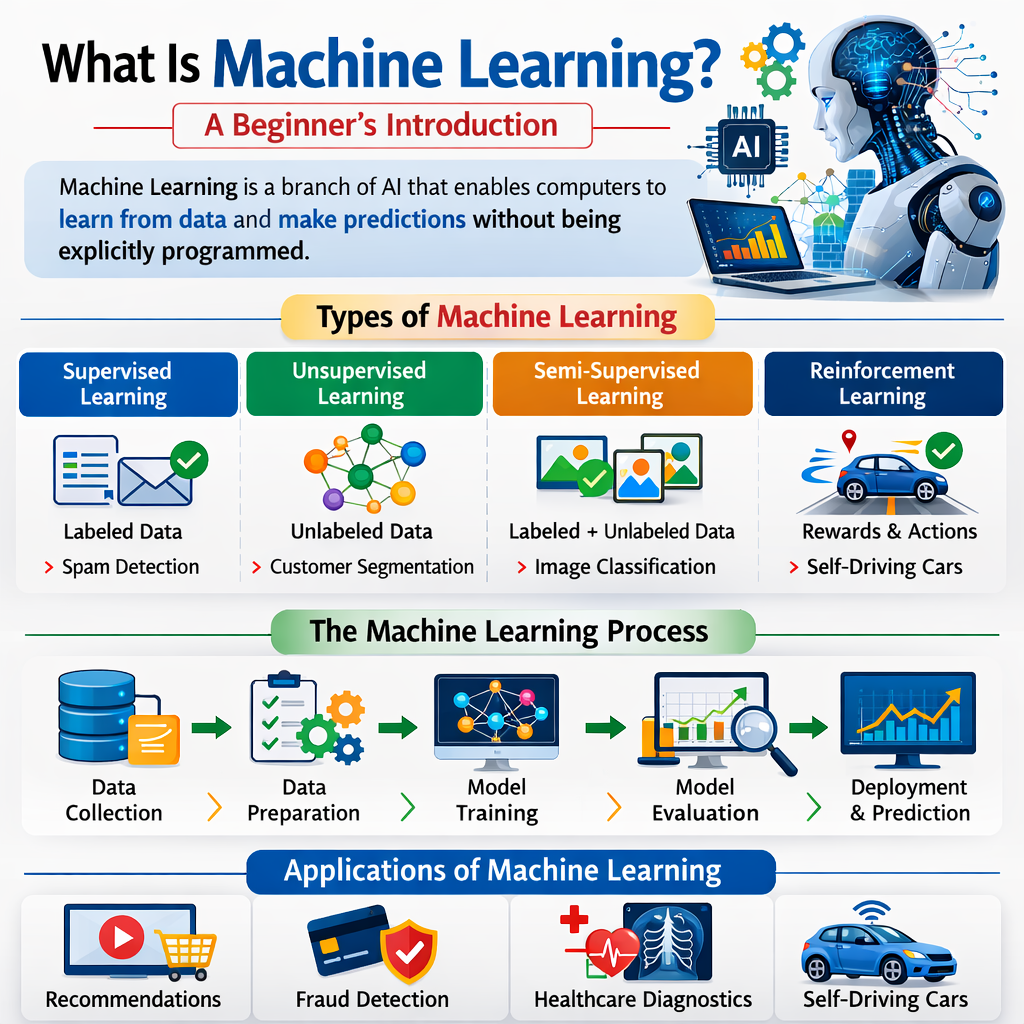
Machine learning is a branch of artificial intelligence that allows computers to learn patterns from data and make decisions or predictions without being explicitly programmed for every possible scenario. Instead of following fixed instructions, machine learning models improve automatically as they are exposed to more data. This ability to learn from experience enables systems to become smarter and more accurate over time.
In this beginner-friendly guide, we will explore what machine learning is, how it works, real-world examples, the learning process, and why it is shaping the future of technology and business.
What Is Machine Learning?
Machine learning is a subset of artificial intelligence (AI) that focuses on building systems that learn from data and improve performance without direct human programming.
In traditional programming, developers write explicit rules that a computer must follow. However, in machine learning, instead of writing rules, programmers provide data and algorithms that allow the system to discover patterns and relationships on its own.
A widely cited definition by computer scientist Arthur Samuel describes machine learning as:
“The field of study that gives computers the ability to learn without being explicitly programmed.”
This means that machine learning systems analyze large datasets, identify patterns, and then use those patterns to make predictions or decisions when new data is introduced.
For example, if you train a machine learning model with thousands of images labeled as cats and dogs, the model learns distinguishing features such as shapes, textures, and patterns. Later, when presented with a new image, it can determine whether it contains a cat or a dog with impressive accuracy.
The real power of machine learning lies in its ability to adapt and improve over time, especially when handling massive amounts of data that would be impossible for humans to analyze manually.
Why Machine Learning Matters Today
Machine learning has become critical because modern society produces enormous amounts of data every day. Businesses, governments, and organizations rely on intelligent systems to analyze this data and extract useful insights.
The importance of machine learning lies in several key capabilities:
- Automation of complex tasks
- Improved decision-making
- Prediction of future outcomes
- Personalized user experiences
- Processing large-scale data efficiently
For example, in healthcare, machine learning algorithms can analyze medical images to detect diseases earlier than traditional methods. In finance, ML models identify fraudulent transactions within milliseconds.
As industries continue to digitize, machine learning is increasingly becoming a foundational technology across sectors such as healthcare, finance, marketing, manufacturing, cybersecurity, and transportation.
How Machine Learning Works
At its core, machine learning works by identifying patterns within data and using those patterns to make predictions or decisions. The process typically involves several key steps that form the machine learning pipeline.
1. Data Collection
Machine learning begins with data. The quality and quantity of data directly influence the performance of a model.
Data may come from various sources such as:
- Databases
- Sensors
- User interactions
- Images and videos
- Financial transactions
- Text documents
For example, an e-commerce recommendation system collects data about customer browsing behavior, purchase history, and product ratings.
2. Data Preparation
Raw data is rarely perfect. It often contains missing values, inconsistencies, or irrelevant information. Therefore, data must be cleaned and prepared before being used for training a model.
This stage typically includes:
- Handling missing values
- Removing duplicates
- Feature engineering
- Normalization or scaling
- Data transformation
Proper data preparation ensures that machine learning models learn accurate and meaningful patterns.
3. Model Training
During training, a machine learning algorithm analyzes the dataset and learns patterns from it.
The algorithm adjusts its internal parameters to minimize errors between predicted results and actual results. This process is often repeated many times to improve accuracy.
For example, if a model predicts house prices, it learns how features such as:
- Location
- Number of bedrooms
- Size of the property
- Market trends
affect the final price.
4. Model Evaluation
After training, the model is evaluated to determine how well it performs on unseen data.
Common evaluation with performance metrics include:
- Accuracy
- Precision
- Recall
- F1 Score
- Mean Squared Error (MSE)
Evaluation helps ensure that the model generalizes well and does not simply memorize the training data.
5. Prediction and Deployment
Once a model performs well, it can be deployed into real-world applications.
The model then processes new data and generates predictions or decisions in real time.
For example:
- Predicting stock market trends
- Detecting credit card fraud
- Recommending products
Types of Machine Learning
Machine learning can be categorized into several major types based on how models learn from data.
| Type of Machine Learning | Description | Example |
|---|---|---|
| Supervised Learning | Models learn from labeled datasets where the correct output is known. | Email spam detection |
| Unsupervised Learning | Models identify patterns in data without labeled outputs. | Customer segmentation |
| Semi-Supervised Learning | Combines a small amount of labeled data with large unlabeled data. | Image classification |
| Reinforcement Learning | Systems learn by interacting with an environment and receiving rewards or penalties. | Self-driving cars |
Each approach serves different purposes depending on the nature of the problem and available data.
Real-World Examples of Machine Learning
Machine learning is already influencing many aspects of daily life and industry operations.
Recommendation Systems
Streaming platforms and e-commerce websites use machine learning to recommend content or products based on user behavior and preferences.
These systems analyze:
- Past purchases
- Browsing history
- Ratings
- Similar user behavior
This improves user experience while increasing engagement and sales.
Fraud Detection
Financial institutions use machine learning to detect unusual patterns in transactions that may indicate fraud.
These models analyze factors such as:
- Transaction location
- Spending patterns
- Time of purchase
- Account history
Machine learning can detect suspicious activities much faster than manual monitoring.
Healthcare Diagnostics
Machine learning models can analyze medical images such as X-rays, MRIs, and CT scans to identify diseases.
In some cases, these systems assist doctors in detecting conditions like:
- Cancer
- Heart disease
- Brain tumors
Earlier detection can significantly improve treatment outcomes.
Self-Driving Cars
Autonomous vehicles rely heavily on machine learning to understand and navigate their environment.
These systems process data from sensors, cameras, and radar to recognize:
- Road signs
- Pedestrians
- Other vehicles
- Traffic patterns
Machine learning enables cars to make real-time driving decisions.
Natural Language Processing
Many modern applications use machine learning to understand human language.
Examples include:
- Voice assistants
- Chatbots
- Language translation systems
- Sentiment analysis tools
Natural Language Processing (NLP) models allow computers to interpret and respond to human communication.
Machine Learning vs Traditional Programming
Understanding the difference between traditional programming and machine learning helps clarify how ML systems operate.
| Traditional Programming | Machine Learning |
|---|---|
| Rules are explicitly written by programmers | Rules are learned from data |
| Works best with structured problems | Handles complex and dynamic problems |
| Limited adaptability | Improves with more data |
| Requires manual updates | Learns automatically |
In traditional programming:
Data + Rules → Output
In machine learning:
Data + Output → Model → Predictions
This shift allows computers to solve problems that would otherwise require thousands of manual rules.
Challenges in Machine Learning
Despite its advantages, machine learning also faces several challenges.
Data Quality Issues
Poor-quality data can lead to inaccurate predictions. Models are only as good as the data they are trained on.
Bias in Algorithms
If training data contains bias, machine learning models may produce biased or unfair outcomes.
High Computational Requirements
Training advanced machine learning models often requires powerful hardware and large computational resources.
Interpretability Problems
Some machine learning models, especially deep learning systems, operate as “black boxes,” making it difficult to understand how they make decisions.
Future of Machine Learning
The future of machine learning is extremely promising. With advances in computing power, data availability, and algorithm development, ML will continue to expand into new domains.
Emerging areas include:
- AI-driven healthcare diagnostics
- Smart cities
- Climate modeling
- Personalized education
- Autonomous transportation
Machine learning is also becoming increasingly accessible through tools such as Python libraries, cloud platforms, and automated machine learning solutions. This democratization allows more people—including students and professionals—to build intelligent systems without deep expertise in advanced mathematics.
As organizations rely more on data-driven decisions, machine learning will remain at the center of technological innovation.
Conclusion
Machine learning represents a fundamental shift in how computers solve problems. Instead of relying on predefined instructions, machine learning systems learn patterns directly from data and improve over time.
From recommendation engines and fraud detection systems to healthcare diagnostics and autonomous vehicles, machine learning is transforming industries and everyday life.
Understanding the basics of machine learning—its concepts, processes, and applications—has become increasingly valuable for students, professionals, and organizations navigating the digital age.
As technology continues to evolve, machine learning will play a crucial role in shaping a smarter, more automated, and data-driven world.