If you’ve ever sat in a dark theatre, spellbound by a superhero defying gravity, a creature that felt too real, or a world that looked like it existed beyond imagination, you’ve already witnessed the quiet magic of Artificial Intelligence. Modern movies or cinema is no longer shaped only by giant cameras, green screens, and massive studios—it’s shaped by algorithms, neural networks, and intelligent systems working tirelessly behind the scenes.
Today’s films are faster to produce, more visually breathtaking, and more immersive than ever before, and the secret ingredient is a technology that never appears on screen: AI. In this article, we dive deep into how AI revolutionizes CGI, visual effects, scene enhancement, and editing, making your favorite movies downright stunning.
1. The Rise of AI in Filmmaking: A Silent Revolution
Artificial Intelligence has rapidly moved from being a futuristic concept to becoming an essential filmmaking tool. It enhances efficiency, reduces production costs, accelerates creative experimentation, and elevates visual realism. Earlier, what required hundreds of artists and months of manual work—like removing wires in action scenes or generating crowds—can now be completed in hours with AI-driven pipelines.
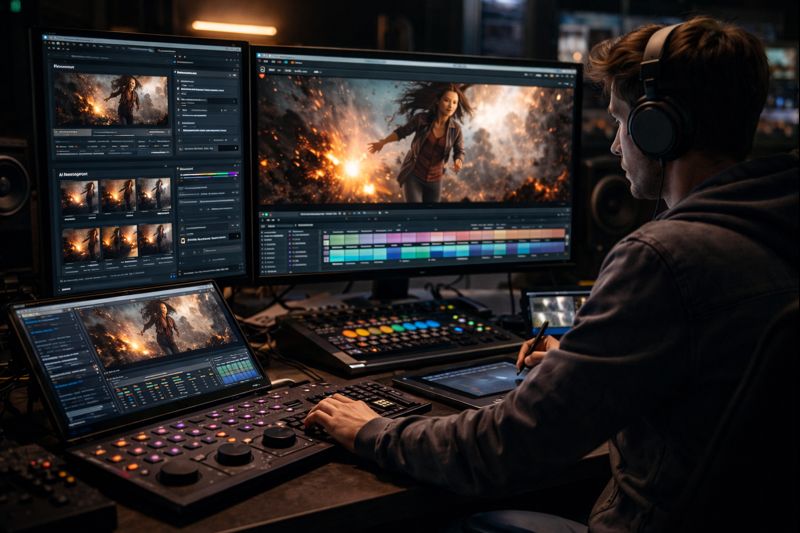
Filmmakers increasingly rely on AI-powered workstations, cloud-based rendering engines, and deep-learning tools to streamline their creative workflow. Tools like AI motion capture, image synthesis, and automated texture enhancement allow artists to create breathtaking visuals that were once impossible or too expensive. Even major film studios now integrate AI directly into production phases, making artificial intelligence the backbone of modern digital artistry.
2. AI and CGI: Creating Worlds That Feel Alive
CGI (Computer-Generated Imagery) has long been at the heart of blockbuster filmmaking, but AI has taken it to a level where digital worlds now feel indistinguishable from reality.
a) AI-Powered 3D Modeling
Traditionally, 3D modeling required painstaking hand-sculpting, but AI can now generate realistic 3D objects from 2D images, speeding up production. Filmmakers use AI-generated models to prototype environments, creatures, and props with stunning textural accuracy.
b) Digital Doubles and Lifelike Characters
AI-driven systems can analyze an actor’s facial expressions and instantly produce digital doubles for dangerous stunts or complex scenes. These digital humans move naturally thanks to deep learning systems that study human motion. Many filmmakers use advanced GPU-powered workstations like this AI-optimized rendering laptop to build and animate these characters at high speed.
AI tools powered by advanced neural rendering techniques can automatically generate lifelike particle effects, water simulations, smoke behavior, and environmental details that used to take weeks of manual animation. Studios increasingly rely on AI-enhanced VFX software like digital compositing tools and AI-based 3D modeling platforms to reduce workload while boosting creative quality. These systems provide artists with intelligent suggestions, automatic refinements, and real-time visual predictions, helping them build richer worlds faster than ever before.
c) Realistic Environment Rendering
AI algorithms can generate vast landscapes—cities, mountains, alien terrains—by analyzing real-world datasets. This saves studios millions and speeds up creative experimentation dramatically.
3. AI in Visual Effects (VFX): The New Creative Superpower
AI enhances almost every step of the VFX pipeline, making effects sharper, faster, and more spectacular.
a) Automated Rotoscoping and Masking
Rotoscoping—once tedious, frame-by-frame manual work—is now mostly automated with AI that tracks objects, identifies edges, and isolates elements with near-perfect accuracy. This cuts hours of work into minutes and allows VFX artists to focus on creativity instead of repetitive labor.
b) Intelligent Particle Effects
From explosions to smoke to magical spells, AI models understand physics-based simulations and automatically adjust particles for more realistic behavior. This gives filmmakers higher-quality effects with minimal manual correction.
c) De-Aging and Face Replacement
AI-driven facial editing tools, powered by deep-learning models similar to face-swap technologies, allow filmmakers to de-age actors, create younger versions of them, or replace stunt performers’ faces seamlessly. These techniques are so advanced that audiences can barely tell where reality ends and AI begins.
4. Scene Enhancement: Making Every Frame Look Perfect
AI doesn’t just create visuals—it also enhances them. Scene enhancement tools powered by machine learning improve lighting, color, clarity, and detail in ways that were once unimaginable.
a) Super-Resolution Upscaling
Older or low-quality footage can now be turned into 4K or even 8K using AI upscalers. Studios restoring classic movies use powerful AI video-enhancement tools to breathe new life into archival footage without reshooting anything.
b) Automated Color Grading
AI studies thousands of professionally graded films and applies consistent, cinematic styling to new footage. This means editors can achieve Hollywood-level color accuracy in hours instead of months.
c) Lighting Correction and Noise Reduction
AI identifies underexposed areas, corrects shadows, and removes noise without losing texture. Whether it’s a dark night chase scene or a poorly lit indoor shot, AI ensures every frame glows with cinematic excellence.
5. AI in Editing: Speeding Up the Creative Workflow
Editing is where the movie truly comes to life, and AI has become a powerful assistant here too.
a) Automatic Scene Detection
AI can analyze footage and detect scene changes, categorize shots by location or lighting type, and cluster similar clips. This helps editors navigate huge video libraries effortlessly.
b) Smart Cutting and Transitions
AI understands pacing, rhythm, and narrative continuity. It can recommend cut points, generate smooth transitions, and even create preliminary edits that human editors can refine.
c) Dialogue Cleanup
AI noise removal tools clean dialogue tracks in seconds, removing:
- Wind
- Traffic
- Background chatter
- Minor distortions
Filmmakers increasingly use tools like this studio-quality AI microphone to capture crystal-clear audio on set before refining it using intelligent noise models.
d) Script-to-Video Matching
Some systems read scripts, identify emotional beats, and automatically match relevant clips, making pre-editing faster and more intuitive.
6. How AI Helps Filmmakers Save Time and Money
Producing a blockbuster used to require massive budgets, but AI helps reduce production costs without compromising visual quality.
a) Fewer Reshoots
AI tools can modify lighting, replace backgrounds, fix continuity errors, or even shift an actor’s gaze—eliminating the need for expensive reshoots.
b) Faster Rendering
AI reduces rendering time dramatically, helping studios deliver movies faster while allowing artists to experiment more.
c) Smaller Teams, Bigger Output
AI automates tasks that once required dozens of specialists. Now, smaller teams can create stunning, high-quality films with fewer manual steps.
7. The Future: What’s Next for AI in Movies?
AI will soon be capable of generating entire scenes—from scripts to storyboards to photorealistic animations—within hours. Filmmakers may soon collaborate with AI systems that suggest sequences, choreograph camera angles, or simulate crowd behavior without requiring human extras.
We may also see AI-driven filmmaking assistants that help directors make on-the-spot decisions during shoots, or real-time CGI rendering that instantly blends digital effects with live-action footage.
How AI Is Reinventing the Entertainment Industry Forever
As AI evolves, the boundary between imagination and reality will blur even further, enabling filmmakers to tell bold, visually stunning stories with unprecedented creative freedom.