
Introduction: The Hidden Mathematical Language Powering Modern AI
How does ChatGPT understand your questions? How does Netflix recommend movies you’ll likely enjoy? How does Google find relevant search results in milliseconds?
The answer lies in embeddings.
Embeddings are one of the most important concepts in modern Artificial Intelligence, Machine Learning, Natural Language Processing (NLP), recommendation systems, and semantic search. They transform complex data like text, images, audio, or products into mathematical vectors that machines can understand and compare efficiently.
If terms like vector spaces, high-dimensional representations, or cosine similarity sound intimidating, don’t worry. This guide explains everything clearly for both beginners and experienced professionals.
By the end, you’ll understand:
- What embeddings are
- Why embeddings are essential in AI
- How vector spaces work
- What cosine similarity means
- Real-world use cases
- Python implementation examples
- Best practices and common mistakes
Let’s decode the mathematics behind intelligent machines.
What Are Embeddings in AI?
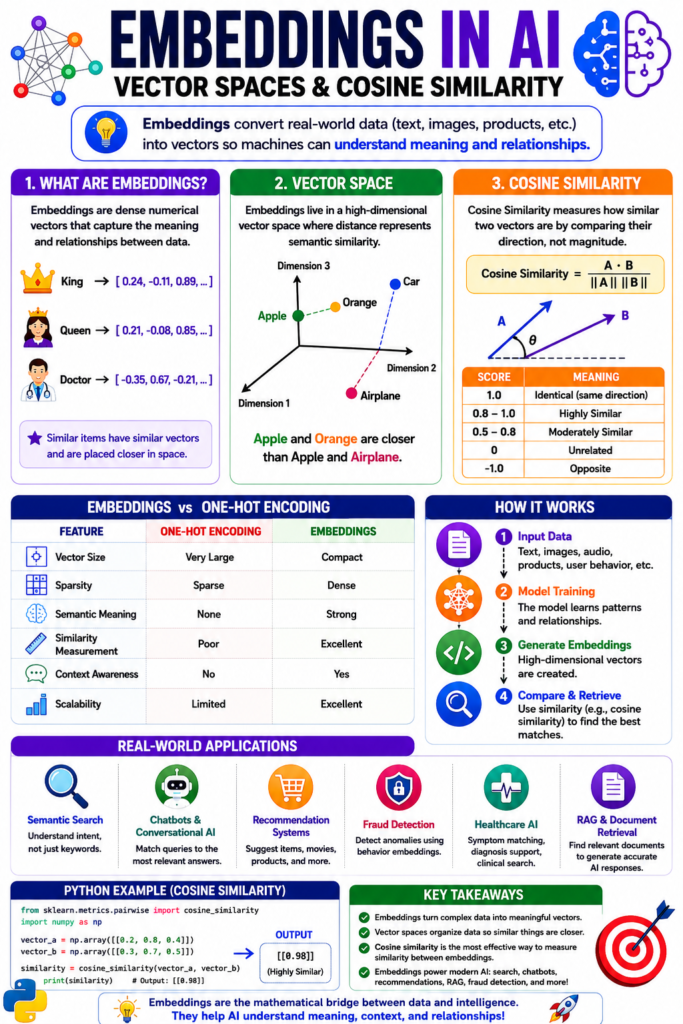
Embeddings are numerical representations of data where similar items are placed close together in a mathematical space. Instead of treating words, images, or products as isolated symbols, embeddings convert them into dense vectors that preserve semantic meaning and relationships.
For example:
- “King” →
[0.24, -0.11, 0.89, ...] - “Queen” →
[0.21, -0.08, 0.85, ...]
These vectors may contain hundreds or thousands of dimensions, but their purpose is simple: capture meaning mathematically.
Traditional representations like one-hot encoding create sparse vectors with little contextual meaning. Embeddings solve this limitation by learning meaningful relationships between entities.
In AI, embeddings help systems recognize that:
- “doctor” and “physician” are related
- “cat” and “dog” are closer than “cat” and “airplane”
- Similar products belong near each other
This makes embeddings foundational to intelligent applications.
Why Embeddings Matter in Artificial Intelligence
Without embeddings, machines process information as disconnected tokens rather than meaningful concepts.
Embeddings allow AI systems to:
- Understand semantic similarity
- Perform recommendation matching
- Enable contextual search
- Improve NLP performance
- Cluster similar data points
- Support Retrieval-Augmented Generation (RAG)
For example, if a user searches:
“best budget smartphone with good camera”
A keyword-based search engine may focus only on exact words.
An embedding-based system understands semantic intent:
- budget phone
- affordable smartphone
- low-cost mobile with camera
This dramatically improves relevance.
Traditional Data Representation vs Embeddings
Comparison Table
| Feature | One-Hot Encoding | Embeddings |
|---|---|---|
| Vector Size | Very large | Compact |
| Sparsity | Sparse | Dense |
| Semantic Meaning | None | Strong |
| Similarity Measurement | Poor | Excellent |
| Computational Efficiency | Low | High |
| Context Awareness | No | Yes |
| Scalability | Limited | Excellent |
Traditional one-hot vectors treat every word independently.
Example:
“cat” → [1,0,0,0]
“dog” → [0,1,0,0]
Distance between cat and dog becomes identical to cat and airplane.
That’s mathematically inefficient and semantically wrong.
Embeddings solve this by learning relationships.
Understanding Vector Spaces in AI
A vector space is a mathematical environment where embeddings live.
Imagine plotting data points on a graph.
In 2D:
- X-axis
- Y-axis
In AI embeddings, instead of 2 dimensions, vectors may have:
- 128 dimensions
- 512 dimensions
- 768 dimensions
- 1536 dimensions
- 4096 dimensions
Each dimension captures hidden characteristics learned by the model.
For language embeddings, dimensions may represent abstract linguistic features such as:
- sentiment
- gender association
- topic similarity
- contextual relationships
Humans cannot directly interpret every dimension, but mathematically, these vectors preserve meaning.
Example conceptually:
| Word | Vector Position |
|---|---|
| Apple | (2.1, 3.5, 0.8) |
| Orange | (2.0, 3.2, 0.7) |
| Car | (8.7, 1.1, 9.0) |
Apple and Orange cluster together.
Car remains far away.
That’s semantic geometry.
How Embeddings Are Created
Embeddings are learned during training using neural networks.
The process:
Step 1: Input Data
Examples:
- text
- images
- audio
- products
- customer profiles
Step 2: Model Training
The model learns contextual patterns.
Example in NLP:
Sentence:
“The cat sat on the mat.”
The model observes relationships:
- cat relates to animal
- sat relates to action
- mat relates to object
Repeated exposure refines vector positions.
Step 3: Vector Generation
Final embeddings become dense vectors:
[0.184, -0.551, 0.762, 0.033, ...]Types of Embeddings in AI
1. Word Embeddings
Represent individual words.
Popular techniques:
- Word2Vec
- GloVe
- FastText
Example:
“king” – “man” + “woman” ≈ “queen”
This demonstrates learned semantic arithmetic.
2. Sentence Embeddings
Represent full sentences.
Useful for:
- semantic search
- chatbot understanding
- document similarity
Example:
“How do I reset my password?”
and
“Forgot password recovery steps”
These should map closely.
3. Document Embeddings
Represent entire documents.
Applications:
- search engines
- legal document comparison
- article recommendation
4. Image Embeddings
CNNs or vision transformers convert images into vectors.
Applications:
- face recognition
- image search
- product matching
5. Multimodal Embeddings
Represent multiple data types in a shared space.
Example:
Text + image embeddings.
Applications:
- image captioning
- cross-modal search
- visual question answering
Cosine Similarity Explained Simply
Cosine similarity measures how similar two vectors are by comparing their direction instead of magnitude.
Formula:Cosine Similarity=∣∣A∣∣∣∣B∣∣A⋅B
Where:
- A = vector 1
- B = vector 2
- dot product = directional overlap
- magnitudes normalize vector length
Interpretation:
| Score | Meaning |
|---|---|
| 1.0 | Identical direction |
| 0.8+ | Highly similar |
| 0.5 | Moderately similar |
| 0 | Unrelated |
| -1 | Opposite |
Cosine similarity works well because semantic meaning depends more on direction than raw size.
Why Cosine Similarity Is Preferred
Alternative distance metrics include:
- Euclidean distance
- Manhattan distance
- Minkowski distance
But cosine similarity often performs better for embeddings because:
- ignores magnitude differences
- emphasizes semantic orientation
- works well in high-dimensional spaces
- computationally efficient
Comparison:
| Metric | Best For | Weakness |
|---|---|---|
| Euclidean | Physical distances | Sensitive to scale |
| Manhattan | Grid movement | Less semantic relevance |
| Cosine Similarity | Embeddings | Ignores absolute magnitude |
Python Example: Calculating Cosine Similarity
from sklearn.metrics.pairwise import cosine_similarity
import numpy as np

vector_a = np.array([[0.2, 0.8, 0.4]])
vector_b = np.array([[0.3, 0.7, 0.5]])

similarity = cosine_similarity(vector_a, vector_b)

print(similarity)
Output:
[[0.98]]This indicates strong similarity.
Python Example: Generating Embeddings
Using Sentence Transformers:
from sentence_transformers import SentenceTransformer
from sklearn.metrics.pairwise import cosine_similarity

model = SentenceTransformer('all-MiniLM-L6-v2')

sentences = [
    "I love machine learning",
    "Artificial intelligence is fascinating"
]

embeddings = model.encode(sentences)

score = cosine_similarity(
    [embeddings[0]],
    [embeddings[1]]
)

print(score)
Real-World Industry Use Cases of Embeddings
Semantic Search
Search engines use embeddings to understand intent rather than exact keyword matching.
Example:
Query:
“cheap gaming laptop”
Matches:
- affordable gaming notebook
- budget gaming PC
This improves search relevance significantly.
Chatbots and Conversational AI
Chatbots convert queries into embeddings for intent matching.
Applications:
- customer support bots
- FAQ assistants
- AI virtual assistants
Embedding similarity helps retrieve relevant responses instantly.
Recommendation Systems
Platforms like Netflix, Amazon, and Spotify rely heavily on embeddings.
Examples:
- similar movies
- related products
- personalized playlists
User behavior and item embeddings interact to generate recommendations.
Fraud Detection
Financial institutions use embeddings to detect suspicious transaction patterns.
Embedding clustering helps identify anomalies.
Healthcare AI
Medical AI uses embeddings for:
- symptom matching
- clinical note similarity
- diagnosis assistance
Semantic relationships improve decision support.
Document Retrieval in RAG Systems
Retrieval-Augmented Generation relies on embeddings.
Workflow:
- User asks question
- Query converted into embedding
- Similar documents retrieved
- LLM generates answer
This powers modern enterprise AI assistants.
Popular Embedding Models
| Model | Best Use |
|---|---|
| Word2Vec | Word relationships |
| GloVe | General NLP |
| FastText | Rare word handling |
| BERT | Contextual embeddings |
| Sentence-BERT | Semantic similarity |
| OpenAI Embeddings | Production AI apps |
| CLIP | Image-text similarity |
Each model serves different needs.
Best Practices for Using Embeddings
Normalize Vectors
Normalization improves cosine comparison consistency.
Choose Domain-Specific Models
Medical text should use medical embeddings.
Legal documents need legal-domain embeddings.
Generic models may underperform.
Use Vector Databases
For production systems:
- FAISS
- Pinecone
- Weaviate
- Chroma
These optimize nearest-neighbor search.
Monitor Embedding Drift
Data evolves.
Old embeddings may lose relevance.
Periodic retraining is important.
Common Mistakes to Avoid
Using Wrong Similarity Metric
Not all embeddings work best with Euclidean distance.
Cosine is usually safer.
Ignoring Data Preprocessing
Poor text cleaning reduces embedding quality.
Examples:
- extra symbols
- encoding issues
- inconsistent casing
Mixing Different Embedding Models
Vectors from different models often occupy incompatible spaces.
Direct comparison becomes meaningless.
Overlooking Dimensionality Costs
Higher dimensions improve expressiveness but increase storage and latency.
Balance is necessary.
Advantages of Embeddings
| Advantage | Description |
|---|---|
| Semantic understanding | Captures meaning |
| Compact vectors | Efficient storage |
| Better search | Intent-based retrieval |
| Scalability | Works across millions of records |
| Cross-domain applicability | NLP, vision, audio |
| Recommendation power | Strong personalization |
Disadvantages of Embeddings
| Disadvantage | Description |
|---|---|
| Training cost | Computationally expensive |
| Interpretability | Hard to explain dimensions |
| Bias propagation | Learns dataset bias |
| Model dependency | Performance varies by model |
| Storage needs | Large vector collections |
Future of Embeddings in AI
Embeddings continue evolving toward:
- multimodal intelligence
- dynamic contextual representations
- personalized embeddings
- real-time adaptive vectors
- agentic AI memory systems
As AI systems become more context-aware, embeddings will remain foundational infrastructure.
Final Thoughts
Embeddings transformed AI from keyword matching into semantic intelligence.
By representing data in vector spaces, machines can compare meaning mathematically instead of relying on literal symbols.
Combined with cosine similarity, embeddings power:
- semantic search
- chatbots
- recommendations
- RAG pipelines
- fraud detection
- healthcare AI
For students, understanding embeddings unlocks modern NLP and machine learning.
For professionals, embeddings are essential for building scalable AI products.
If AI is the brain, embeddings are the language neurons use to communicate.