
Introduction: Why CNNs Are Transforming the Way Machines See the World
Imagine a machine that can recognize faces, detect diseases from medical scans, drive cars autonomously, and even generate realistic images—all by learning from pixels. This is not science fiction; it is the power of Convolutional Neural Networks (CNNs). As a specialized class of deep learning models, CNNs have revolutionized image processing by mimicking how the human visual cortex interprets visual data.
In an era dominated by visual information—from social media images to satellite imagery—CNNs have become the backbone of modern computer vision systems. Whether you are a student exploring artificial intelligence, a data scientist building models, or a professional aiming to understand deep learning applications, mastering CNN basics is essential. This article breaks down CNN architecture, explains how it works, and explores its real-world applications in a structured, practical, and accessible way.
What is a Convolutional Neural Network (CNN)?
A Convolutional Neural Network is a type of deep neural network specifically designed to process structured grid data such as images. Unlike traditional neural networks, CNNs are highly efficient at capturing spatial hierarchies and patterns in visual data.
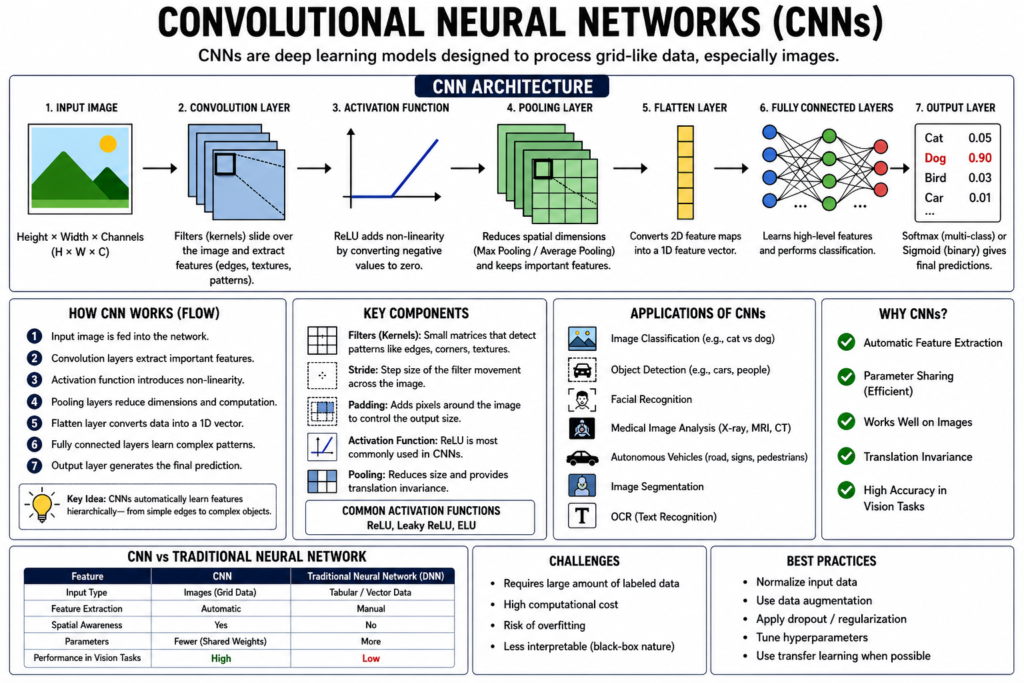
At its core, a CNN processes an image by passing it through multiple layers, each extracting increasingly complex features—from edges and textures to objects and shapes. This hierarchical learning allows CNNs to outperform traditional machine learning models in image-related tasks.
Why CNNs Are Important in Image Processing
Traditional image processing techniques relied heavily on manual feature extraction, which was time-consuming and often inaccurate. CNNs eliminate this need by automatically learning relevant features during training.
Key Advantages:
- Automatic Feature Extraction: No need for handcrafted features
- Parameter Sharing: Reduces computational complexity
- Translation Invariance: Recognizes objects regardless of position
- High Accuracy: Especially in tasks like classification and detection
These advantages make CNNs indispensable in modern image processing workflows.
Core Structure of a CNN
A CNN is composed of several types of layers, each playing a unique role in transforming input data into meaningful output. Understanding these layers is crucial to grasp how CNNs work.
1. Input Layer
The input layer receives the raw image data, typically represented as a 3D matrix (height × width × channels). For example, a colored image of size 64×64 pixels would have 3 channels (RGB), resulting in a 64×64×3 input.
This layer does not perform computations but serves as the entry point for the network.
2. Convolutional Layer
The convolutional layer is the heart of a CNN. It applies filters (kernels) to the input image to extract features.
How It Works:
- A small matrix (filter) slides over the image
- Performs element-wise multiplication
- Produces a feature map
Example Code (Python with TensorFlow/Keras):
from tensorflow.keras.layers import Conv2Dconv_layer = Conv2D(filters=32, kernel_size=(3,3), activation='relu')
Key Concepts:
- Filters/Kernels: Detect patterns like edges or textures
- Stride: Step size of filter movement
- Padding: Preserves spatial dimensions
3. Activation Function (ReLU)
After convolution, an activation function introduces non-linearity into the model.
Common Function:
- ReLU (Rectified Linear Unit): Converts negative values to zero
from tensorflow.keras.layers import Activationactivation = Activation('relu')
This allows the network to learn complex patterns beyond linear relationships.
4. Pooling Layer
Pooling reduces the spatial dimensions of feature maps while retaining important information.
Types:
- Max Pooling: Selects the maximum value
- Average Pooling: Computes the average value
from tensorflow.keras.layers import MaxPooling2Dpool = MaxPooling2D(pool_size=(2,2))
Benefits:
- Reduces computation
- Prevents overfitting
- Extracts dominant features
5. Flatten Layer
The flatten layer converts the 2D feature maps into a 1D vector so it can be fed into fully connected layers.
from tensorflow.keras.layers import Flattenflatten = Flatten()
6. Fully Connected Layer (Dense Layer)
This layer performs classification based on extracted features.
from tensorflow.keras.layers import Densedense = Dense(128, activation='relu')
The final layer typically uses:
- Softmax for multi-class classification
- Sigmoid for binary classification
7. Output Layer
The output layer produces the final prediction.
output = Dense(10, activation='softmax') # Example for 10 classes
How CNN Works: Step-by-Step Flow
- Input image is fed into the network
- Convolution layers extract features
- Activation functions add non-linearity
- Pooling reduces dimensions
- Flatten converts data to vector
- Dense layers perform classification
- Output layer generates prediction
This pipeline enables CNNs to learn from raw pixel data effectively.
CNN Architecture Example (Simple Model)
from tensorflow.keras.models import Sequential
from tensorflow.keras.layers import Conv2D, MaxPooling2D, Flatten, Densemodel = Sequential([
    Conv2D(32, (3,3), activation='relu', input_shape=(64,64,3)),
    MaxPooling2D(2,2),
    Conv2D(64, (3,3), activation='relu'),
    MaxPooling2D(2,2),
    Flatten(),
    Dense(128, activation='relu'),
    Dense(10, activation='softmax')
])model.summary()
This is a basic CNN used for image classification tasks.
Key Concepts in CNN
Feature Maps
Feature maps are outputs of convolution layers that highlight detected patterns like edges or shapes.
Stride and Padding
- Stride controls movement of filters
- Padding ensures output size consistency
Hyperparameters
- Number of filters
- Kernel size
- Learning rate
- Batch size
CNN vs Traditional Neural Networks
| Feature | CNN | Traditional Neural Network |
|---|---|---|
| Input Type | Images (grid-like data) | Structured/tabular data |
| Feature Extraction | Automatic | Manual |
| Parameter Efficiency | High (shared weights) | Low |
| Spatial Awareness | Yes | No |
| Performance in Vision | Excellent | Poor |
| Complexity | Moderate to High | Low to Moderate |
CNNs clearly outperform traditional neural networks in image-related tasks due to their ability to capture spatial features.
Applications of CNN in Image Processing
CNNs are widely used across industries due to their ability to interpret visual data accurately.
1. Image Classification
Assigning labels to images (e.g., cat vs dog)
2. Object Detection
Detecting multiple objects within an image (e.g., cars, people)
3. Facial Recognition
Used in security systems and smartphones
4. Medical Image Analysis
Detecting diseases from X-rays, MRIs, CT scans
5. Autonomous Vehicles
Identifying roads, pedestrians, traffic signals
6. Image Segmentation
Dividing images into meaningful parts
7. OCR (Optical Character Recognition)
Reading text from images
Real-World Impact of CNNs
CNNs power many technologies we use daily:
- Google Photos image search
- Self-driving cars
- Healthcare diagnostics
- Retail product recognition
- Surveillance systems
Their ability to learn visual patterns has made them a cornerstone of artificial intelligence.
Challenges of CNNs
Despite their strengths, CNNs come with limitations:
- High Computational Cost
- Large Data Requirement
- Risk of Overfitting
- Black-box Nature (low interpretability)
These challenges require careful model design and optimization.
Best Practices for Building CNN Models
- Normalize input data
- Use data augmentation
- Apply dropout for regularization
- Tune hyperparameters carefully
- Use pre-trained models (Transfer Learning)
Future of CNNs in AI
CNNs continue to evolve with innovations like:
- Efficient architectures (MobileNet, EfficientNet)
- Hybrid models (CNN + Transformers)
- Edge AI for real-time processing
As AI advances, CNNs will remain central to visual intelligence systems.
Conclusion
Convolutional Neural Networks have fundamentally transformed image processing by enabling machines to understand and interpret visual data with remarkable accuracy. From recognizing everyday objects to diagnosing life-threatening diseases, CNNs are reshaping industries and pushing the boundaries of artificial intelligence.
Understanding CNN structure—from convolutional layers to fully connected networks—provides a strong foundation for anyone entering the field of deep learning. With the right knowledge and tools, you can leverage CNNs to build powerful image-based applications and contribute to the future of intelligent systems.