
Introduction: The Complete Beginner-to-Advanced Guide to Custom AI Training
Artificial Intelligence has rapidly evolved from simple rule-based systems into powerful Large Language Models (LLMs) capable of understanding, generating, and reasoning with human language. Models such as GPT, Llama, Claude, Mistral, and Gemini have transformed industries ranging from healthcare and finance to education and software development. However, despite their impressive capabilities, foundation models are not always perfectly aligned with specific business requirements, industry terminology, or organizational goals. This is where fine-tuning becomes one of the most important techniques in modern AI development.
Fine-tuning allows developers, organizations, and researchers to adapt a pre-trained language model to specialized tasks, domain-specific knowledge, unique communication styles, and industry requirements. Instead of building a language model from scratch—which requires enormous datasets, computational resources, and expertise—fine-tuning enables organizations to leverage existing models and customize them efficiently.
In this comprehensive guide, we will explore what fine-tuning is, how it works, different fine-tuning approaches, practical examples, advantages, challenges, future trends, and implementation techniques for modern LLMs.
What Is Fine-Tuning in Large Language Models?
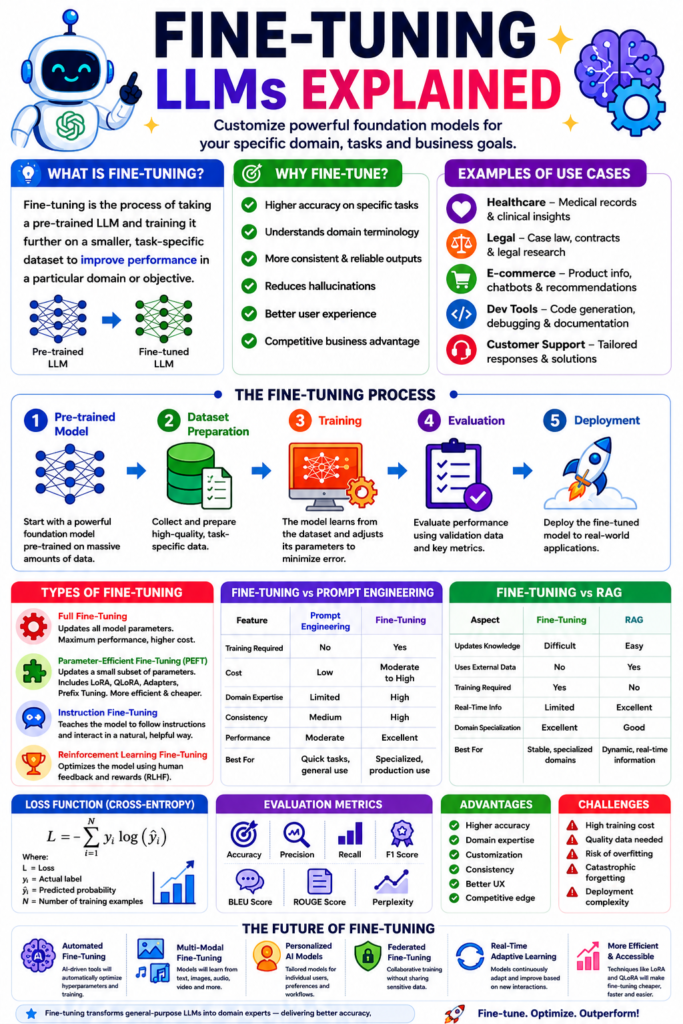
Fine-tuning is the process of taking a pre-trained language model and continuing its training on a smaller, task-specific dataset to improve performance on a particular domain or objective.
A foundation model is initially trained on vast amounts of internet text, books, articles, code repositories, and other data sources. While this pre-training provides general language understanding, it does not necessarily make the model an expert in specialized areas such as medicine, legal documentation, financial analysis, customer support, or company-specific knowledge.
Fine-tuning modifies the model’s weights using carefully curated datasets so that it performs better on targeted tasks.
For example:
- A healthcare organization can fine-tune a model on medical records and clinical terminology.
- A law firm can fine-tune a model on legal documents and case studies.
- An e-commerce company can fine-tune a chatbot using product catalogs and customer interactions.
- A software company can fine-tune a coding assistant on proprietary codebases.
The result is a model that demonstrates greater accuracy, relevance, and consistency within a specific domain.
Why Fine-Tuning Is Important
While general-purpose LLMs are highly capable, they often face limitations when dealing with specialized tasks. Generic models may misunderstand industry-specific terminology, provide inconsistent outputs, or fail to follow organizational communication standards.
Fine-tuning helps address these challenges by improving domain adaptation, task performance, output consistency, and contextual understanding.
Organizations increasingly rely on fine-tuning because it enables:
- Better accuracy on specialized tasks
- Reduced hallucinations in specific domains
- Customized response styles
- Improved customer experience
- Competitive business advantages
- More efficient AI deployment
As AI adoption grows, fine-tuning has become a strategic capability for companies seeking differentiated AI solutions.
How Fine-Tuning Works
The fine-tuning process typically follows several stages.
Step 1: Pre-Trained Foundation Model
The process begins with a foundation model that has already learned language patterns through large-scale pre-training.
Examples include:
- GPT models
- Llama models
- Mistral models
- Falcon models
- Gemma models
These models already understand grammar, reasoning, context, and language generation.
Step 2: Dataset Preparation
A high-quality dataset is essential for successful fine-tuning.
The dataset usually contains:
| Input | Expected Output |
|---|---|
| Customer query | Customer support response |
| Medical symptoms | Diagnosis explanation |
| Programming problem | Correct code solution |
| Legal question | Legal guidance |
The quality of the dataset often influences performance more than the model architecture itself.
Step 3: Training Process
The model learns from the new dataset by adjusting its internal parameters.
The objective is to minimize prediction errors.
The standard loss function used during fine-tuning is Cross-Entropy Loss:
L=-\sum_{i=1}^{N} y_i \log(\hat{y}_i)
Where:
- L = Loss
- y = Actual label
- ŷ = Predicted probability
- N = Number of training examples
The optimization algorithm continuously updates model weights to reduce loss.
Step 4: Evaluation
After training, the model is evaluated using validation datasets.
Common evaluation metrics include:
- Accuracy
- Precision
- Recall
- F1 Score
- BLEU Score
- ROUGE Score
- Perplexity
Step 5: Deployment
The fine-tuned model is deployed into production environments such as:
- Chatbots
- Virtual assistants
- Recommendation systems
- Content generation tools
- Enterprise AI solutions
Types of Fine-Tuning
Full Fine-Tuning
In full fine-tuning, all model parameters are updated.
This approach provides maximum customization but requires substantial computational resources.
Advantages
- Highest performance potential
- Complete model adaptation
- Best domain specialization
Disadvantages
- Expensive training
- Large storage requirements
- Longer training times
Parameter-Efficient Fine-Tuning (PEFT)
PEFT updates only a small subset of model parameters.
Popular techniques include:
- LoRA (Low-Rank Adaptation)
- QLoRA
- Adapters
- Prefix Tuning
This approach significantly reduces computational costs.
Instruction Fine-Tuning
Instruction tuning teaches models to follow human instructions more effectively.
Example:
Instruction:
“Summarize this article.”
Output:
Concise article summary.
This technique improves conversational AI performance.
Reinforcement Learning Fine-Tuning
Models can also be optimized using human feedback.
The objective function often involves maximizing rewards:
J(\theta)=\mathbb{E}[R]
Where:
- J(θ) = Objective function
- R = Reward
This technique is commonly used in advanced AI alignment systems.
Fine-Tuning vs Prompt Engineering
Many organizations wonder whether fine-tuning is necessary when prompt engineering already exists.
| Feature | Prompt Engineering | Fine-Tuning |
| Cost | Low | Moderate to High |
| Training Required | No | Yes |
| Domain Expertise | Limited | High |
| Consistency | Medium | High |
| Performance | Moderate | Excellent |
| Deployment Complexity | Low | Higher |
Prompt engineering is ideal for quick solutions, while fine-tuning is preferred for long-term specialized applications.
Fine-Tuning vs Retrieval-Augmented Generation (RAG)
A common debate in modern AI is Fine-Tuning versus RAG.
| Aspect | Fine-Tuning | RAG |
| Updates Knowledge | Difficult | Easy |
| Uses External Documents | No | Yes |
| Training Required | Yes | No |
| Real-Time Information | Limited | Excellent |
| Infrastructure Complexity | Medium | Higher |
| Domain Specialization | Excellent | Good |
In many enterprise applications, combining Fine-Tuning and RAG provides the best results.
Popular Fine-Tuning Techniques
LoRA (Low-Rank Adaptation)
LoRA is one of the most widely used methods today.
Instead of updating billions of model parameters, LoRA inserts smaller trainable matrices into transformer layers.
Benefits include:
- Lower GPU requirements
- Faster training
- Reduced storage
- High efficiency
QLoRA
QLoRA combines quantization and LoRA.
Advantages:
- Reduced memory consumption
- Supports large models on consumer GPUs
- Lower infrastructure costs
Adapters
Adapter layers are inserted into pre-trained networks.
Benefits:
- Modular architecture
- Multiple tasks can share one base model
- Easy maintenance
Python Example: Fine-Tuning an LLM Using Hugging Face
The Hugging Face ecosystem has simplified LLM fine-tuning considerably.
Install Required Libraries
pip install transformers datasets torchLoad Pretrained Model
from transformers import AutoTokenizer, AutoModelForCausalLM

model_name = "gpt2"

tokenizer = AutoTokenizer.from_pretrained(model_name)
model = AutoModelForCausalLM.from_pretrained(model_name)
Load Dataset
from datasets import load_dataset

dataset = load_dataset("imdb")
Tokenization
def tokenize_function(examples):
    return tokenizer(
        examples["text"],
        truncation=True,
        padding="max_length"
    )

tokenized_dataset = dataset.map(tokenize_function)
Training
from transformers import Trainer, TrainingArguments

training_args = TrainingArguments(
    output_dir="./results",
    num_train_epochs=3,
    per_device_train_batch_size=8
)

trainer = Trainer(
    model=model,
    args=training_args,
    train_dataset=tokenized_dataset["train"]
)

trainer.train()
This simple workflow demonstrates the foundation of fine-tuning using modern AI frameworks.
Challenges in Fine-Tuning LLMs
Despite its benefits, fine-tuning introduces several challenges.
Data Quality Issues
Poor datasets can degrade performance rather than improve it.
Common problems include:
- Incomplete records
- Biased examples
- Duplicate data
- Incorrect labels
High Computational Costs
Large models require significant GPU resources.
Training costs can become substantial for billion-parameter models.
Overfitting
When training data is too small, the model may memorize examples instead of generalizing.
Catastrophic Forgetting
The model may lose some general capabilities while learning domain-specific knowledge.
Security and Privacy Concerns
Sensitive information may inadvertently become embedded in model parameters.
Organizations must implement proper data governance policies.
Advantages of Fine-Tuning LLMs
| Advantage | Description |
| Higher Accuracy | Better task-specific performance |
| Domain Expertise | Learns specialized terminology |
| Customization | Tailored outputs |
| Improved Consistency | Standardized responses |
| Competitive Edge | Business differentiation |
| Better User Experience | More relevant answers |
Fine-tuning enables organizations to transform general-purpose AI into domain experts.
Disadvantages of Fine-Tuning LLMs
| Disadvantage | Description |
| High Training Cost | Requires GPUs and infrastructure |
| Data Requirements | Needs quality datasets |
| Maintenance Effort | Continuous updates required |
| Risk of Overfitting | Small datasets may reduce generalization |
| Deployment Complexity | More operational overhead |
Understanding these trade-offs is essential before starting a fine-tuning project.
Best Practices for Successful Fine-Tuning
To maximize performance:
- Use clean and diverse datasets.
- Start with strong foundation models.
- Monitor validation metrics carefully.
- Use parameter-efficient methods when possible.
- Evaluate extensively before deployment.
- Combine fine-tuning with RAG when needed.
- Regularly retrain models using updated data.
Organizations that follow these practices typically achieve significantly better outcomes.
Future of Fine-Tuning LLMs
The future of fine-tuning is evolving rapidly.
Several trends are shaping the next generation of AI customization:
Automated Fine-Tuning
AI systems will increasingly optimize hyperparameters automatically, reducing human intervention.
Multi-Modal Fine-Tuning
Future models will learn simultaneously from:
- Text
- Images
- Audio
- Video
- Sensor data
Personalized AI Models
Users may eventually have individualized AI assistants fine-tuned specifically for their preferences and workflows.
Federated Fine-Tuning
Organizations will fine-tune models collaboratively without sharing sensitive data.
Real-Time Adaptive Learning
Future systems may continuously adapt based on interactions while maintaining safety and reliability.
These developments will make fine-tuning more accessible, efficient, and powerful across industries.
Conclusion
Fine-tuning has become one of the most valuable techniques for transforming general-purpose Large Language Models into highly specialized AI systems. By leveraging pre-trained foundation models and adapting them to domain-specific datasets, organizations can achieve superior accuracy, consistency, and business value without the enormous cost of training models from scratch.