Introduction: How LLMs Are Transforming the Future of Human Communication?
In just a few years, Large Language Models (LLMs) have moved from being experimental research projects to becoming some of the most powerful technologies shaping the modern digital world. Whether it is ChatGPT answering questions, AI assistants generating code, tools summarizing research papers, or applications translating languages instantly, LLMs are quietly transforming how humans interact with machines. What once required teams of experts and hours of manual work can now happen in seconds through conversational AI systems capable of understanding and generating human-like text.
But what exactly are Large Language Models? How do they generate meaningful responses that often sound surprisingly intelligent? Why are companies investing billions into this technology, and why are educators, developers, researchers, marketers, and businesses rapidly adopting it?
Understanding LLMs is no longer only for AI researchers or data scientists. Today, students use them for learning, professionals use them for productivity, developers use them for automation, and organizations use them to improve decision-making and customer experiences. This article explains Large Language Models in a simple yet detailed manner, covering how they work, how they generate text, their architecture, training process, applications, limitations, examples, and the future of AI-powered communication.
What Are Large Language Models (LLMs)?
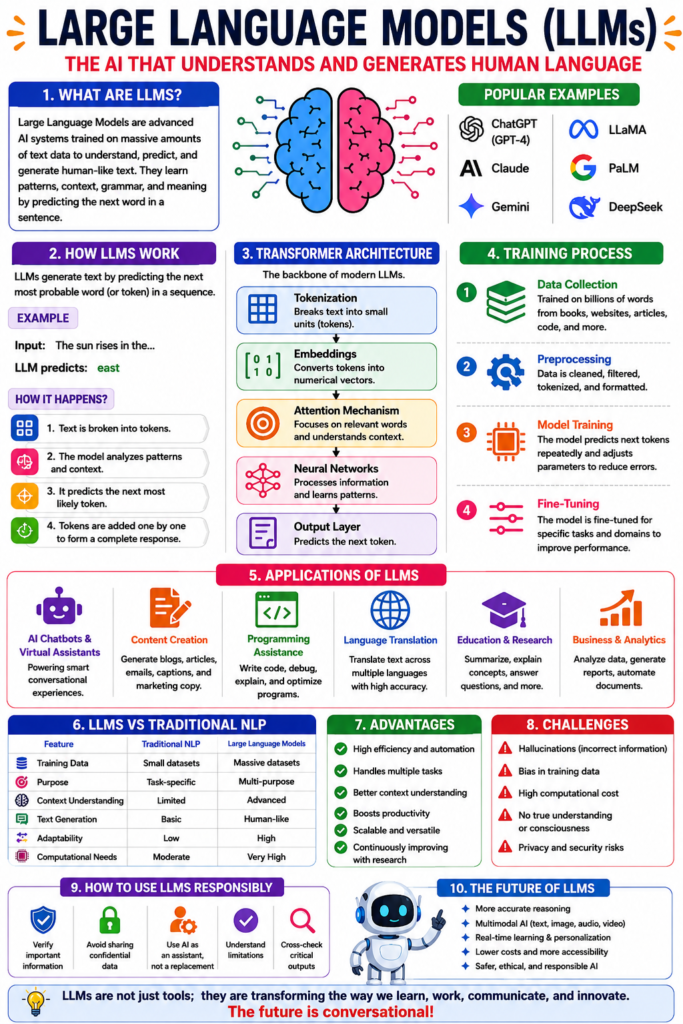
Large Language Models, commonly known as LLMs, are advanced artificial intelligence systems trained to understand, process, and generate human language. They are built using deep learning techniques and massive datasets containing books, articles, websites, research papers, conversations, and other forms of text.
The term “large” refers to two major aspects:
- The enormous amount of training data used.
- The massive number of parameters inside the model.
Parameters are internal numerical values that help the model learn language patterns, relationships between words, grammar, reasoning structures, and contextual understanding. Modern LLMs can contain billions or even trillions of parameters.
Some well-known examples of LLMs include:
- ChatGPT
- GPT-4
- Claude
- Gemini
- LLaMA
- PaLM
- DeepSeek
These models are designed to predict the next word in a sentence given the preceding words. Surprisingly, this simple concept becomes extremely powerful when trained at massive scale.
For example:
Input Prompt:
“Artificial Intelligence is changing the world because…”
Possible LLM Output:
“Artificial Intelligence is changing the world because it enables machines to perform tasks that traditionally required human intelligence, improving efficiency, automation, and decision-making across industries.”
The model generates this response not because it “thinks” like a human, but because it has learned patterns from vast amounts of language data.
Why Are LLMs So Important?
LLMs represent a major breakthrough in Natural Language Processing (NLP). Earlier AI systems were highly specialized and limited to specific tasks. Modern LLMs, however, are general-purpose language engines capable of performing multiple tasks without task-specific programming.
These models can:
- Answer questions
- Write articles
- Summarize documents
- Translate languages
- Generate code
- Analyze data
- Create chatbots
- Assist in education
- Perform reasoning tasks
- Generate creative content
This versatility makes LLMs valuable across industries such as healthcare, finance, education, software development, research, marketing, and customer support.
How Do Large Language Models Work?
At their core, LLMs work by predicting the next most probable word or token in a sequence.
For example:
Sentence Input:
“The sun rises in the…”
The model predicts:
“east”
This prediction process may seem simple, but the underlying architecture is highly sophisticated.
The Role of Tokens
LLMs do not process entire sentences directly. Instead, they break text into smaller units called tokens.
Example:
Sentence:
“Machine learning is powerful.”
Possible tokens:
- Machine
- learning
- is
- powerful
- .
The model processes these tokens mathematically and learns relationships between them.
The Transformer Architecture: The Foundation of Modern LLMs
Most modern LLMs are built using the Transformer architecture introduced in the famous 2017 research paper:
“Attention Is All You Need”
The Transformer architecture revolutionized AI because it enabled models to process language more efficiently and understand context better than previous approaches.
Key Components of Transformers
| Component | Purpose |
|---|---|
| Tokenization | Breaks text into tokens |
| Embeddings | Converts words into numerical vectors |
| Attention Mechanism | Helps model focus on relevant words |
| Neural Networks | Processes patterns and relationships |
| Output Layer | Predicts next token |
Understanding the Attention Mechanism
The attention mechanism is one of the most important innovations in LLMs.
It allows the model to determine which words are most relevant when generating the next word.
For example:
“The cat sat on the mat because it was soft.”
Here, the word “it” refers to “the mat,” not “the cat.”
The attention mechanism helps the model understand this relationship.
This contextual understanding is why LLMs can generate coherent and contextually meaningful responses.
Training Process of Large Language Models
Training an LLM involves feeding enormous amounts of text into the model and allowing it to learn patterns through prediction tasks.
Step 1: Data Collection
Training datasets may include:
- Books
- Wikipedia articles
- Websites
- Research papers
- News articles
- Programming code
- Public conversations
The larger and more diverse the dataset, the better the model can understand language.
Step 2: Preprocessing
The collected text is cleaned and transformed into machine-readable formats.
This includes:
- Removing duplicates
- Filtering harmful content
- Tokenizing text
- Formatting datasets
Step 3: Model Training
The model repeatedly predicts missing or next words and adjusts internal parameters to reduce prediction errors.
This process requires:
- Massive computational power
- GPUs and TPUs
- Distributed systems
- Weeks or months of training
Step 4: Fine-Tuning
After general training, models are often fine-tuned for specific tasks such as:
- Customer support
- Medical assistance
- Coding help
- Legal analysis
- Educational tutoring
Fine-tuning improves performance in specialized domains.
How LLMs Generate Text
Text generation happens through probability prediction.
Suppose the input is:
“The future of AI is…”
The model calculates probabilities for possible next words.
Example:
| Word | Probability |
|---|---|
| bright | 35% |
| uncertain | 20% |
| evolving | 15% |
| transformative | 10% |
The model selects one based on probability strategies.
This process repeats token by token until a complete response is generated.
Simple Python Example of Text Generation
Below is a basic example using the Hugging Face Transformers library:
from transformers import pipeline

generator = pipeline("text-generation", model="gpt2")

result = generator(
    "Artificial Intelligence will",
    max_length=50,
    num_return_sequences=1
)

print(result[0]['generated_text'])
Explanation
| Code Component | Purpose |
|---|---|
| pipeline() | Loads text generation pipeline |
| model=”gpt2″ | Uses GPT-2 model |
| max_length | Limits generated text length |
| num_return_sequences | Number of outputs generated |
This demonstrates how developers can use pre-trained LLMs for applications.
Popular Applications of Large Language Models
LLMs are being used across multiple industries and domains.
1. AI Chatbots and Virtual Assistants
Examples include:
- ChatGPT
- Customer support bots
- AI tutors
- Personal assistants
These systems improve user interaction through conversational responses.
2. Content Creation
LLMs help generate:
- Blog posts
- Product descriptions
- Marketing copy
- Emails
- Social media captions
This saves time and improves productivity.
3. Programming Assistance
AI coding tools can:
- Generate code
- Debug errors
- Explain algorithms
- Suggest optimizations
Developers increasingly rely on LLM-powered coding assistants.
4. Language Translation
Modern LLMs provide highly accurate multilingual translation capabilities compared to traditional systems.
5. Education and Research
Students and researchers use LLMs for:
- Summarization
- Question answering
- Learning support
- Research assistance
- Concept explanations
Comparison Between Traditional NLP and LLMs
| Feature | Traditional NLP | Large Language Models |
|---|---|---|
| Training Size | Small datasets | Massive datasets |
| Flexibility | Task-specific | Multi-purpose |
| Context Understanding | Limited | Advanced |
| Text Generation | Basic | Human-like |
| Adaptability | Low | High |
| Computational Needs | Moderate | Extremely high |
Advantages of Large Language Models
High Efficiency
LLMs automate repetitive language tasks quickly.
Scalability
One model can perform multiple tasks simultaneously.
Context Awareness
They generate more coherent and contextually accurate responses.
Productivity Enhancement
Professionals can complete tasks faster using AI assistance.
Continuous Improvement
Newer models become increasingly powerful with better training techniques.
Challenges and Limitations of LLMs
Despite their capabilities, LLMs are not perfect.
1. Hallucinations
LLMs sometimes generate false or misleading information confidently.
Example:
A model may invent references, facts, or citations.
2. Bias
Training data may contain social or cultural biases that influence outputs.
3. High Computational Cost
Training advanced LLMs requires enormous resources and electricity.
4. Lack of True Understanding
LLMs recognize patterns but do not possess human consciousness or reasoning in the human sense.
5. Privacy Concerns
Using sensitive or confidential data with AI systems may create security risks.
LLMs vs Human Intelligence
A common misconception is that LLMs “think” like humans.
In reality, they operate through statistical pattern prediction rather than consciousness or self-awareness.
| Human Intelligence | LLM Intelligence |
|---|---|
| Conscious reasoning | Pattern prediction |
| Emotions | No emotions |
| Real-world experience | Trained on text data |
| Common sense | Limited simulation |
| Creativity from experience | Creativity from learned patterns |
Although LLMs appear intelligent, they fundamentally operate differently from humans.
The Future of Large Language Models
The future of LLMs is expected to include:
- More accurate reasoning
- Better multimodal AI
- Real-time learning
- Improved personalization
- Lower computational costs
- Safer AI systems
- Domain-specific AI assistants
Future systems may combine:
- Text
- Images
- Audio
- Video
- Robotics
This could enable more advanced human-computer interaction.
Ethical Considerations in LLM Development
As LLM adoption grows, ethical concerns become increasingly important.
Key considerations include:
- AI misinformation
- Deepfakes
- Copyright issues
- Job displacement
- Data privacy
- Responsible AI usage
Governments, researchers, and organizations are actively developing AI regulations and ethical frameworks.
Best Practices for Using LLMs Responsibly
Users should:
- Verify important information
- Avoid sharing confidential data
- Use AI as assistance, not replacement
- Understand model limitations
- Cross-check critical outputs
Responsible usage ensures better outcomes and reduced risks.
Conclusion
Large Language Models represent one of the most significant technological advancements in artificial intelligence and natural language processing. By learning from massive datasets and leveraging transformer-based architectures, these models can generate highly sophisticated and human-like text across countless applications.
From education and software development to healthcare and business automation, LLMs are reshaping how people access information, communicate, and solve problems. However, while these systems are powerful, they also come with limitations such as hallucinations, bias, computational costs, and ethical challenges.
Understanding how LLMs work is essential in today’s AI-driven world. Whether you are a student exploring artificial intelligence, a developer building AI-powered applications, or a professional seeking productivity improvements, learning about LLMs provides valuable insight into the technology that is rapidly transforming the future.
As research continues, Large Language Models will likely become even more capable, accessible, and integrated into everyday life, making AI literacy an increasingly important skill for the modern generation.