
Introduction: Guide to Writing Better AI Prompts
Artificial Intelligence is transforming the way people work, learn, create, and communicate. From generating blog posts and writing code to building chatbots and automating workflows, AI tools have become powerful digital assistants across industries. However, the quality of AI-generated output depends heavily on one crucial skill: prompt engineering.
Prompt engineering is rapidly emerging as one of the most valuable skills in the AI era. Whether you are a student experimenting with AI tools, a developer building intelligent applications, a marketer creating content, or a business professional automating tasks, understanding how to communicate effectively with AI models can dramatically improve results.
Many people assume AI tools automatically understand every instruction perfectly. In reality, AI models respond based on the quality, structure, clarity, and context of the prompts they receive. A vague prompt often produces generic or inaccurate output, while a well-designed prompt can generate highly accurate, creative, and useful responses.
This article explores prompt engineering basics in detail, including important techniques, practical examples, comparison tables, advantages, limitations, future scope, and Python implementations for developers.
What is Prompt Engineering?
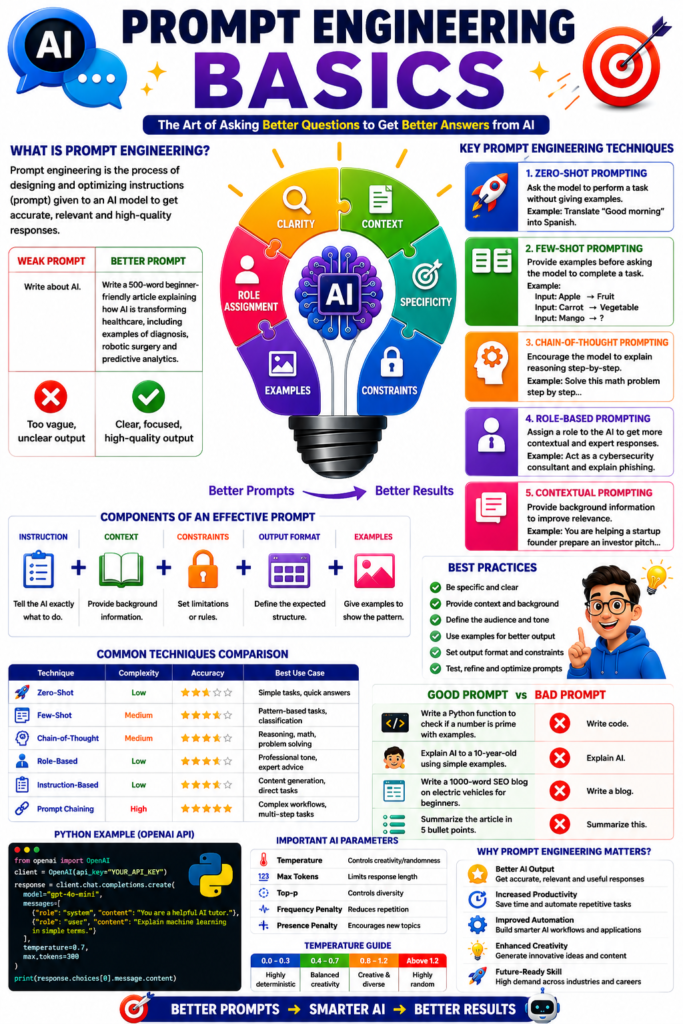
Prompt engineering is the process of designing and optimizing instructions given to an AI model to achieve accurate, relevant, and high-quality outputs. A prompt is simply the input text provided to an AI system such as ChatGPT, Claude, Gemini, or other large language models (LLMs).
Prompt engineering involves understanding how AI models interpret language and structuring instructions in a way that guides the model toward the desired response.
For example:
Weak Prompt
Write about AI.
This prompt is too broad and lacks direction.
Improved Prompt
Write a 500-word beginner-friendly article explaining how AI is transforming healthcare, including examples of diagnosis, robotic surgery, and predictive analytics.
The second prompt provides context, audience information, topic boundaries, and expected structure, resulting in significantly better output.
Why Prompt Engineering Matters
AI models generate responses based on patterns learned from massive datasets. They do not truly “understand” human intentions like humans do. Prompt engineering helps bridge this gap by giving clearer instructions and reducing ambiguity.
Good prompt engineering helps users:
- Generate more accurate responses
- Save time and reduce editing
- Improve creativity and consistency
- Build reliable AI applications
- Automate repetitive tasks
- Reduce hallucinations and irrelevant answers
As AI becomes more integrated into workplaces, prompt engineering is increasingly viewed as a critical digital skill similar to coding, search optimization, or data analysis.
How Prompt Engineering Works
Large Language Models predict the next most likely word based on the prompt and conversation context. The prompt acts as a guide that influences the model’s reasoning path, tone, style, and response structure.
The effectiveness of a prompt generally depends on:
| Factor | Description |
|---|---|
| Clarity | Clear instructions reduce confusion |
| Context | Background information improves relevance |
| Specificity | Detailed requirements guide better output |
| Constraints | Limits improve precision |
| Examples | Demonstrations help the model imitate patterns |
| Role Assignment | Defining a role improves contextual accuracy |
Core Components of an Effective Prompt
Instruction
Tell the AI exactly what to do.
Example:
Summarize the following article in simple language.
Context
Provide supporting background information.
Example:
The audience is beginner-level students preparing for interviews.
Constraints
Specify limitations or rules.
Example:
Use less than 300 words and include bullet points.
Output Format
Define the expected structure.
Example:
Provide the answer in a markdown table format.
Types of Prompt Engineering Techniques
Zero-Shot Prompting
Zero-shot prompting means asking the AI to perform a task without giving examples.
Example
Translate the following English sentence into French:
"How are you today?"
The model performs the task directly based on prior training.
Advantages
- Fast and simple
- Useful for common tasks
- Requires minimal setup
Disadvantages
- Less reliable for complex tasks
- May generate inconsistent results
Few-Shot Prompting
Few-shot prompting provides examples before asking the AI to complete a task.
Example
Input: Apple → Fruit
Input: Carrot → Vegetable
Input: Mango →
Output:
Fruit
Few-shot prompting improves consistency by demonstrating patterns.
Advantages
- Better accuracy
- More controlled output
- Useful for classification tasks
Disadvantages
- Longer prompts
- Higher token usage
Chain-of-Thought Prompting
Chain-of-thought prompting encourages the AI to explain reasoning step-by-step.
Example
A shop sells 5 pens for $10. What is the price of 8 pens? Explain step by step.
This technique improves logical reasoning and mathematical accuracy.
Benefits
- Better reasoning
- Improved problem-solving
- Transparent thought process
Role-Based Prompting
Role-based prompting assigns a professional identity to the AI.
Example
Act as an experienced cybersecurity consultant and explain phishing attacks to employees.
This technique influences tone, vocabulary, and expertise level.
Common Roles
| Role | Use Case |
|---|---|
| Teacher | Educational explanations |
| Software Engineer | Coding support |
| Marketing Expert | Ad copy generation |
| HR Recruiter | Resume reviews |
| Financial Analyst | Investment summaries |
Instruction-Based Prompting
Instruction-based prompts focus on direct commands.
Example
Create a LinkedIn post about remote work trends in 2026 using a professional tone.
This is one of the most commonly used techniques in content creation and automation.
Contextual Prompting
Contextual prompting includes detailed background information to improve accuracy.
Example
You are helping a startup founder prepare investor pitch content for an AI-based healthcare app targeting rural clinics.
The added context improves domain-specific responses.
Prompt Chaining
Prompt chaining breaks a large task into smaller connected prompts.
Example Workflow
- Generate blog outline
- Expand each section
- Create SEO title
- Generate social media captions
This approach improves quality and workflow automation.
Comparison of Prompt Engineering Techniques
| Technique | Complexity | Accuracy | Best Use Case |
|---|---|---|---|
| Zero-Shot | Low | Medium | Simple tasks |
| Few-Shot | Medium | High | Pattern-based tasks |
| Chain-of-Thought | Medium | High | Reasoning problems |
| Role-Based | Low | Medium-High | Professional tone |
| Instruction-Based | Low | Medium-High | Direct content generation |
| Prompt Chaining | High | Very High | Complex workflows |
Examples of Good vs Bad Prompts
| Bad Prompt | Improved Prompt |
|---|---|
| Write code | Write a Python function to sort a list using quicksort with comments |
| Explain AI | Explain artificial intelligence to a 10-year-old using simple examples |
| Create blog | Write a 1000-word SEO blog on electric vehicles for beginners |
| Summarize this | Summarize the following article in 5 bullet points using simple language |
Prompt Engineering for Different Industries
Education
Teachers and students use prompts for:
- Study material generation
- Quiz creation
- Research summaries
- Personalized tutoring
Example
Create 10 beginner-level Python MCQs with answers and explanations.
Software Development
Developers use prompts for:
- Code generation
- Debugging
- Documentation
- API integration
Example
Write a Flask API endpoint for user login with JWT authentication.
Marketing
Marketers use prompts for:
- SEO content
- Ad copy
- Email campaigns
- Product descriptions
Example
Generate a persuasive email campaign for a fitness app launch.
Healthcare
Healthcare professionals use prompts for:
- Medical documentation
- Clinical summaries
- Patient communication
- Research assistance
Business and Productivity
Businesses use prompt engineering for:
- Workflow automation
- Customer support
- Meeting summaries
- Data insights
Important Prompt Engineering Best Practices
Be Specific
Specific prompts reduce ambiguity and improve relevance.
Weak Prompt
Write about smartphones.
Better Prompt
Write a 700-word comparison between Android and iPhone smartphones for college students.
Use Structured Instructions
Clearly organize requirements.
Example
Write a blog post with:
1. Introduction
2. Benefits
3. Challenges
4. Conclusion
Define Audience and Tone
Audience definition improves communication quality.
Example
Explain blockchain technology to non-technical business owners in simple language.
Request Examples
Examples improve output consistency.
Example
Generate product descriptions similar to this style:
"Elegant, lightweight, and designed for modern professionals."
Set Output Constraints
Constraints improve control.
Example
Limit the response to 5 bullet points.
Python Example Using OpenAI API
Developers often integrate prompt engineering into applications using Python.
from openai import OpenAI

client = OpenAI(api_key="YOUR_API_KEY")

response = client.chat.completions.create(
    model="gpt-4.1-mini",
    messages=[
        {
            "role": "system",
            "content": "You are a helpful AI tutor."
        },
        {
            "role": "user",
            "content": "Explain machine learning in simple terms."
        }
    ],
    temperature=0.7,
    max_tokens=300
)

print(response.choices[0].message.content)
Important Parameters in AI Prompting
| Parameter | Purpose |
|---|---|
| Temperature | Controls creativity/randomness |
| Max Tokens | Limits response length |
| Top-p | Controls diversity |
| Frequency Penalty | Reduces repetition |
| Presence Penalty | Encourages new topics |
Understanding Temperature Formula
Temperature affects randomness in AI responses.
Lower temperature values produce more focused and predictable responses, while higher values increase creativity and variation.
Conceptually:
0 \leq Temperature \leq 2
Typical Usage
| Temperature | Behavior |
|---|---|
| 0.0–0.3 | Highly deterministic |
| 0.4–0.7 | Balanced creativity |
| 0.8–1.2 | Creative and diverse |
| Above 1.2 | Highly random |
Common Mistakes in Prompt Engineering
Using Vague Instructions
Unclear prompts produce inconsistent outputs.
Overloading the Prompt
Too much information can confuse the model.
Ignoring Context
Lack of context reduces relevance.
Not Testing Variations
Prompt optimization often requires experimentation.
Assuming AI is Always Correct
AI may hallucinate or generate inaccurate information.
Advantages of Prompt Engineering
| Advantage | Explanation |
|---|---|
| Better AI Output | Improves relevance and quality |
| Increased Productivity | Saves time in repetitive tasks |
| Lower Development Costs | Reduces manual effort |
| Improved Automation | Enables scalable AI workflows |
| Enhanced Creativity | Helps generate innovative ideas |
Disadvantages of Prompt Engineering
| Disadvantage | Explanation |
|---|---|
| Trial and Error | Requires experimentation |
| Model Dependency | Different models behave differently |
| Token Limitations | Large prompts increase costs |
| Hallucinations | AI may still produce false information |
| Skill Requirement | Effective prompting requires practice |
Future Scope of Prompt Engineering
Prompt engineering is expected to become even more important as AI systems grow more advanced and integrated into daily workflows.
Future developments may include:
- AI agents capable of autonomous reasoning
- Multi-modal prompting using text, images, audio, and video
- Personalized AI assistants
- Automated prompt optimization systems
- Industry-specific prompt libraries
- Voice-based prompt engineering
- AI-powered workflow orchestration
Companies are already hiring professionals with prompt engineering expertise for roles in AI operations, content automation, customer support, and software development.
As generative AI expands into education, healthcare, finance, e-commerce, and research, prompt engineering will likely become a foundational digital literacy skill.
Tips to Become Better at Prompt Engineering
Practice Regularly
Experiment with different prompt styles and structures.
Study AI Behavior
Observe how models respond to instruction changes.
Learn Prompt Patterns
Reuse successful templates for similar tasks.
Combine Techniques
Use role prompting with chain-of-thought reasoning for better results.
Stay Updated
AI models evolve rapidly, and prompting strategies continue to improve.
Conclusion
Prompt engineering is far more than simply asking questions to AI. It is the art and science of communicating effectively with intelligent systems to unlock accurate, creative, and high-value responses. As generative AI becomes deeply embedded in industries and everyday workflows, the ability to design effective prompts is becoming one of the most practical and future-ready digital skills.
From zero-shot prompting and chain-of-thought reasoning to role-based and contextual prompting, understanding these techniques allows users to maximize AI performance across content creation, software development, research, education, business automation, and beyond.
For beginners, the best approach is experimentation. Start with simple prompts, observe how the AI responds, refine instructions, add context, and gradually develop more advanced prompting strategies. Over time, prompt engineering becomes an essential bridge between human intention and machine intelligence.
In the AI-driven future, those who know how to ask better questions will consistently get better answers.