
Introduction: Why Similarity Search Has Become the Brain Behind Modern AI Applications
Imagine asking an AI chatbot, “Show me policies related to employee reimbursement for travel,” even though the exact document uses the phrase business expense compensation guidelines. A traditional keyword-based search engine might fail because it looks for exact word matches. A similarity search system, however, understands that travel reimbursement and business expense compensation are conceptually related. This is precisely why similarity search has become one of the most important technologies in the era of Large Language Models (LLMs).
Similarity search is the process of finding data points that are semantically or mathematically close to a query rather than relying on exact textual matching. In simpler terms, it helps machines find “things that mean something similar,” even if the wording, structure, or representation differs.
This capability has become foundational for LLM-powered applications such as Retrieval-Augmented Generation (RAG), recommendation systems, document search engines, AI assistants, semantic product discovery, fraud detection, image retrieval, and knowledge management systems.
As LLMs continue to transform industries, similarity search acts as the retrieval intelligence that helps these systems locate the most relevant information quickly and accurately. Without it, many AI applications would either hallucinate answers or fail to retrieve useful contextual knowledge.
This guide explains similarity search from the ground up, making it useful for beginners, students, working professionals, and developers who want both conceptual understanding and practical implementation knowledge.
What Is Similarity Search?
Similarity search is a computational method used to identify items in a dataset that are most similar to a given query based on defined similarity metrics.
Unlike exact-match search, similarity search compares relationships, meaning, structure, or mathematical closeness between entities.
For example:
Traditional Search Query:
“Best smartphone under 30000”
Traditional systems may look for exact occurrences of those words.
Similarity Search Query Understanding:
The system may also retrieve:
- Affordable phones below ₹30K
- Budget premium smartphones
- Mid-range Android devices
- Value-for-money mobile phones
Because the system understands semantic similarity.
Mathematically, if objects are represented as vectors:
and a database vector is:
Similarity search calculates how close these vectors are using distance or similarity metrics.
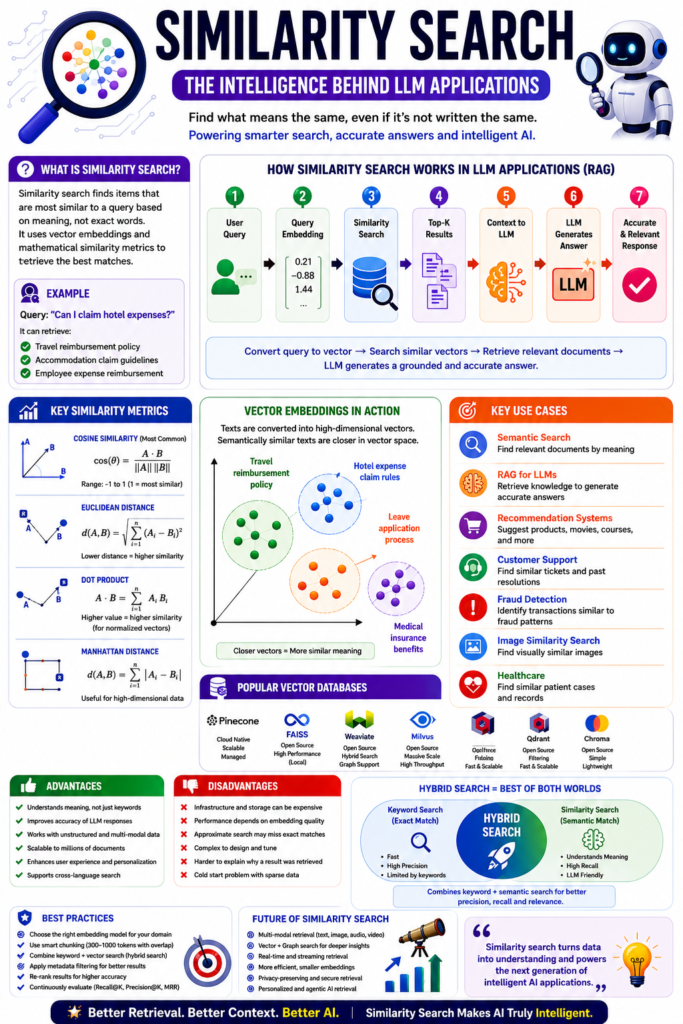
Why Similarity Search Matters in LLM Applications
Large Language Models generate responses based on patterns learned during training. However, they do not inherently “know” your private company documents, latest research papers, customer tickets, or internal databases unless connected to retrieval systems.
Similarity search solves this problem.
When a user asks a question:
- Convert the query into an embedding vector
- Search a vector database for similar vectors
- Retrieve relevant documents
- Feed retrieved context to the LLM
- Generate a grounded response
This pipeline powers Retrieval-Augmented Generation (RAG).
Without similarity search:
- LLM responses may hallucinate
- Private knowledge cannot be accessed
- Real-time information becomes unavailable
- Enterprise AI assistants become unreliable
With similarity search:
- Answers become context-aware
- Responses improve in accuracy
- Knowledge retrieval becomes scalable
- AI becomes trustworthy
Traditional Search vs Similarity Search
| Feature | Traditional Keyword Search | Similarity Search |
|---|---|---|
| Matching Logic | Exact keywords | Semantic meaning |
| Understanding Synonyms | Weak | Strong |
| Context Awareness | Limited | High |
| Natural Language Queries | Poor | Excellent |
| Works with Embeddings | No | Yes |
| LLM Integration | Weak | Essential |
| Multilingual Capability | Limited | Strong |
| Recommendation Use Cases | Weak | Excellent |
Traditional search remains useful in exact lookup scenarios, but LLM-driven applications require meaning-based retrieval.
Core Concept: Vector Embeddings
Similarity search depends heavily on vector embeddings.
Embeddings are numerical representations of text, images, audio, or other data types in high-dimensional vector space.
Example:
Text:
“Artificial Intelligence improves search systems.”
Embedding:
Another sentence:
“AI makes retrieval smarter.”
Embedding:
These vectors are numerically close because meanings are similar.
Embedding models learn semantic relationships, so mathematically nearby vectors represent conceptually similar content.
Popular embedding models include:
- OpenAI text embeddings
- Sentence Transformers
- BERT embeddings
- Cohere embeddings
- Instructor embeddings
- E5 embeddings
Mathematical Foundations of Similarity Search
Similarity search relies on mathematical comparison functions.
1. Cosine Similarity
The most common metric.
Formula:
Where:
- A⋅B = dot product
- ∣∣A∣∣ = magnitude of vector A
- ∣∣B∣∣ = magnitude of vector B
Interpretation:
- 1 = identical direction
- 0 = unrelated
- -1 = opposite meaning
Python example:
import numpy as np

A = np.array([1, 2, 3])
B = np.array([2, 3, 4])

cosine = np.dot(A, B) / (np.linalg.norm(A) * np.linalg.norm(B))
print(cosine)
Best for:
- semantic text search
- embeddings
- document retrieval
2. Euclidean Distance
Formula:
Python:
distance = np.linalg.norm(A - B)
print(distance)
Best for:
- geometric proximity
- clustering
- low-dimensional data
3. Dot Product Similarity
Formula:
Python:
dot = np.dot(A, B)
print(dot)
Best for:
- normalized embeddings
- fast vector retrieval
4. Manhattan Distance
Formula:
Useful when absolute coordinate differences matter.
How Similarity Search Works Step by Step
Let us break the workflow.
Step 1: Data Collection
Source data may include:
- PDFs
- emails
- support tickets
- websites
- knowledge bases
- product catalogs
- SQL records
Example:
A company has 50,000 policy documents.
Step 2: Chunking
Large documents are split into smaller chunks.
Example:
Instead of embedding a 100-page PDF, split into sections.
Why?
Because embeddings work better with focused context.
Step 3: Embedding Generation
Each chunk becomes a vector.
Example:
documents = [
    "Travel reimbursement policy",
    "Employee leave rules",
    "Medical insurance benefits"
]
Generated vectors:
[
 [0.22, 1.11, -0.31],
 [0.90, -0.11, 0.44],
 [0.67, 0.21, -1.20]
]
Step 4: Vector Storage
Vectors are stored in vector databases such as:
- Pinecone
- FAISS
- Weaviate
- Milvus
- Qdrant
- Chroma
Step 5: Query Embedding
User asks:
“Can I claim hotel expenses?”
Convert query into vector.
Step 6: Nearest Neighbor Search
Search for closest vectors.
Example output:
- Travel reimbursement policy
- accommodation claim guidelines
- employee expense reimbursement
Step 7: LLM Response Generation
Retrieved context is sent to the LLM.
Final answer becomes grounded in retrieved facts.
Similarity Search in Retrieval-Augmented Generation (RAG)
RAG is one of the most important LLM architectures today.
Workflow:
User Query → Embedding → Similarity Search → Context Retrieval → LLM Generation
Example:
User asks:
“What are the cancellation rules for premium membership?”
Similarity search retrieves:
- refund policy
- premium subscription terms
- billing FAQ
LLM synthesizes the answer.
Benefits:
- reduced hallucination
- dynamic knowledge access
- enterprise search capability
- document-grounded AI
Popular Vector Databases Comparison
| Vector Database | Open Source | Cloud Managed | Best Use Case | Speed |
|---|---|---|---|---|
| FAISS | Yes | No | Local experimentation | Very Fast |
| Pinecone | No | Yes | Production LLM apps | Fast |
| Weaviate | Yes | Yes | Hybrid search | Fast |
| Milvus | Yes | Yes | Large-scale vector search | Very Fast |
| Qdrant | Yes | Yes | Metadata filtering | Fast |
| Chroma | Yes | Limited | Lightweight prototypes | Moderate |
Python Example: Simple Similarity Search
Using scikit-learn:
from sklearn.metrics.pairwise import cosine_similarity
from sentence_transformers import SentenceTransformer

model = SentenceTransformer('all-MiniLM-L6-v2')

documents = [
    "Travel reimbursement policy",
    "Leave application process",
    "Medical claim instructions"
]

doc_embeddings = model.encode(documents)

query = "Can I claim hotel expenses?"
query_embedding = model.encode([query])

scores = cosine_similarity(query_embedding, doc_embeddings)

print(scores)
Expected output:
[[0.89 0.22 0.31]]Highest score indicates best match.
Approximate Nearest Neighbor (ANN): Why Speed Matters
Imagine searching through:
10 million vectors.
Exact nearest neighbor search becomes expensive.
Complexity:
ANN algorithms trade tiny accuracy loss for massive speed gains.
Popular ANN methods:
- HNSW
- IVF
- PQ
- Annoy
- ScaNN
Benefits:
- millisecond retrieval
- production scalability
- reduced compute cost
This is critical for chatbots needing real-time responses.
Similarity Search Use Cases Beyond LLMs
Semantic Search
Google-like intelligent document search.
Examples:
- legal research
- academic archives
- enterprise knowledge search
Recommendation Systems
Find similar:
- movies
- products
- songs
- courses
Example:
“Users who liked this also liked…”
Image Similarity Search
Upload an image, retrieve visually similar items.
Applications:
- fashion search
- medical imaging
- duplicate detection
Fraud Detection
Detect transactions similar to suspicious patterns.
Cybersecurity
Find anomalous behavior patterns.
Healthcare
Patient case similarity analysis.
Customer Support
Retrieve historically resolved tickets.
Advantages of Similarity Search
Semantic Understanding
Meaning matters more than exact wording.
Better User Experience
Natural language interaction feels human.
LLM Compatibility
Essential for RAG architectures.
Scalability
Works across millions of records.
Multi-Modal Capability
Supports:
- text
- image
- audio
- code embeddings
Personalization
Recommendation systems improve dramatically.
Cross-Language Search
English query can retrieve Hindi or Spanish semantic equivalents if embeddings support multilinguality.
Disadvantages of Similarity Search
High Infrastructure Cost
Embedding generation + vector storage can be expensive.
Complexity
Requires:
- chunking strategy
- embedding selection
- vector indexing
- metadata filtering
Approximation Errors
ANN may occasionally miss exact best matches.
Embedding Quality Dependency
Poor embeddings = poor retrieval.
Cold Start Problems
Sparse data hurts recommendation quality.
Hard Explainability
“Why was this result retrieved?” may be unclear.
Best Practices for LLM Similarity Search Systems
Choose Good Embeddings
Match embedding model to domain.
Examples:
- legal
- medical
- code
- multilingual
Smart Chunking
Bad chunking ruins retrieval.
Recommended chunk sizes:
- 300–1000 tokens
With overlap:
- 10–20%
Hybrid Search
Combine:
- keyword search
- semantic similarity
Best for precision + recall.
Metadata Filtering
Example:
Search only:
- HR policies
- 2026 documents
- approved FAQs
Re-ranking
Initial retrieval followed by smarter ranking models.
Query Expansion
Expand short user queries semantically.
Similarity Search Architecture for LLM Apps
Typical architecture:
User Query
   ↓
Embedding Model
   ↓
Vector Database
   ↓
Top-K Retrieval
   ↓
Re-Ranker
   ↓
LLM Prompt Construction
   ↓
Generated Answer
Production systems may add:
- caching
- observability
- access control
- hybrid retrieval
- response validation
Future Scope of Similarity Search
Similarity search is evolving rapidly.
Emerging trends include:
Multi-Modal Retrieval
Unified search across:
- text
- image
- voice
- video
Vector + Graph Search
Combining semantic similarity with relationship intelligence.
Personalized Retrieval
Context-aware user-specific search.
Agentic AI Integration
Autonomous AI agents using retrieval loops.
Real-Time Streaming Retrieval
Instant indexing of live data.
Smaller Efficient Embeddings
Reduced latency and cost.
Privacy-Preserving Retrieval
Secure enterprise AI deployments.
Similarity Search vs Hybrid Search vs Keyword Search
| Feature | Keyword Search | Similarity Search | Hybrid Search |
|---|---|---|---|
| Exact Match | Excellent | Weak | Excellent |
| Semantic Understanding | Weak | Excellent | Excellent |
| LLM Compatibility | Limited | Strong | Best |
| Synonym Handling | Weak | Strong | Strong |
| Enterprise Search | Moderate | Strong | Best |
| Precision | High | Moderate | High |
| Recall | Low | High | High |
Hybrid search is increasingly becoming the production standard.
Common Mistakes Beginners Make
Using Wrong Embeddings
General models for domain-specific data.
No Document Chunking
Large blobs reduce relevance.
Ignoring Metadata
Filtering matters.
Blindly Trusting Top Result
Re-ranking improves accuracy.
Skipping Evaluation
Measure:
- Recall@K
- Precision@K
- MRR
- NDCG
Final Thoughts
Similarity search is no longer just a technical optimization—it is a core intelligence layer for modern AI systems.
Large Language Models are excellent at language generation, but retrieval is what makes them practical, factual, and enterprise-ready. Similarity search provides that retrieval capability by enabling systems to understand meaning rather than exact wording.
Whether you are a student learning Artificial Intelligence, a developer building RAG applications, a data scientist designing recommendation engines, or a business leader implementing intelligent search, understanding similarity search is becoming essential.
As AI systems evolve toward agentic reasoning, multimodal retrieval, and real-time knowledge augmentation, similarity search will remain one of the most foundational technologies powering intelligent applications.