Introduction
Artificial Intelligence has evolved rapidly over the past few years, transforming the way machines understand language, images, audio, and human behavior. One of the most fascinating developments in modern AI is the ability of large language models and machine learning systems to perform tasks with little or no training examples. This capability has introduced powerful key prompting concepts known as Zero-Shot Learning, One-Shot Learning, and Few-Shot Learning.
Traditionally, machine learning models required thousands or even millions of labeled examples to learn a task effectively. However, modern AI systems such as Large Language Models (LLMs) can often perform surprisingly well with minimal guidance. This breakthrough has significantly reduced data requirements, accelerated development cycles, and expanded AI applications across industries.
Whether you are a student exploring machine learning, a developer building AI applications, a data scientist working with limited datasets, or a business professional interested in AI innovations, understanding these learning paradigms is essential. In this comprehensive guide, we will explore zero-shot, one-shot, and few-shot learning, their working principles, advantages, limitations, real-world applications, and future potential.
Understanding the Need for Alternative Learning Approaches
Before discussing the different learning methods, it is important to understand the challenge they address.
Traditional supervised learning relies heavily on large labeled datasets. For example, if you want a model to identify cats and dogs, you might need thousands of labeled images. Collecting, cleaning, and annotating such datasets is expensive, time-consuming, and often impractical.
Many real-world scenarios suffer from limited data availability. Medical diagnosis datasets, rare disease images, legal documents, scientific research papers, and specialized industrial records may not contain enough examples for traditional training methods.
To solve this problem, researchers developed learning approaches that enable models to generalize from minimal examples. This is where zero-shot, one-shot, and few-shot learning become extremely valuable.
What is Zero-Shot Learning?
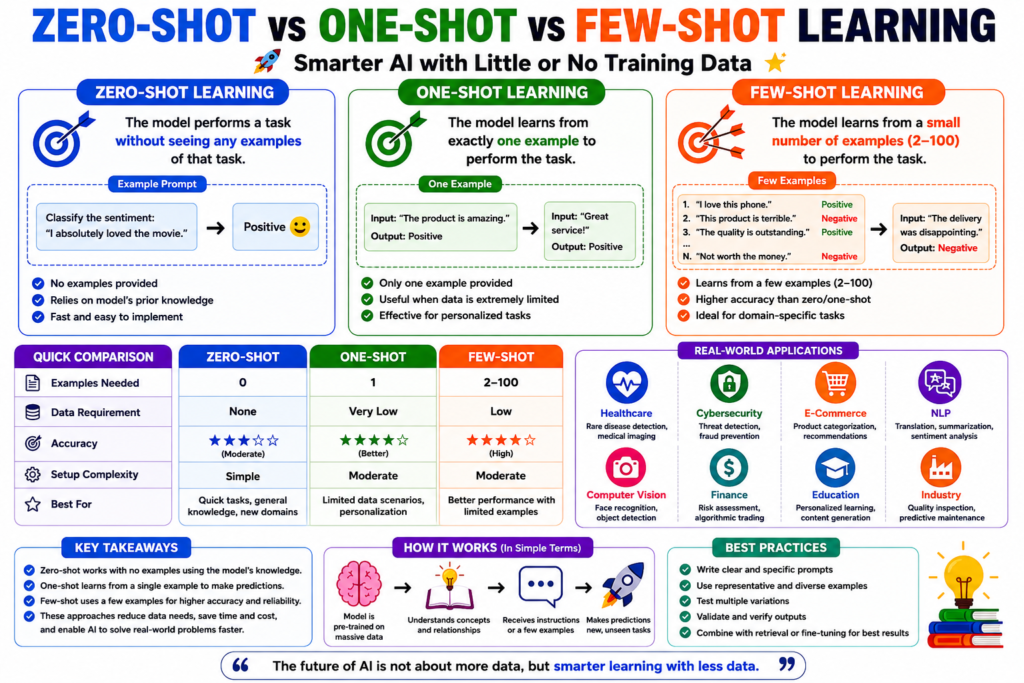
Zero-Shot Learning (ZSL) refers to a machine learning approach where a model performs a task without being explicitly trained on examples of that specific task.
Instead of learning directly from task-specific examples, the model leverages its existing knowledge acquired during pre-training and applies reasoning to solve new problems.
How Zero-Shot Learning Works
In zero-shot learning, the model receives only instructions or task descriptions without any examples.
For example:
Prompt:
Classify the sentiment of this sentence:
"I absolutely loved the movie."

Output:
Positive
The model has never been specifically trained on this exact example but can infer the sentiment based on its prior knowledge.
Modern LLMs like GPT models are excellent examples of zero-shot learning systems because they can perform translation, summarization, classification, coding, and question-answering without seeing task-specific demonstrations.
Real-World Example
Suppose an AI system has learned concepts related to animals.
Even if it has never seen an image of a zebra during training, it may identify a zebra if provided with a description such as:
“An animal that looks like a horse but has black and white stripes.”
This ability to recognize unseen classes is the essence of zero-shot learning.
Advantages of Zero-Shot Learning
- No labeled training examples required
- Reduces data collection costs
- Faster deployment of AI solutions
- Highly scalable across tasks
- Useful for rare and unseen categories
Disadvantages of Zero-Shot Learning
- Lower accuracy compared to trained models
- Performance depends heavily on prompt quality
- May struggle with highly specialized domains
- Can generate inconsistent outputs
What is One-Shot Learning?
One-Shot Learning is a machine learning approach where a model learns to perform a task using only a single example.
Unlike zero-shot learning, where no examples are provided, one-shot learning offers exactly one demonstration to guide the model.
How One-Shot Learning Works
The model receives one example showing the desired input-output relationship.
Example:
Example:
Input: "The product is amazing."
Output: Positive

Now classify:
"The service was excellent."
Using the provided example, the model learns the pattern and applies it to the new input.
Face Recognition Example
One of the most popular applications of one-shot learning is facial recognition.
Imagine a security system that sees only one photograph of a person. The system must later identify that person from various angles, lighting conditions, and facial expressions.
Traditional machine learning might require hundreds of images, while one-shot learning aims to achieve recognition using only one reference image.
Advantages of One-Shot Learning
- Requires minimal labeled data
- Useful when data collection is difficult
- Faster model adaptation
- Effective for personalized AI applications
Disadvantages of One-Shot Learning
- Single example may not represent all variations
- Risk of overfitting
- Sensitive to noisy examples
- Performance can vary significantly
What is Few-Shot Learning?
Few-Shot Learning (FSL) refers to learning from a small number of examples, typically between 2 and 100 samples.
Few-shot learning represents a middle ground between zero-shot and traditional supervised learning.
How Few-Shot Learning Works
The model receives a small set of demonstrations before solving new tasks.
Example:
Example 1:
Text: "I love this phone."
Sentiment: Positive

Example 2:
Text: "This product is terrible."
Sentiment: Negative

Example 3:
Text: "The quality is outstanding."
Sentiment: Positive

Now classify:
"The delivery service was disappointing."
The examples help the model understand the task pattern more clearly.
Why Few-Shot Learning Works So Well
Large Language Models develop generalized representations during massive pre-training.
Few-shot examples activate relevant knowledge and guide the model toward the desired output format and reasoning path.
This often results in significantly higher accuracy compared to zero-shot approaches.
Advantages of Few-Shot Learning
- Higher accuracy than zero-shot learning
- Requires only limited training examples
- Faster implementation
- Works well for domain-specific tasks
- Improves prompt reliability
Disadvantages of Few-Shot Learning
- Requires carefully selected examples
- Context window limitations in LLMs
- Increased prompt complexity
- May still underperform compared to fully trained models
Zero-Shot vs One-Shot vs Few-Shot Learning
The following table highlights the key differences among these learning paradigms.
| Feature | Zero-Shot Learning | One-Shot Learning | Few-Shot Learning |
|---|---|---|---|
| Training Examples | 0 | 1 | Few examples |
| Data Requirement | None | Very Low | Low |
| Accuracy | Moderate | Better | High |
| Setup Complexity | Simple | Moderate | Moderate |
| Generalization | High | Medium | High |
| Prompt Dependency | Very High | High | Medium |
| Development Speed | Fastest | Fast | Fast |
| Use Cases | Classification, Translation | Face Recognition | Domain-Specific Tasks |
Visual Comparison
| Learning Type | Example Count | Human Analogy |
|---|---|---|
| Zero-Shot | 0 | Solving a problem from general knowledge |
| One-Shot | 1 | Learning from one demonstration |
| Few-Shot | 2–100 | Learning after seeing a few examples |
| Supervised Learning | Thousands | Learning through extensive practice |
Mathematical Perspective
In traditional supervised learning, a model learns a function:
f(x)=y
where:
- x = input data
- y = target output
The objective is often minimizing loss:
L(y,\hat{y})
In few-shot learning, the challenge becomes learning a new task from a very small support set:
Support Set = {(x1,y1), (x2,y2), ..., (xn,yn)}
where n is extremely small.
The goal is to generalize effectively despite limited examples.
Python Example: Zero-Shot Classification
Using Hugging Face Transformers:
from transformers import pipeline

classifier = pipeline(
    "zero-shot-classification",
    model="facebook/bart-large-mnli"
)

text = "The movie was absolutely fantastic."

labels = ["Positive", "Negative", "Neutral"]

result = classifier(text, labels)

print(result)
Output
{
 'labels': ['Positive', 'Neutral', 'Negative'],
 'scores': [0.97, 0.02, 0.01]
}
The model performs classification without task-specific training.
Python Example: Few-Shot Prompting with LLMs
prompt = """
Example 1:
Review: Amazing product
Sentiment: Positive

Example 2:
Review: Worst experience ever
Sentiment: Negative

Review: Excellent customer support
Sentiment:
"""

response = llm.invoke(prompt)

print(response)
The examples guide the model toward the desired prediction.
Popular Techniques Used in Few-Shot Learning
Meta-Learning
Meta-learning is often called “learning to learn.”
Instead of learning one specific task, the model learns general learning strategies that can be transferred to new tasks with minimal examples.
Transfer Learning
Transfer learning uses knowledge gained from one domain and applies it to another related domain.
For example, an image model trained on millions of photographs can adapt to medical imaging using only a few examples.
Metric Learning
Metric learning focuses on measuring similarity between examples.
The model learns an embedding space where similar objects are close together while different objects remain far apart.
Siamese Networks
Siamese Networks are widely used in one-shot learning.
These networks compare pairs of inputs and determine whether they belong to the same category.
Common applications include:
- Face recognition
- Signature verification
- Fraud detection
- Product matching
Real-World Applications
Natural Language Processing
Modern chatbots and virtual assistants heavily rely on few-shot and zero-shot learning.
Applications include:
- Sentiment analysis
- Text classification
- Translation
- Summarization
- Question answering
Healthcare
Medical datasets are often limited.
Few-shot learning helps in:
- Rare disease detection
- Medical image analysis
- Drug discovery
- Clinical decision support
Cybersecurity
AI systems can identify new threats with minimal examples.
Applications include:
- Malware detection
- Fraud prevention
- Intrusion detection
E-Commerce
Online businesses use few-shot learning for:
- Product categorization
- Recommendation systems
- Customer review analysis
- Personalized shopping experiences
Computer Vision
Applications include:
- Facial recognition
- Object detection
- Industrial quality inspection
- Autonomous vehicles
Challenges in Zero-Shot and Few-Shot Learning
Despite impressive capabilities, these approaches face several challenges.
Data Distribution Shift
New tasks may differ significantly from training data.
This can reduce performance and reliability.
Hallucinations
Large language models sometimes generate incorrect information while appearing confident.
Prompt Sensitivity
Small wording changes can produce very different outputs.
Domain Knowledge Limitations
Highly specialized fields such as medicine, law, and engineering may require additional fine-tuning.
Evaluation Complexity
Measuring performance becomes difficult when only a handful of examples are available.
Future Scope of Zero-Shot and Few-Shot Learning
The future of AI increasingly depends on reducing data requirements.
Several emerging trends indicate strong growth for these learning paradigms.
More Powerful Foundation Models
Future models will possess broader world knowledge and stronger reasoning abilities, improving zero-shot performance.
Personalized AI Systems
AI assistants will adapt to individual users using only a few interactions.
Autonomous AI Agents
Agent-based systems will use few-shot reasoning to perform complex workflows without extensive retraining.
Scientific Research
Researchers will apply few-shot learning to rare diseases, material science, and climate studies where data is scarce.
Edge AI and IoT
Resource-constrained devices will benefit from learning capabilities that require minimal data and computational resources.
Best Practices for Developers
To maximize performance when using zero-shot or few-shot approaches:
- Write clear and specific prompts
- Use representative examples
- Keep examples consistent
- Test multiple prompt variations
- Validate outputs carefully
- Combine retrieval systems with prompting
- Fine-tune models when higher accuracy is required
When Should You Use Each Approach?
| Scenario | Recommended Method |
|---|---|
| No labeled data available | Zero-Shot Learning |
| Only one example available | One-Shot Learning |
| Limited examples available | Few-Shot Learning |
| Large labeled dataset available | Supervised Learning |
| Rapid prototyping | Zero-Shot Learning |
| Production-grade accuracy | Few-Shot Learning or Fine-Tuning |
Conclusion
Zero-shot, one-shot, and few-shot learning represent some of the most important breakthroughs in modern artificial intelligence. They dramatically reduce the need for large labeled datasets while enabling AI systems to solve new problems with remarkable flexibility. Zero-shot learning allows models to perform tasks without examples, one-shot learning learns from a single demonstration, and few-shot learning achieves strong performance using only a small collection of examples.
As Large Language Models, foundation models, and agentic AI systems continue to evolve, these learning paradigms will become increasingly central to AI development. Organizations can build smarter applications faster, researchers can tackle data-scarce problems more effectively, and developers can create powerful AI solutions without the traditional burden of massive datasets. Understanding these concepts is no longer optional for AI professionals—it is becoming a fundamental skill for anyone working with modern machine learning and generative AI technologies.