Introduction: How Google’s Revolutionary NLP Model Changed Artificial Intelligence Forever
Artificial Intelligence has transformed the way humans interact with machines, but one breakthrough completely reshaped Natural Language Processing (NLP): BERT. Before BERT, machines struggled to truly understand language context. Search engines often misunderstood user intent, chatbots sounded robotic, and text-processing systems failed to grasp the meaning behind words. Then came BERT — Bidirectional Encoder Representations from Transformers — a model introduced by Google that revolutionized how AI understands human language. Instead of reading text in a single direction, BERT reads language bidirectionally, analyzing both left and right context simultaneously.
This advancement dramatically improved search engines, virtual assistants, translation systems, sentiment analysis, and modern AI applications. Today, BERT remains one of the foundational technologies behind intelligent language systems and continues influencing advanced AI models worldwide.
In this article, you will deeply understand BERT’s architecture, working mechanism, training process, advantages, limitations, and real-world NLP applications. Whether you are a student learning AI, a data scientist building NLP projects, or a professional exploring modern machine learning systems, this guide provides a detailed and educational explanation of BERT in a simple yet technically accurate manner.
What is BERT?
BERT stands for Bidirectional Encoder Representations from Transformers. It is a pre-trained deep learning model designed for Natural Language Processing tasks. BERT was introduced in 2018 by researchers at Google and quickly became one of the most influential NLP models ever developed.
Traditional NLP models processed text either from left to right or right to left. This created limitations because understanding language requires context from both directions. BERT solved this issue using a bidirectional training approach, allowing the model to understand the complete context of words in a sentence.
For example, consider the word “bank” in these two sentences:
- “He deposited money in the bank.”
- “She sat near the river bank.”
Older NLP systems struggled to differentiate meanings accurately because they lacked contextual understanding. BERT analyzes surrounding words from both sides and correctly interprets the meaning.
This capability made BERT highly effective for tasks such as:
- Question answering
- Sentiment analysis
- Text classification
- Named entity recognition
- Search engine optimization
- Language translation
- Chatbots
- Content recommendation systems
Why BERT Became a Breakthrough in NLP
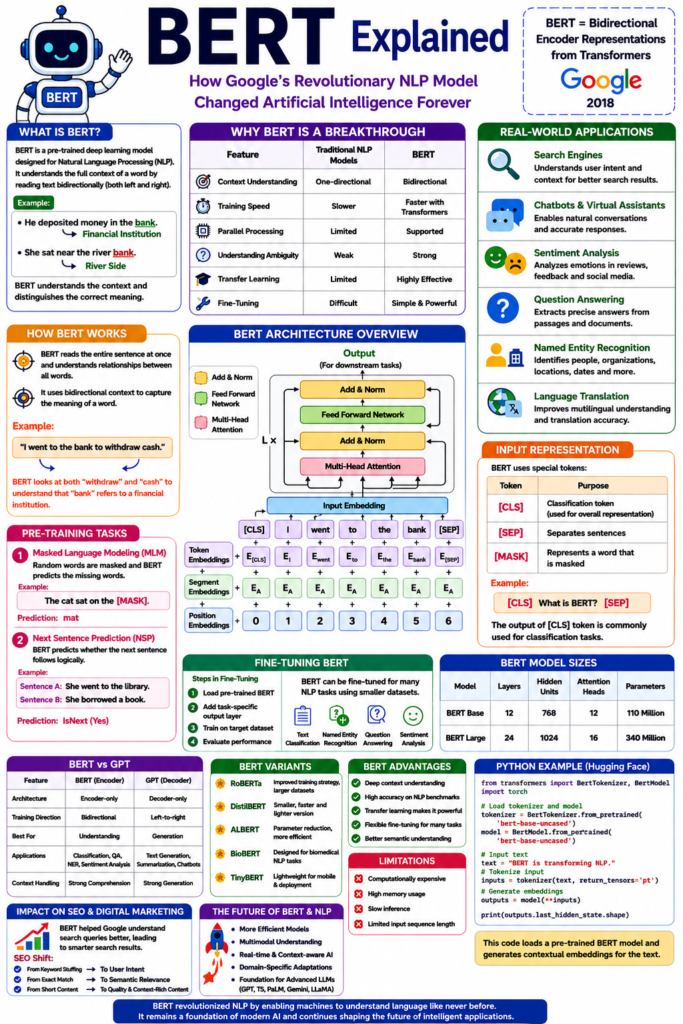
Before BERT, NLP models like RNNs and LSTMs had several limitations. They processed text sequentially, making training slow and limiting long-range context understanding. BERT leveraged the Transformer architecture, which enabled parallel processing and deeper contextual understanding.
The major reasons BERT became revolutionary include:
| Feature | Traditional NLP Models | BERT |
|---|---|---|
| Context Understanding | One-directional | Bidirectional |
| Training Speed | Slower | Faster with Transformers |
| Parallel Processing | Limited | Supported |
| Understanding Ambiguity | Weak | Strong |
| Transfer Learning | Limited | Highly effective |
| Fine-Tuning | Difficult | Simple and powerful |
BERT introduced transfer learning effectively into NLP, similar to how pre-trained models transformed computer vision. Developers could fine-tune BERT for specific tasks using relatively small datasets instead of training massive models from scratch.
Understanding the Transformer Architecture Behind BERT
To understand BERT, it is important to understand the Transformer architecture introduced in the famous research paper “Attention Is All You Need.”
The Transformer model replaced recurrent structures with self-attention mechanisms. Instead of processing words one by one, Transformers process all words simultaneously and determine relationships between them using attention scores.
BERT uses only the Encoder part of the Transformer architecture.
Main Components of Transformer Encoder
1. Input Embeddings
Words are converted into numerical vectors called embeddings. BERT combines three embeddings:
- Token Embeddings
- Segment Embeddings
- Positional Embeddings
These embeddings help the model understand:
- Word identity
- Sentence relationships
- Word positions
2. Self-Attention Mechanism
The self-attention mechanism helps BERT determine which words are important relative to other words in the sentence.
For example:
“The animal didn’t cross the street because it was tired.”
BERT understands that “it” refers to “animal” rather than “street” because self-attention captures semantic relationships.
The attention calculation is conceptually represented as:
Attention(Q,K,V)=softmax(dkQKT)V
Where:
- Q = Query
- K = Key
- V = Value
This formula enables contextual representation learning.
3. Multi-Head Attention
Instead of performing attention once, BERT uses multiple attention heads simultaneously. Each head learns different linguistic relationships such as:
- Grammar
- Semantics
- Syntax
- Contextual dependencies
This improves language understanding significantly.
4. Feed Forward Neural Networks
After attention layers, outputs pass through dense neural networks that learn deeper representations.
5. Layer Normalization and Residual Connections
These improve training stability and help very deep models learn efficiently.
How BERT Works
BERT processes text differently from older models. It reads entire sentences simultaneously rather than sequentially.
Bidirectional Learning
The most important innovation in BERT is bidirectional learning.
For example:
“I went to the bank to withdraw cash.”
BERT examines both “withdraw” and “cash” to understand that “bank” refers to a financial institution.
This dual-directional understanding makes BERT extremely effective for contextual interpretation.
Pre-Training Tasks in BERT
BERT is trained using two major tasks.
1. Masked Language Modeling (MLM)
During training, random words are masked, and BERT predicts missing words.
Example:
Input:
“The cat sat on the [MASK].”
Prediction:
“mat”
This teaches contextual understanding.
2. Next Sentence Prediction (NSP)
BERT learns sentence relationships by predicting whether one sentence logically follows another.
Example:
Sentence A:
“She went to the library.”
Sentence B:
“She borrowed a book.”
BERT predicts that Sentence B likely follows Sentence A.
This improves question-answering and conversational systems.
BERT Architecture Explained
BERT comes in multiple versions.
| Model | Layers | Hidden Units | Attention Heads | Parameters |
|---|---|---|---|---|
| BERT Base | 12 | 768 | 12 | 110 Million |
| BERT Large | 24 | 1024 | 16 | 340 Million |
The deeper the model, the more contextual knowledge it learns.
Input Representation in BERT
BERT uses special tokens:
| Token | Purpose |
|---|---|
| [CLS] | Classification token |
| [SEP] | Separates sentences |
| [MASK] | Hidden word prediction |
Example:
[CLS] What is BERT? [SEP]The [CLS] token output is commonly used for classification tasks.
Fine-Tuning BERT for NLP Tasks
One major advantage of BERT is fine-tuning. After pre-training on massive text datasets, BERT can adapt to specific tasks using smaller datasets.
Steps in Fine-Tuning
- Load pre-trained BERT
- Add task-specific output layer
- Train on target dataset
- Evaluate performance
This approach saves computational resources and improves accuracy.
Example: Using BERT in Python
Below is a simple example using the Hugging Face Transformers library.
from transformers import BertTokenizer, BertModel
import torch

# Load tokenizer and model
tokenizer = BertTokenizer.from_pretrained('bert-base-uncased')
model = BertModel.from_pretrained('bert-base-uncased')

# Input text
text = "BERT is transforming NLP."

# Tokenize input
inputs = tokenizer(text, return_tensors='pt')

# Generate embeddings
outputs = model(**inputs)

# Last hidden states
last_hidden_states = outputs.last_hidden_state

print(last_hidden_states.shape)
This code loads a pre-trained BERT model and generates contextual embeddings for text.
Real-World Applications of BERT
BERT transformed numerous industries and AI applications.
1. Search Engines
Google integrated BERT into search systems to better understand user queries and search intent.
Example:
- Understanding conversational searches
- Handling long-tail keywords
- Improving semantic relevance
This greatly improved SEO and search rankings.
2. Chatbots and Virtual Assistants
BERT enables conversational AI systems to understand natural human language more accurately.
Applications include:
- Customer support bots
- AI assistants
- Automated responses
3. Sentiment Analysis
Businesses use BERT to analyze customer feedback, reviews, and social media sentiment.
Example:
- Product review classification
- Brand monitoring
- Public opinion analysis
4. Question Answering Systems
BERT powers advanced QA systems capable of extracting precise answers from documents.
Example:
- Educational platforms
- AI tutoring systems
- Enterprise knowledge bases
5. Named Entity Recognition (NER)
BERT identifies important entities in text such as:
- Person names
- Organizations
- Locations
- Dates
This is widely used in legal, medical, and financial industries.
6. Language Translation
Although Transformer-based models like T5 and GPT advanced translation further, BERT significantly improved multilingual understanding.
Advantages of BERT
| Advantage | Explanation |
|---|---|
| Deep Context Understanding | Reads both directions simultaneously |
| High Accuracy | Performs exceptionally on NLP benchmarks |
| Transfer Learning | Pre-trained knowledge reusable |
| Flexible Fine-Tuning | Easily adapted to tasks |
| Better Semantic Understanding | Understands meaning beyond keywords |
Limitations of BERT
Despite its power, BERT has challenges.
| Limitation | Description |
|---|---|
| Computationally Expensive | Requires powerful GPUs |
| Large Memory Usage | Very high parameter count |
| Slow Inference | Heavy for real-time systems |
| Context Window Limit | Limited input sequence size |
These limitations led to lighter alternatives like DistilBERT and ALBERT.
BERT vs GPT
Many people compare BERT with GPT models.
| Feature | BERT | GPT |
|---|---|---|
| Architecture | Encoder-only | Decoder-only |
| Training Direction | Bidirectional | Left-to-right |
| Best For | Understanding | Generation |
| Applications | Classification, QA | Text generation |
| Context Handling | Strong comprehension | Strong generation |
Both models are transformer-based but optimized for different objectives.
Variants of BERT
Several improved versions of BERT emerged later.
| Variant | Improvement |
|---|---|
| RoBERTa | Better training strategy |
| DistilBERT | Smaller and faster |
| ALBERT | Parameter reduction |
| BioBERT | Biomedical NLP |
| TinyBERT | Lightweight deployment |
These variants solve efficiency and domain-specific challenges.
Impact of BERT on SEO and Digital Marketing
BERT significantly changed Search Engine Optimization practices. Since Google understands context better, keyword stuffing became less effective.
Modern SEO strategies now focus on:
- User intent
- Natural language
- Semantic relevance
- Conversational content
- High-quality informative writing
Content creators must now prioritize human-readable, context-rich articles rather than repetitive keyword optimization.
Future of BERT and NLP
BERT opened the door for large-scale language understanding models. It influenced later innovations such as:
- GPT models
- T5
- PaLM
- Gemini
- LLaMA
Future NLP systems are expected to become:
- More efficient
- Multimodal
- Context-aware
- Real-time adaptive
- Domain-specialized
Even with newer architectures emerging, BERT remains foundational in NLP education and industry applications.
Conclusion
BERT fundamentally transformed Natural Language Processing by introducing bidirectional contextual understanding using Transformer encoders. Unlike traditional NLP systems that processed text sequentially, BERT analyzes language from both directions simultaneously, enabling deeper comprehension of meaning, context, and relationships between words. This innovation dramatically improved search engines, conversational AI, sentiment analysis, question answering systems, and many other AI-driven applications.
Its architecture, based on self-attention mechanisms and transfer learning, made NLP systems more accurate, scalable, and adaptable than ever before. While BERT has computational limitations, its influence on modern AI is undeniable. Nearly every advanced language model today builds upon concepts introduced or popularized by BERT.
For students, AI professionals, researchers, and developers, understanding BERT is essential because it serves as a cornerstone of modern Natural Language Processing. Whether you aim to build intelligent chatbots, improve search systems, create NLP products, or pursue AI research, mastering BERT provides a strong foundation for understanding how machines truly process human language.